
KAIST's RRNCO Beats Neural Routing Models on 100 Real-World Cities
A new neural routing architecture handles asymmetric distances and durations from actual road networks, with a benchmark spanning 100 real cities.
 Pro
Takeaways
- RRNCO closes the sim-to-real gap for neural vehicle routing on asymmetric real-world road networks. Paper
- Adaptive Node Embedding fuses coordinates and sampled distances via a learned gate, avoiding full matrix processing.
- Neural Adaptive Bias jointly models distance, duration, and directional angles inside attention, a first for routing.
- New 100-city benchmark built on OpenStreetMap with asymmetric distance and duration matrices for training and evaluation.
- Beats all neural baselines on asymmetric TSP, CVRP, and CVRPTW; hits 1.80% gap versus LKH3 in 23 seconds.
- Code, dataset, and pretrained models are open source. GitHub repo
Most neural routing models are trained on a fantasy version of the world where every road runs in both directions at equal cost and every trip is a straight line between two points. That works fine for research papers, but it falls apart the moment a delivery truck hits a one-way street or a rush-hour traffic jam. A team from KAIST, Omelet, Radical Numerics, and Singapore Management University is pushing to close that gap with RRNCO, a routing model plus a 100-city benchmark that was just accepted to ICLR 2026.
Vehicle routing problems are NP-hard optimization problems that require determining optimal routes for a fleet of vehicles while satisfying various operational constraints. Neural Combinatorial Optimization (NCO) has become the trendy way to attack them, using reinforcement learning to teach a model to construct routes one node at a time rather than relying on hand-tuned heuristics. The catch: most existing NCO research primarily relies on simplified synthetic datasets for both training and testing that fail to capture the foundational asymmetries of real-world road networks.
Why simulated routing keeps breaking in the wild
Two things go wrong when you take a standard NCO model into production. First, real road networks are asymmetric: the drive from A to B is rarely the same distance or duration as B to A because of one-way streets, turn restrictions, and traffic. Second, most neural routing architectures are node-centric transformers. Their attention mechanisms operate on node embeddings, so it is non-trivial to incorporate rich structural information contained in edge features like a full distance matrix. Prior attempts to handle edge data typically encoded a single cost matrix, usually distance, and ignored duration, geometry, and their correlations.

Two architectural changes that do the heavy lifting
RRNCO keeps the familiar encoder-decoder transformer skeleton but reworks how spatial information enters the model. The first new piece is Adaptive Node Embedding (ANE). Instead of feeding the entire N x N distance matrix through attention, ANE samples a handful of nearby neighbors per node using a probability that scales with the inverse of distance, then fuses those distance features with raw coordinate embeddings through a learned gate. This gating mechanism allows the model to adaptively weigh the importance of coordinate-based and distance-based features for each node, so the model does not have to process every pairwise edge.
The second piece is the Neural Adaptive Bias (NAB). It replaces a hand-crafted attention bias term with one that is learned jointly from three sources: the distance matrix, the duration matrix, and a matrix of directional angles between nodes computed with arctan2. Each is projected into an embedding space, then combined via a softmax-normalized gating network that decides how much weight to give each modality per instance. The output is a per-pair bias matrix that plugs directly into an Adaptation Attention Free Module, guiding which nodes the decoder should consider next.

The joint modeling matters. An ablation on the time-window variant shows that removing duration bumps the optimality gap from 3.74% to 3.93%, and further removing the angle information pushes it to 4.06%. On clustered out-of-distribution instances, the gap grows from 4.29% to 4.84% once those signals are stripped away.
A benchmark built from 100 real cities
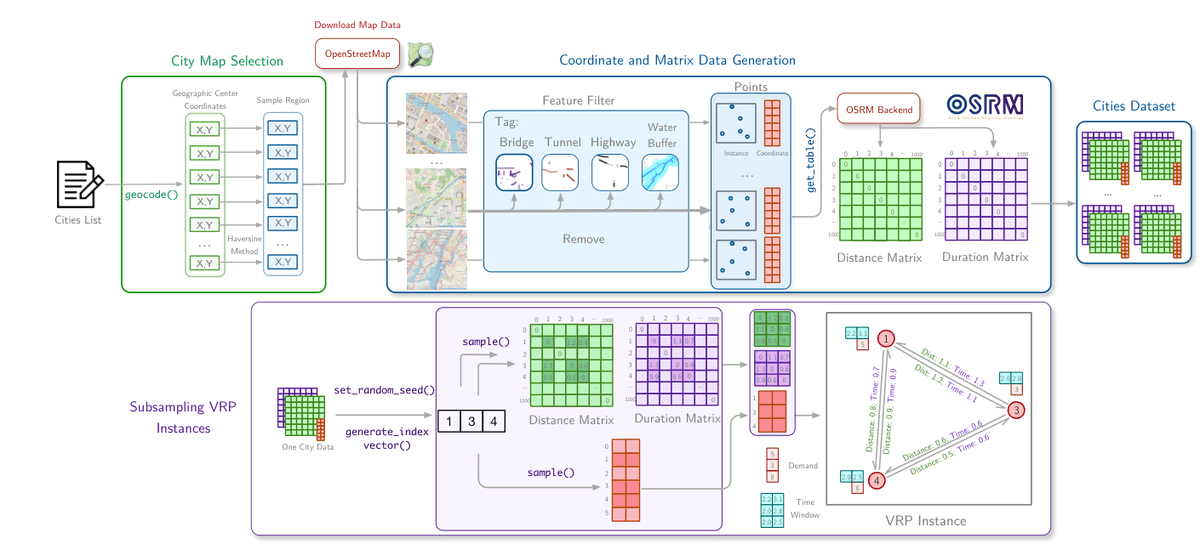
The architecture is only half the story. The team also built a data generation pipeline on top of the Open Source Routing Machine, an open-source engine that computes travel times over OpenStreetMap data. For each of 100 cities across six continents, they extract a standardized 3x3 km area, sample 1000 street-level points weighted by road segment length, and compute full 1000x1000 asymmetric distance and duration matrices. The city list is genuinely diverse:
- 25 Asian cities, 21 European, 15 in the Americas each, 14 African, 10 Oceanian
- 50 large (over 1M people), 30 medium, 20 small urban centers
- Layouts ranging from Manhattan-style grids to the radial pattern of Paris and the medieval organic streets of Fez
Speed is a real advantage of the open-source approach. Through the efficient get_table function in the router implementation via the OSRM table service, a complete 1000x1000 origin-destination matrix can be processed within 18 seconds, compared to more than 20 seconds for a 350x350 matrix using commercial APIs. Instances are then subsampled on the fly, so an RL agent can train on effectively unlimited variations from about 1.5GB of base topology data.
The results
Across three problems, asymmetric TSP, asymmetric capacitated VRP, and the same with time windows, RRNCO beats every other neural baseline tested and gets within a few percent of the traditional heavy-hitters like LKH3 and PyVRP, while running orders of magnitude faster. On in-distribution asymmetric TSP, RRNCO hits a 1.80% gap in 23 seconds versus LKH3's optimal solutions that took 1.6 hours. On the harder clustered out-of-distribution split, RRNCO holds a 2.25% gap while the next-best neural method (MatNet) sits at 5.88% and node-only methods like POMO blow up to 146%.
The team also tested robustness on the SVRPBench stochastic multi-period time-dependent VRP benchmark, which layers rush-hour congestion, log-normal traffic noise, and Poisson-distributed incidents on top of a base problem. A multi-snapshot variant of NAB, which processes three temporal views of the duration matrix during encoding, scored a cost of 594.19 versus 601.03 for the standard model and 610.08 for OR-Tools. Notably, OR-Tools fails to find feasible solutions for 75.8% of instances within the time limit, highlighting the practical advantage of neural solvers in time-constrained scenarios. RRNCO maintains full feasibility and zero time window violations while producing routes in 0.20 seconds per instance.
When it makes sense to reach for it
RRNCO is a good fit if you are working on last-mile delivery, dispatch, or any routing problem where the road network genuinely matters and you need to make decisions in seconds rather than hours. It handles capacity constraints, time windows, and asymmetric travel patterns in a single unified framework, and it generalizes to city topologies it has never seen. Where it is weaker: traditional solvers like LKH3 and PyVRP still edge it out on absolute solution quality when given hours to run, so if you have a small fleet and overnight compute budgets, classical optimization is still the safer bet.
The full pipeline is open source on GitHub under an MIT license, with pretrained checkpoints and the 100-city dataset hosted on Hugging Face. The repo includes an OSRM setup for regenerating data from scratch, training scripts for all three problem variants, and evaluation code with the same seeds used in the paper.