
KAIST's GaussianFlow SLAM Beats Every Monocular Baseline Without a Depth Sensor
A KAIST team turns optical flow into a geometry supervisor for monocular 3D Gaussian Splatting SLAM, beating depth-prior methods on tracking accuracy.
Takeaways
- KAIST introduces GaussianFlow SLAM, the first monocular 3DGS-SLAM to use optical flow supervision with closed-form analytic gradients.
- Projected Gaussian motion is aligned with dense optical flow to fix geometry without needing any depth sensor.
- Analytic gradients are fused into the 3DGS CUDA kernel, avoiding PyTorch autograd overhead at SLAM scale.
- Beats MonoGS, HI-SLAM2, WildGS-SLAM, Photo-SLAM on most EuRoC and TUM RGB-D tracking sequences.
- Runs at 0.17 FPS online but 466 FPS rendering; not real-time yet, but geometrically robust.
- Accepted to IEEE RA-L 2026; code release pending on GitHub.
Monocular SLAM systems built on 3D Gaussian Splatting have a well-known weakness: without depth from an RGB-D sensor, stereo pair, or LiDAR, the Gaussians tend to settle into locally pretty but geometrically wrong configurations. A new paper from KAIST proposes to fix this by borrowing a signal that a single moving camera does provide reliably: dense optical flow between frames.
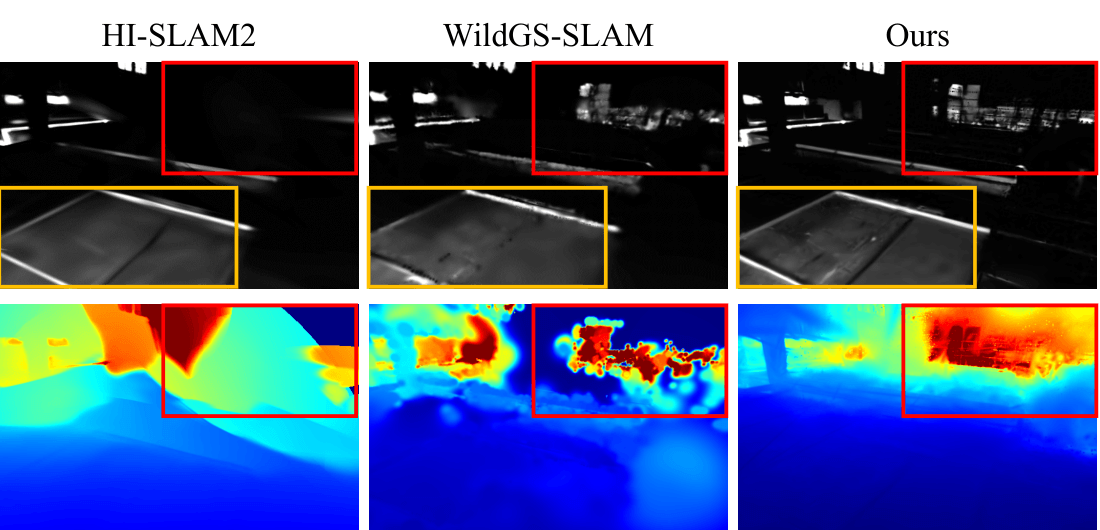
The system, called GaussianFlow SLAM, treats the projected motion of the Gaussians themselves as a differentiable quantity and forces it to match the optical flow predicted by a neural network. The result is a monocular 3DGS-SLAM that outperforms every published monocular Gaussian splatting baseline on tracking accuracy across most sequences of two standard benchmarks.
Why monocular Gaussian splatting keeps breaking
3DGS is optimized around given 3D points, and the absence of accurate geometric priors increases susceptibility to local minima. Without those priors, Gaussians fail to converge to geometrically consistent positions and instead overfit to particular views. Depth-supervised setups sidestep this by seeding each primitive with a real depth measurement, but a plain RGB camera has no such crutch.
Two workarounds have dominated recent literature. Multi-view training helps a little but remains limited without geometric cues such as cross-view correspondences, and neural-network depth priors can bootstrap the scene at the cost of accumulating scale-alignment errors or reintroducing structural distortion. Tracking has a nastier failure mode: when the geometry in the 3DGS is imprecise, rendered images misalign with the real scene, degrading pose estimation and kicking off a self-reinforcing loop in which bad maps corrupt poses and bad poses corrupt the map.
Make Gaussians move like the pixels do
GaussianFlow, borrowing a term coined for a dynamic scene paper by Gao et al., is the 2D projected motion of a Gaussian between two frames. Take a Gaussian visible at pixel p in frame t, project it into frame t+1 using the new camera pose, and compute where its rendered footprint moves. That yields a per-Gaussian flow vector. Sum these contributions with the standard 3DGS alpha-blending weights and you get a rendered flow field that should, in a static scene, exactly match the optical flow predicted by an off-the-shelf network.