
KAIST's ECG-Reasoning-Benchmark Catches Top AI Models Faking Heart Diagnoses at 6%
A new benchmark strips ECG-reading AI models of their explanations and finds their reasoning chains collapse below 6% completion.
 Pro
Takeaways
- New multi-turn benchmark evaluates step-by-step ECG reasoning across 17 diagnoses with 6,400+ samples: paper
- Top model Gemini-3-Flash completes full reasoning chains only 6.26% of the time on PTB-XL.
- ECG-specific models like PULSE and ECG-R1 collapse from ~85% to ~25% when forced to use ground-truth reasoning.
- Authors built a UNet3+ signal pipeline producing verifiable ground truth, bypassing LLM-generated rationales.
- Four-step loop tests criterion selection, finding identification, lead/wave/measurement grounding, and diagnostic decision.
- Dataset and code available on GitHub and Hugging Face.
State of the art multimodal models can produce fluent, textbook-sounding ECG reports. But a new benchmark from a team at KAIST asks whether they are actually reading the squiggles or just guessing from patterns and then confabulating a justification. The answer is uncomfortable: ECG-Reasoning-Benchmark shows that even the best frontier models complete a full clinical reasoning chain less than 6% of the time.
Why current ECG evaluations lie to us
Multimodal Large Language Models (MLLMs) show promising performance in automated electrocardiogram interpretation, but the way we evaluate them is broken in two ways. First, it remains unclear whether they genuinely perform actual step-by-step reasoning or just rely on superficial visual cues. Second, the standard evaluation is LLM-as-a-Judge, where a language model scores whether a generated explanation looks similar to a reference explanation, which was itself written by another LLM that never saw the actual ECG. That measures linguistic style, not clinical grounding.
The training pipelines have the same flaw. In datasets like ECGInstruct, the rationales were synthesized by a text model given only the final diagnostic label, so models learn to recite the textbook description associated with a diagnosis rather than reading the signal.
A four-step interrogation for every finding
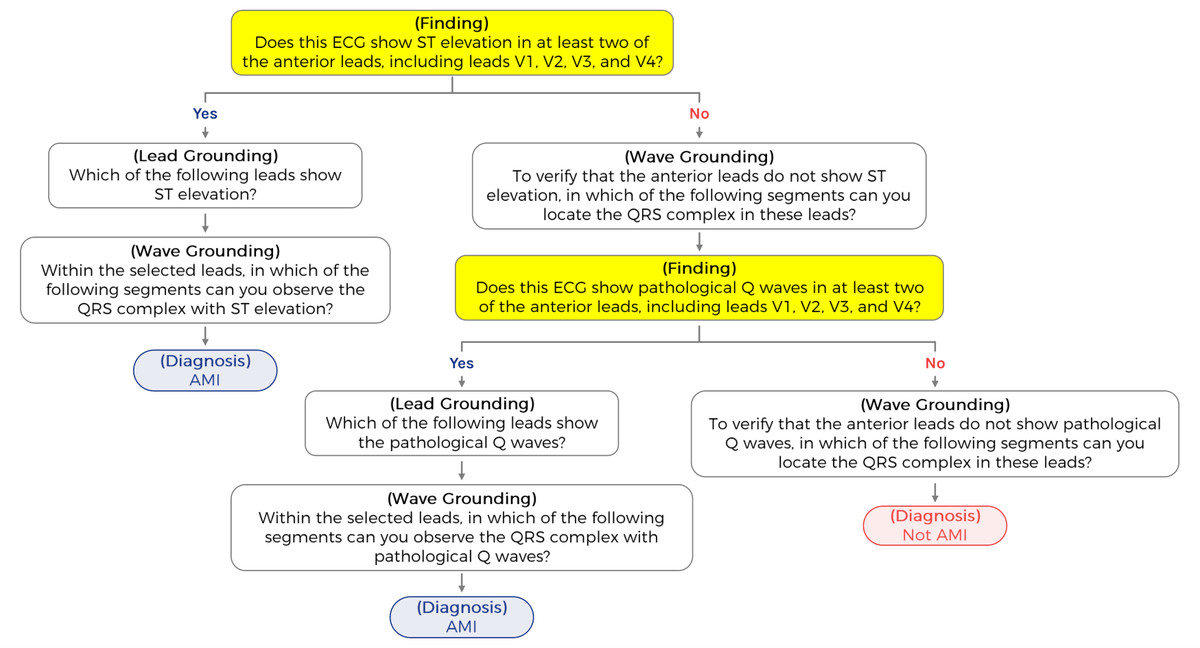
The ECG-Reasoning-Benchmark replaces subjective scoring with a rigid multi-turn examination across over 6,400 samples to systematically assess step-by-step reasoning across 17 core ECG diagnoses. For every clinical finding required for a diagnosis, the model must survive four steps:
- Criterion Selection: pick the right diagnostic criterion from distractors, including options that are true of the current ECG but irrelevant to the target diagnosis.
- Finding Identification: confirm whether that finding is present in the recording.
- ECG Grounding: point to the specific leads, temporal wave segments, and measurement ranges that prove it.
- Diagnostic Decision: decide if the evidence so far confirms the diagnosis or if more findings are needed.

To build ground truth for this without relying on another LLM, the authors built an automated ECG analysis pipeline. It uses a UNet3+ segmenter to delineate P, QRS, and T waves, applies post-processing tricks like template matching to catch non-conducted P waves, then quantifies durations, intervals, amplitudes, and QRS morphology. Those measurements feed hierarchical logic diagrams covering 17 diagnoses, codified from cardiology textbooks and validated by three board-certified internists. On the LUDB delineation benchmark the pipeline hits recall/precision of 1.000 for QRS complexes and 0.978/0.937 for P waves.

The 6% ceiling
The authors evaluated 18 model configurations, including ECG-specific systems (PULSE, GEM, ECG-R1, OpenTSLM), medical models (MedGemma, Hulu-Med), open general models (Qwen3-VL, Llama-3.2-Vision), and proprietary systems (Gemini 2.5/3, GPT-5-Mini, GPT-5.2). The results are stark:
- Completion, the strict metric requiring every reasoning step correct, tops out around 6%. Gemini-3-Flash leads at 6.26% on PTB-XL and ECG-R1-RL hits 5.81% on MIMIC-IV-ECG.
- Depth scores rarely exceed 2.0 out of 4, meaning models can name the criterion (step 1) but stumble at identifying the finding in the signal and grounding it to specific leads and waves.
- Small medical models collapse entirely: OpenTSLM (3B), MedGemma (4B) and MedGemma-1.5 (4B) score around or below 1% Completion, often losing focus during the multi-turn loop.
The most damning finding comes from comparing Initial Diagnosis Accuracy (IDA), where the model just guesses a diagnosis, against GT-RDA, where the model is handed the complete correct reasoning chain and only needs to make the final call. General models behave as expected: Hulu-Med (32B) jumps from 57% IDA to 99.4% GT-RDA on PTB-XL. But ECG-specific models go the other way. Our comprehensive evaluation of state-of-the-art models reveals a critical failure in executing multi-step logical deduction. Although models possess the medical knowledge to retrieve clinical criteria for a diagnosis, they exhibit near-zero success rates (6% Completion) in maintaining a complete reasoning chain. ECG-R1-RL drops from 85% IDA to 23% GT-RDA. PULSE drops from 81% to 35%. They know the answer without the evidence, and get confused when forced to work through it.
What this means if you build medical AI
The takeaway for anyone training an ECG or medical vision model: fine-tuning on GPT-4-generated rationales optimizes a shortcut. The model learns to associate a whole-image visual gestalt with a diagnosis label and generates plausible cardiology prose after the fact. It never learns to measure a PR interval or check for notched R waves in lateral leads. LLM-as-a-Judge scoring will happily reward that behavior.
The full dataset is on Hugging Face under both PTB-XL and MIMIC-IV-ECG sources, and the GitHub repo ships a pip install -e . package with CLI tools for running inference and computing Completion, Depth, GT-RDA, and a forced-commit variant that tracks how accuracy grows as findings are revealed. Practically, the benchmark is useful for two things: catching reasoning regressions when fine-tuning ECG models, and stress testing any medical MLLM that claims to explain itself. It is deliberately not designed for handling diagnostic ambiguity, since borderline cases were filtered out to preserve ground-truth reliability.