
KAIST Puts an AI Tutor in AR Headsets and Learners Ask Smarter Questions
A CHI '26 study of 40 learners shows AR virtual agents trigger deeper 'why' questions during CPR training, while flat-screen agents drive procedural nitpicking.
 Pro
Takeaways
- KAIST researchers introduce a 5W1H framework for analyzing spoken questions to embodied virtual agents.
- AR-based virtual tutors triggered more frequent, longer questions focused on conceptual "why" reasoning.
- Screen-based tutors pushed learners toward procedural nitpicking and narrowing to specific factual details.
- Presence acted as a selective spotlight: suppressing questions during demos, boosting reflection at session end.
- AR learners scored higher on practical CPR performance (11.65 vs 9.70) but not on knowledge quizzes.
- System built on Unity, Meta Quest 3, Ready Player Me, Whisper, and OpenAI gpt-4o-mini.
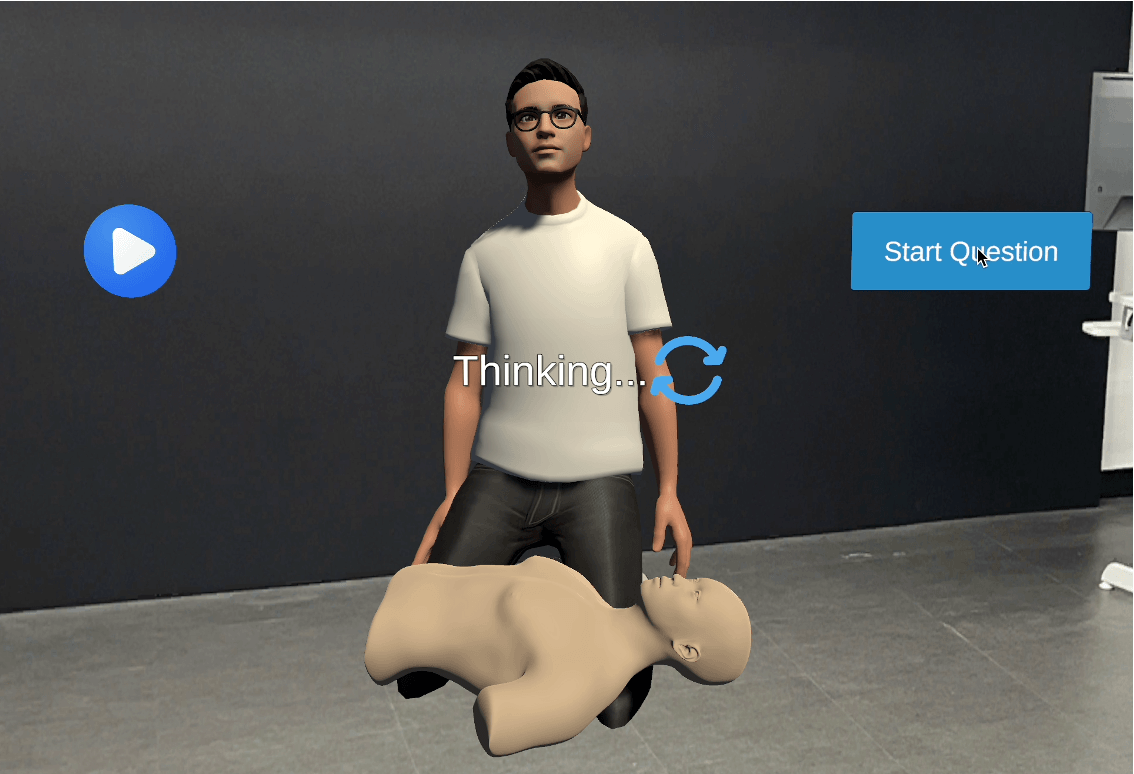
Drop an AI tutor into a headset instead of a laptop screen and learners start asking fundamentally different questions. That is the core finding of a new CHI '26 paper from KAIST's UVR Lab that put 40 people through a CPR training session with an LLM-powered avatar, once in augmented reality on a Meta Quest 3 and once as a talking head on a 15-inch laptop.
The researchers built a real-time Q&A system where an identical avatar delivered identical CPR instruction across both conditions, then measured what learners actually asked, when, and why. The gap between the two setups turned out to be less about volume and more about the shape of curiosity itself.

Why questioning behavior is a proxy worth measuring
Most research on LLM-driven virtual agents in XR has focused on system-level metrics or post-hoc surveys about presence and usability. Little attention has been paid to how learners construct and adapt their spoken inquiries during interaction. That matters because question-asking is one of the cleanest behavioral signals of cognitive engagement we have, and findings from text-based chatbot studies do not translate cleanly to embodied voice interfaces.
To close that gap, the authors propose a 5W1H framework that decomposes each learner question along six axes: Who (learner traits), When (timing in the lesson), Where (visual attention), What (topic, type, form), Why (intention), and How (volume and linguistic complexity). The taxonomy is borrowed from ubiquitous computing and adapted for the messiness of spoken, embodied Q&A.
The system under the hood
The pipeline is a fairly standard modern stack, but the engineering choices are worth noting for anyone building similar tutors. Instructor motions were captured from a 3-minute 14-second CPR tutorial using an OptiTrack marker-based suit and converted to FBX in Blender. The resulting animations were applied to a Ready Player Me avatar via Unity's Timeline. Instructional audio was transcribed using Whisper and then resynthesized into sentence-level segments through the OpenAI TTS API (echo voice). Lip sync was implemented using BlendShape animation.
For the Q&A loop itself, speech capture runs through Meta's Voice SDK (Wit.ai), and the learner's transcribed question is combined with contextual information and submitted to the OpenAI Chat Completions API (gpt-4o-mini). A scene graph encoding action-object relations from the captured demonstration grounds the responses. When the relevant scene-graph context is unavailable, the system falls back to domain-general responses to maintain conversational continuity.
What the AR and video conditions actually produced
Twenty participants got the AR-IVA condition on a Meta Quest 3; twenty got the same content rendered as a 2D video on a laptop with a static image of the physical room as the background. Results diverged sharply:
- Presence: Participants in the AR-IVA condition reported higher spatial presence (M=3.66, SD=0.57) than those in the Video-IVA condition (M=3.01, SD=0.53), t(37.78)=3.75, p<.001. AR-IVA participants also reported higher social presence (M=4.96, SD=0.49) versus Video-IVA (M=4.46, SD=0.89), t(29.60)=2.20, p=.036.
- Question volume: AR-IVA participants asked more questions (M=6.60, SD=2.64) and spent longer (M=8.33 minutes, SD=2.95) than Video-IVA participants, who asked fewer questions (M=4.20, SD=1.58) and spent less time (M=7.53 minutes, SD=2.22).
- Question intent: AR learners skewed toward clarifying ambiguity and seeking deeper understanding. Video learners skewed toward narrowing to specifics.
- Practical performance: Hands-on scores were significantly higher in the AR-IVA condition (M=11.65, SD=2.37) than in Video-IVA (M=9.70, SD=2.13), t(38)=2.74, p=.009. Quiz scores on declarative knowledge did not differ.
Presence as a spotlight, not a magic wand
One of the more counterintuitive findings: presence did not function as a universal mediator between modality and behavior. It worked as a selective filter. Presence was associated with suppressed questioning during active demonstration and increased reflective inquiry at the end of the session. High presence essentially told learners when to shut up and pay attention, then when to surface their accumulated questions.
Spatial presence also pulled attention toward core CPR procedures and away from peripheral topics, which is useful if you are designing for skill acquisition but potentially limiting if you want breadth. The authors are careful to note that motivational and strategic traits, measured via the MSLQ questionnaire, moderated most effects more strongly than the medium itself did.
What this is useful for, and where it falls short
If you are building embodied tutors, the practical takeaway is that modality is not neutral content delivery. AR appears to prime learners for procedural execution alongside conceptual "why" reasoning, making it a good fit for skills training like medical procedures, equipment maintenance, or lab work. Flat-screen delivery tends to trigger fact-checking behavior, which may suit reference-style or verification-heavy content.
The paper suggests three concrete design directions:
- Modality-adaptive response logic: Reinforce causal, "why"-oriented explanations in AR; emphasize procedural verification in video.
- Adaptive personalization: Weight scaffolding based on the learner's motivational profile from something like MSLQ, not just their raw behavior.
- Non-intrusive bookmarking: Let learners log questions during the demo without breaking flow, then surface them in a post-session review.
The limits are worth flagging. The sample is 40 university-age participants in a lab, the session runs under 10 minutes, and the "Where" dimension of the framework was dropped from analysis because both conditions had the same visual focal points. Longitudinal studies with eye-tracking would strengthen the framework considerably, and the novelty of AR headsets almost certainly inflates the presence effects observed here.
Code and reproducibility
The paper does not link a public repository for the IVA system itself. The stack is reproducible from the description (Unity, Meta Quest 3, Ready Player Me, Whisper, OpenAI TTS, gpt-4o-mini, Wit.ai STT), and full questionnaire items plus prompting details for the LLM topic modeling, type dichotomization, and form classification pipelines are promised in the supplementary materials on the ACM Digital Library entry. Anyone wanting to replicate the 5W1H analysis will need to rebuild the rule-based lexicons and confidence-triggered LLM cascade from the paper's descriptions.