
KAIST Fixes Janus-Pro's Blurry Images Without Retraining the Model
A diffusion decoder trained only on ImageNet-1K cuts Janus-Pro 7B's generation FID by 34 percent without retraining the underlying VLM.
 Pro
Takeaways
- New diffusion decoder improves Janus-Pro 7B's image fidelity by 34% FID without retraining the VLM.
- Trains only on ImageNet-1K for 50K steps on four A100 GPUs, avoiding foundation-model rebuild costs.
- Converts VLM token logits into continuous distribution-weighted code vectors plus four uncertainty features.
- Logit Calibration reshapes cheap VQ-VAE encoder logits to match real VLM sharpness during training.
- Reconstruction FID drops from 2.85 to 0.75 on ImageNet, 4.49 to 1.81 on MJHQ-30K.
- Cannot fix semantic errors like misspellings or distorted anatomy inherited from the VLM's tokens.
Autoregressive vision-language models like Janus-Pro can compose scenes with impressive semantic accuracy, but the images they emit often look mushy, with warped shapes and lost detail. A new paper from KAIST and Microsoft Research Asia argues the bottleneck is not the transformer itself but the discrete VQ-VAE decoder bolted on the end, and it proposes a way to swap that decoder for a diffusion model without touching a single weight of the pretrained VLM.
The method, called Distribution-Conditioned Diffusion Decoding (DCDD), turns the VLM's soft token logits into continuous conditioning signals for a diffusion transformer. On the MJHQ-30K benchmark with Janus-Pro 7B, 30 denoising steps yield a 34% lower FID while increasing end-to-end latency by 31%. The whole thing is trained on ImageNet-1K, which is orders of magnitude smaller than what tokenizer-replacement approaches demand.
Why discrete tokens keep capping fidelity
Modern autoregressive image generators pick one entry from a codebook of thousands of visual prototypes at every spatial position, then decode that grid of indices back to pixels. Visual fidelity remains fundamentally limited by the use of discrete image tokenization, because collapsing a rich probability distribution to a single index throws away everything the model was uncertain about.
Two workarounds already exist. The first replaces the discrete tokenizer with a continuous or hybrid one, and the second bolts a diffusion decoder onto the VLM through joint training. Adapting pretrained VLM models to such representations requires large-scale data and training costs comparable to the original pretraining. Both approaches essentially rebuild the foundation model, which is prohibitive for almost everyone outside a handful of frontier labs.

The key insight: logits already contain the uncertainty
The authors noticed that during inference the pretrained VLM produces image-token logits that get transformed in the Logit-to-Code Distributional Mapping stage into continuous distribution-weighted code vectors and complementary uncertainty features capturing the reliability and ambiguity of each token prediction. In plain terms: before the model commits to a single token, it holds a soft belief over the whole codebook. That belief encodes fine appearance cues that vanish the moment you pick argmax.
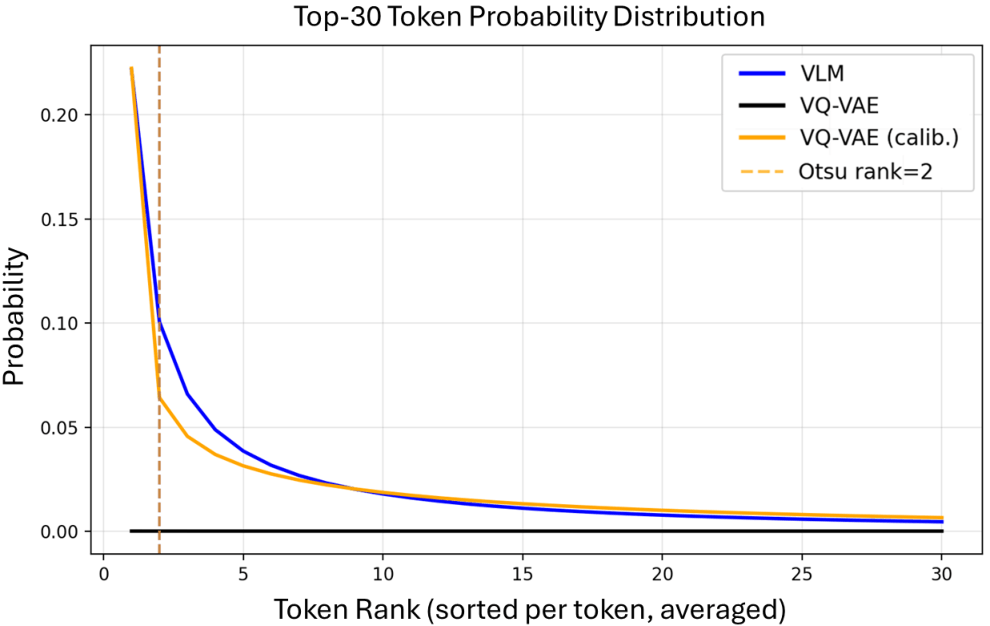
Their analysis of Janus-Pro 7B backs this up quantitatively. Applying Otsu's thresholding to token probabilities gives a threshold rank of 2 for the VLM, meaning at least two codebook vectors typically carry meaningful mass. The top-1 probability averages 0.22, not close to 1.0, so the effective output is not one-hot at all.
How the pipeline works
DCDD has three tightly coupled parts:
- Logit-to-Code Distributional Mapping (LCDM). Each token's softmax distribution is used to compute a probability-weighted sum of all 16,384 codebook vectors, producing a continuous embedding per patch. Four extra scalars (max probability, top-1 minus top-2 margin, adaptive top-K mass, and tail entropy) are attached as uncertainty features.
- Logit Calibration (LC). Diffusion training needs ground-truth logits, but the VLM is frozen and slow, so proxy logits come from cosine similarities between the VQ-VAE encoder's features and the codebook. Raw proxy logits are near-uniform, with a normalized entropy of 0.99 versus 0.42 for the real VLM. Calibration applies affine scaling, a temperature knob, and label smoothing to match VLM statistics without adding learnable parameters.
- Distribution-Conditioned Diffusion Decoder (DCDD). The team finetunes FLUX.1-Fill, an inpainting diffusion transformer, so only its attention and adapter layers update. The conditioning tensor is injected by simple linear projection and additive fusion with noisy latent tokens.

The numbers
On pure image reconstruction with the Janus-Pro 7B VQ-VAE tokenizer at 384x384, DCDD drops reconstruction FID on ImageNet-1K from 2.85 to 0.75, and from 4.49 to 1.81 on MJHQ-30K. SSIM and LPIPS move only slightly, which the authors describe as intentional: the decoder polishes fidelity while leaving semantic structure alone.
For end-to-end text-to-image, generation FID on MJHQ-30K falls from 14.29 to 9.42 with Janus-Pro 7B. GenEval overall accuracy nudges up from 77.24 to 78.31, with clear gains in Single, Two, and Counting categories, because sharper object boundaries help automated detectors. Training took 50K steps on four A100 80GB GPUs, which is trivially small next to VLM pretraining.
Where it breaks
The decoder can only refine what the VLM hands it. In the ablation writeup, the team shows their model sharpens the letters on a stop sign but cannot fix a misspelled "STOPP" originating from the VLM's token generation. Anatomically implausible outputs stay implausible.
Backbone strength matters too. On LlamaGen-XL at 256x256, DCDD improves reconstruction FID substantially but gains on text-to-image are marginal, and GenEval accuracy actually drops slightly. When the base VLM produces token sequences with weak semantic coherence, a fancier decoder cannot rescue them and may amplify the errors instead.
What is genuinely new here
Diffusion-based decoders for VQ-VAE outputs are not novel, and prior work like DiVAE already replaced the CNN decoder with a denoising diffusion process. The real contribution is the logit calibration trick that makes training viable without ever running the VLM. By reshaping cheap VQ-VAE encoder logits to match the sharpness statistics of true VLM outputs, the team sidesteps the usual chicken-and-egg problem of needing paired (VLM logits, ground-truth image) data at training time.
For teams already deployed on Janus-Pro, Emu3, or similar discrete-token generators, this offers a drop-in path to substantially better images: preserving the VLM without modifying or retraining the VLM itself, with the diffusion pathway toggleable when latency budget allows. The paper does not mention a public code release, but the components (FLUX.1-Fill, Janus-Pro 7B's tokenizer, ImageNet-1K) are all publicly available, making reimplementation straightforward.