
KAIST Builds Contexty So AI Finally Understands Your Actual Reasoning
A KAIST-led team built a system that captures fleeting reasoning during knowledge work and hands users an editable canvas of what the AI knows about them.
 Pro
Takeaways
- KAIST-led team introduces Contexty, a system for capturing in-situ thoughts as AI context.
- Snippet memoing uses global shortcuts to capture screen fragments plus short memos without leaving the task.
- A canvas panel exposes the AI's memory as editable cards organized into hierarchical branches with links.
- Study of 12 users showed significant gains in task awareness, thought structuring, authorship, and control.
- Participants preferred snippet-grounded responses over non-grounded ones 78.1% of the time in a blind A/B probe.
- Built on Electron, tldraw, gpt-4o-mini for pipeline tasks, and gpt-4.1 for conversational chat.
Talking to an LLM often feels like starting over. You read three papers, form a hunch about which one matters, weigh two options against each other, then type a prompt that reduces all of that reasoning to a single sentence. The model has no idea what you were actually thinking. A team from KAIST, UC Berkeley, and CMU built a system called Contexty that captures those in-the-moment cognitive moves and turns them into an editable representation of the AI's context.

The gap between what you did and why you did it
Recent work shows that passively observing on-screen activity provides rich contextual signals, but behavioral traces reveal what a user did and where they spent time without capturing the internal criteria or interpretations behind those actions. Auto-summaries from tools like ChatGPT memory have the opposite problem: they distill interaction history into system-generated abstractions rather than reflecting how users prioritize information or organize relationships between ideas.
The authors frame this as two connected failures. First, a capturing problem: users have no lightweight way to externalize reasoning while they work. Second, a visibility problem: even when context is shared, it gets buried in chat history or reduced to summaries neither side can meaningfully inspect.
Snippets as first-class context
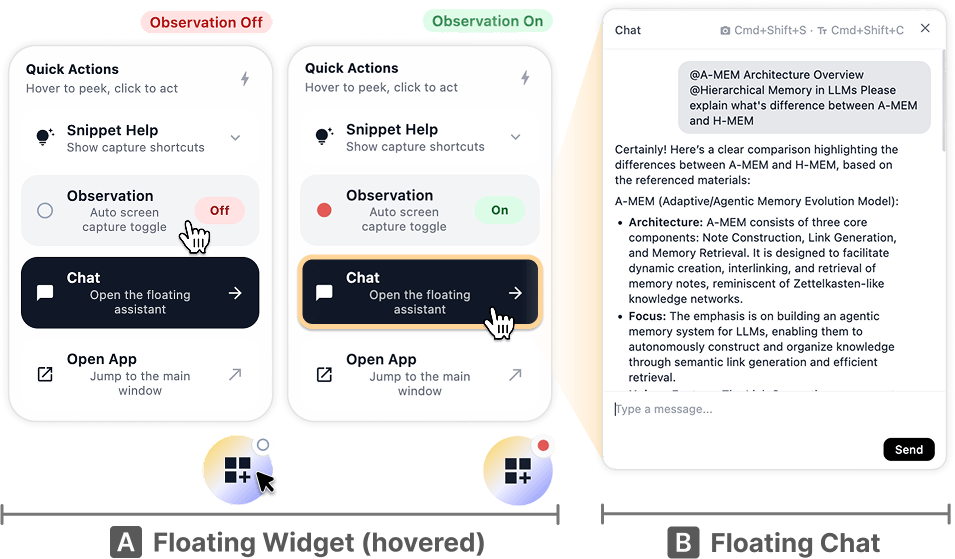
The team started with a probe study to test a simple idea called snippet memoing. Global keyboard shortcuts (Cmd/Ctrl+Shift+S for screenshots, Cmd/Ctrl+Shift+C for text) can be triggered from any application without switching windows. A popup appears with the captured content and a text field where you write a short memo: a tentative thought, an interpretation, a reason it might matter later.