
KAIST Builds a Dirt-Cheap Robot Joint Sensor That Beats Strain Gauges by 12x
A KAIST team built a slim, non-contact optical torque sensor that measures joint forces with 2.14 times better resolution than standard least-squares calibration.
 Pro
Takeaways
- KAIST team proposes a non-contact optical joint torque sensor using photo-reflectors instead of strain gauges.
- Eight sensors arranged in four directions provide redundancy that a quadratic-programming calibration exploits to cut noise.
- Achieves 0.0266 Nm RMS error, 0.083 percent FS max error, and 0.0224 Nm resolution at 1 kHz unfiltered.
- QP calibration delivers 2.14x better resolution than the standard least-squares baseline.
- Compact 96 mm by 12 mm form factor with CAN-FD readout, STM32H7 MCU, and TMP117 temperature compensation.
- Motor tests show RMS error cut by 92 to 96 percent versus current-based control in the sub-0.2 Nm regime.
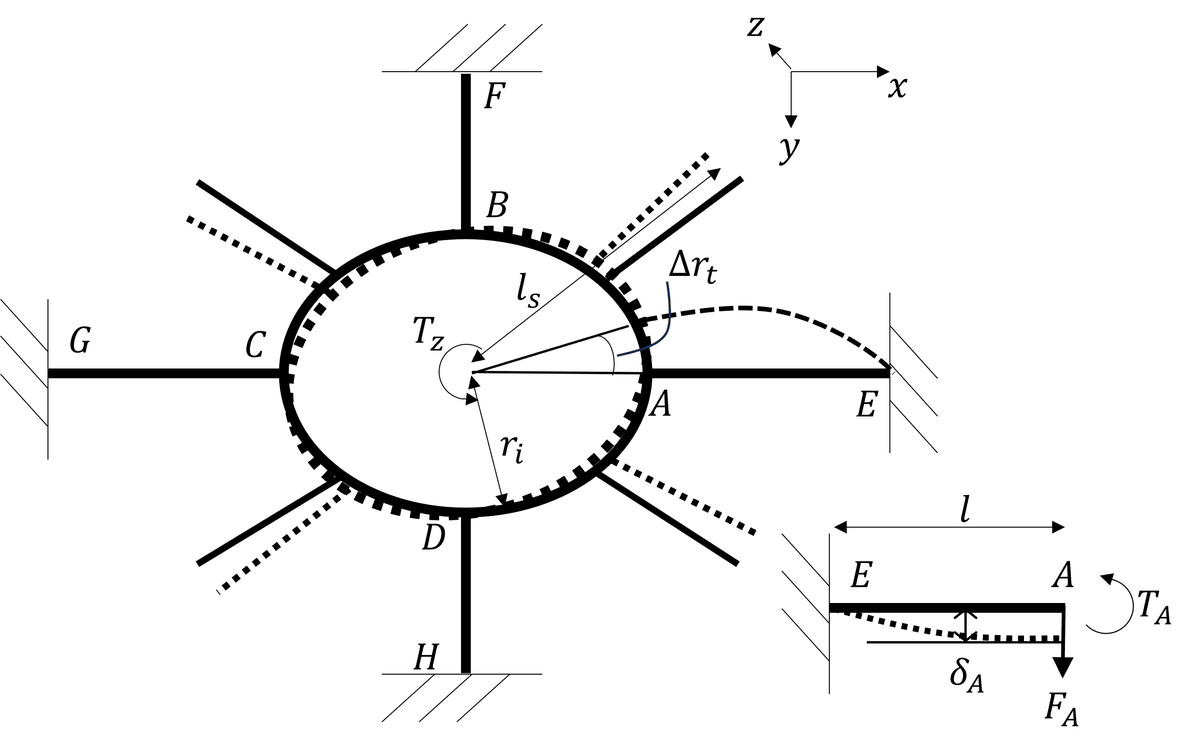
Collaborative robots have a low-torque blind spot. When a manipulator needs to gently probe a surface or hold still against a light push, its estimate of what's happening at the joint tends to fall apart. A team from KAIST's Mechatronics, Systems and Control lab has put out a paper proposing a fix: a compact optical joint torque sensor that skips strain gauges entirely, relies on cheap photo-reflectors, and squeezes extra precision out of a redundant sensing array using a convex optimization trick.
The result is a 96 mm by 12 mm disc that bolts onto a joint and reports z-axis torque with an RMS error of 0.0266 Nm and a resolution of 0.0224 Nm at 1 kHz, no filtering applied.
Where current sensing falls apart
Most commercial cobots estimate joint torque by reading motor current and multiplying by a torque constant. It's cheap, but breaks down in the region where interaction control matters most. Manipulators with high gear ratios suffer from stiction and friction that dominate in static or near-static regimes, so precise low-torque control gets even harder when you rely on current alone.
The paper cites the UR5e as a reference point: its force and torque resolutions are reported at roughly 3.5 N and 0.2 Nm, insufficient for high-precision manipulation and delicate interaction tasks. Dedicated joint torque sensors do exist, but they typically rely on strain gauges glued into Wheatstone bridges, which means expensive parts, extra amplifier circuitry, and manual assembly that doesn't scale.