
KAIST Beats SeViLA by Teaching a Tiny Module to Pick 4 Frames
A KAIST team turns keyframe selection into a trainable module for video QA, using LMM-generated pseudo-labels and coverage regularization to hit 73.3% on NExT-QA.
 Pro
Takeaways
- KAIST introduces question-aware keyframe selection for video QA, hitting 73.3% average on NExT-QA.
- Beats SeViLA (71.5%) using only a linear Gaussian generator instead of a billion-parameter LMM selector.
- Synthetic Keyframe Supervision uses Qwen2.5-VL to generate pseudo frame labels via four prioritized rules.
- Question-conditioned Coverage Regularization adapts diversity strength based on descriptive, temporal, or causal question type.
- Ablations show removing SKS drops descriptive accuracy from 77.8 to 69.0, confirming both components matter.
- Selects just 4 keyframes from 32, cutting inference cost while improving causal and temporal reasoning.
Video question answering has a scaling problem. Feed a large multimodal model every frame of a 44-second clip and you burn tokens, slow inference, and dilute the very evidence the model needs to answer. A team from KAIST has a cleaner approach: teach a lightweight module to pick the four frames that actually matter, using a bigger vision-language model as a silent tutor.
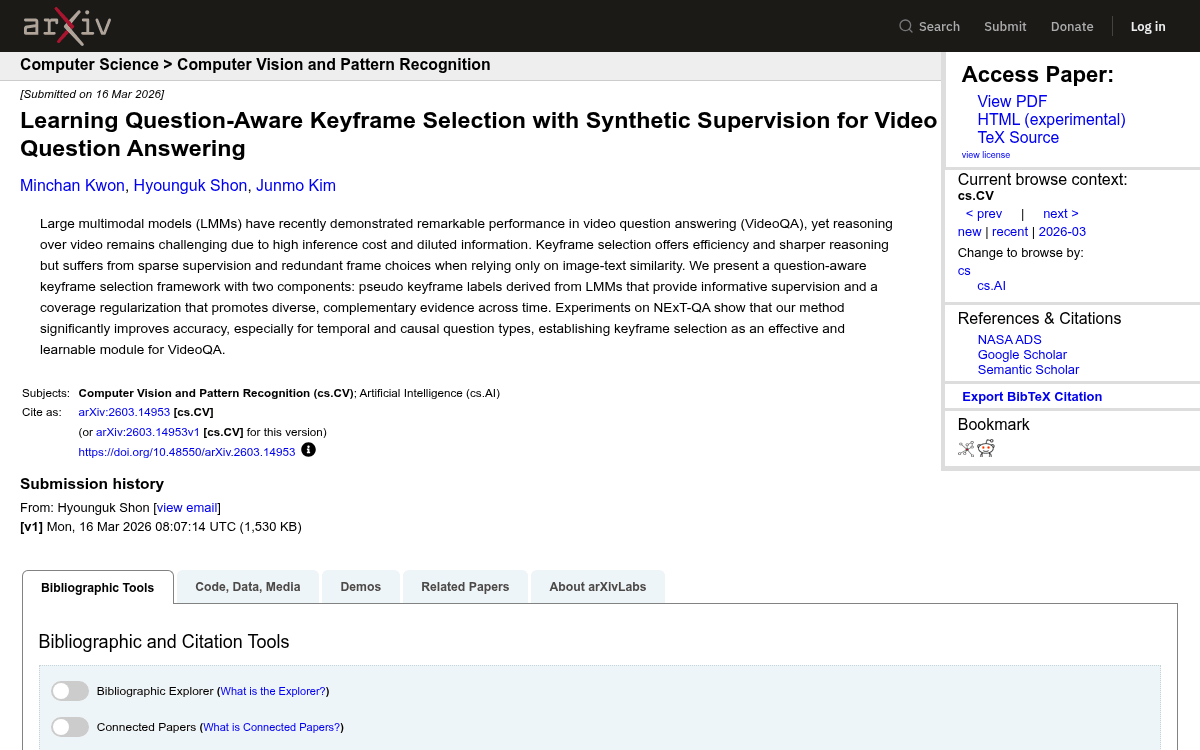
Their paper, Learning Question-Aware Keyframe Selection with Synthetic Supervision for Video Question Answering, pushes accuracy on the NExT-QA benchmark to 73.3%, outperforming SeViLA while using a selector that is essentially a linear layer.
Why keyframe selection is stuck
Keyframe selection is the obvious efficiency lever for video QA, but it has been hard to learn properly. Typical VideoQA datasets provide only question-answer pairs without temporal annotations, so there is no ground truth for which frames matter. Picking the top-k frames is also discrete and non-differentiable, which has pushed prior work into either reinforcement learning or noisy gradient approximations.
The common escape hatch is ranking frames by CLIP similarity against the question text. That fails in three concrete ways the authors identify:
- Framewise matching treats frames independently and fails to capture inter-frame dependencies central to temporal and causal reasoning, so questions like "what happens after the door opens?" fall apart.
- Selecting the top-k frames by similarity often yields temporally adjacent near-duplicates, wasting the frame budget on redundant moments.
- The selector needs high-level video-question understanding it was never trained to have, a chicken-and-egg supervision paradox.
Two ideas glued to a Gaussian selector
The framework builds on GCG's Gaussian Generator, which produces K Gaussian masks over time whose sum defines a keyframe probability distribution. The top-N frames from that distribution are passed through a Q-former into the downstream LMM. The novelty is what supervises and shapes those masks.

Synthetic Keyframe Supervision (SKS). Instead of trusting CLIP alone, the authors prompt Qwen2.5-VL to select frame indices relevant to the question, following four prioritized rules: informative frames first, no near-duplicates, preserve temporal order for before/after questions, and fall back to uniform sampling only if nothing satisfies the first three. These VLM-generated indices become pseudo keyframe labels, mixed with CLIP-based supervision during training. The idea is that the LMM's attention already captures temporal and causal cues that framewise similarity cannot.
Question-conditioned Coverage Regularization (QCCR). At test time, a coverage term rewards the selector for spreading picks across the timeline rather than clustering on one moment. Critically, the regularization strength λ(Q) is conditioned on the question type. To infer that type, the authors reuse the LMM backbone itself with a small prompt classifier, then assign a predefined coverage weight per category. Descriptive questions tolerate tight clustering, temporal questions demand spread.
The CLIP vs VLM contrast, in one example

For the question "What does the child do after ending the call?", CLIP awards its top scores to frames showing the child on the phone, because those frames literally match the words "child" and "call". The VLM ranking flips this, correctly promoting frames from after the call ends and demoting the phone-answering scene. Blending both signals is what gives the selector its edge on causal reasoning.
Numbers on NExT-QA
NExT-QA contains 5.4k videos with an average length of 44s and 52k QA pairs, covering descriptive, temporal, and causal question types. The authors set T=32 frames per video and select N=4 keyframes, using InstructBLIP as the downstream LMM.
| Method | Descriptive | Temporal | Causal | Average |
|---|---|---|---|---|
| GCG (baseline) | 69.0 | 74.4 | 67.8 | 70.4 |
| SeViLA | 80.8 | 66.4 | 71.9 | 71.5 |
| Ours | 77.8 | 71.5 | 71.6 | 73.3 |
The headline is beating SeViLA on average despite SeViLA using a multi-billion-parameter LMM for its own keyframe selection. The KAIST selector is effectively a Gaussian generator sitting on top of an EVA-CLIP encoder, which is a substantial compute advantage.
Ablations back up both components. Removing QCCR drops the average from 73.3 to 71.5, with the biggest hit on temporal questions (71.5 to 67.9) where redundant clustering hurts most. Removing SKS causes an even sharper collapse on descriptive questions, from 77.8 to 69.0, which matches the intuition that pure similarity picks visually dominant but semantically shallow frames.
Where this fits and where it does not
The real breakthrough is treating keyframe selection as a supervised learning problem where the labels are synthesized by a stronger model, not annotated by humans or approximated through RL. That reframing gives a small, cheap module access to the temporal understanding of a much larger one, and it composes with any downstream LMM that consumes frames.
Limitations worth flagging:
- Evaluation is only on NExT-QA. Long-form benchmarks with hour-scale videos or dense event streams are not tested.
- The N=4 keyframe budget suits scene-level questions. Episodic content requiring dozens of evidence moments may need a different regime.
- Pseudo-labels inherit whatever biases Qwen2.5-VL has, and the ablation shows that on temporal questions the CLIP-only variant actually scores higher, suggesting the VLM supervision is not universally better.
- The paper does not mention a public code release, so reproducing the full pipeline currently means rebuilding on top of the GCG codebase.
For anyone shipping video QA systems, the takeaway is practical: a distilled, question-aware selector can match or beat much heavier LMM-based selectors, and the recipe (mix CLIP with LMM-generated pseudo-labels, add coverage regularization keyed to question type) is straightforward to port to other backbones.