
KAIL Cuts Robot Walking Force Errors in Half Where Motion AI Fails
A new ablation study shows motion-only imitation learning produces convincing gait animations but physically wrong joint forces, unless ground contact rewards are added.
 Pro
Takeaways
- Motion-only imitation learning reproduces gait kinematics but produces physically implausible joint moments and ground forces.
- Adding GRF and CoP reward terms cuts center-of-pressure error by up to 44.3%.
- Kinematic reward stays at 0.93-0.95 regardless of kinetic terms, so motion fidelity is not sacrificed.
- Hip, knee, and ankle moment RMSE drop significantly (p<0.0001) when kinetics rewards are added.
- Built on Residual Force Control with PPO in MuJoCo at 450 Hz, small MLP policy.
- Implication: biomechanics and exoskeleton pipelines need force-plate supervision, not just motion capture.
Imitation learning has become the default recipe for teaching simulated humans and humanoid robots to walk. Feed a policy motion capture clips, reward it for matching joint angles, and reinforcement learning does the rest. But a new study argues that this approach quietly hides a serious problem: the resulting walkers look right while getting the physics of force production badly wrong, which matters the moment you try to use those policies for biomechanics, clinical diagnosis, or exoskeleton design.
The paper, Beyond Motion Imitation: Is Human Motion Data Alone Sufficient to Explain Gait Control and Biomechanics?, runs a careful ablation on the reward function of a PPO-based gait imitator and shows that adding two ground-contact reward terms cuts center-of-pressure error nearly in half and significantly improves joint moment estimates at the hip, knee, and ankle.
The trap hidden inside motion-only rewards
Classical biomechanics computes joint moments through inverse dynamics: take measured motion, measure ground reaction forces (GRFs) with a force plate, and apply the Recursive Newton-Euler algorithm to a segmented body model. It works, but it requires a gait lab.
Motion-only imitation learning (MOIL) promises a way out. MOIL tracks joint kinematics or sparse task rewards without relying on external force measurements such as GRFs, which is appealing because motion is now easy to capture with wearables or smartphone video, while force plates are not. The hope is that a policy trained to reproduce motion will implicitly learn realistic joint torques and muscle activations as a byproduct.

The authors' central claim is that this hope is misplaced. RL can yield policies that produce targeted gait motion while relying on unrealistically altered foot-ground interaction, which would significantly deteriorate the joint kinetics estimates. In other words, the policy cheats: it finds unphysical contact forces that happen to reproduce the reference trajectory.
KAIL: adding force and pressure to the reward
The proposed fix, called kinetics-aware imitation learning (KAIL), extends the residual-force-control framework of Yuan and Kitani with two extra reward terms:
- GRF reward: exponential penalty on the difference between simulated and measured sagittal-plane vertical and anterior-posterior ground reaction forces for each foot.
- CoP reward: exponential penalty on the anterior-posterior center-of-pressure location under each foot, which controls where the contact force is applied.
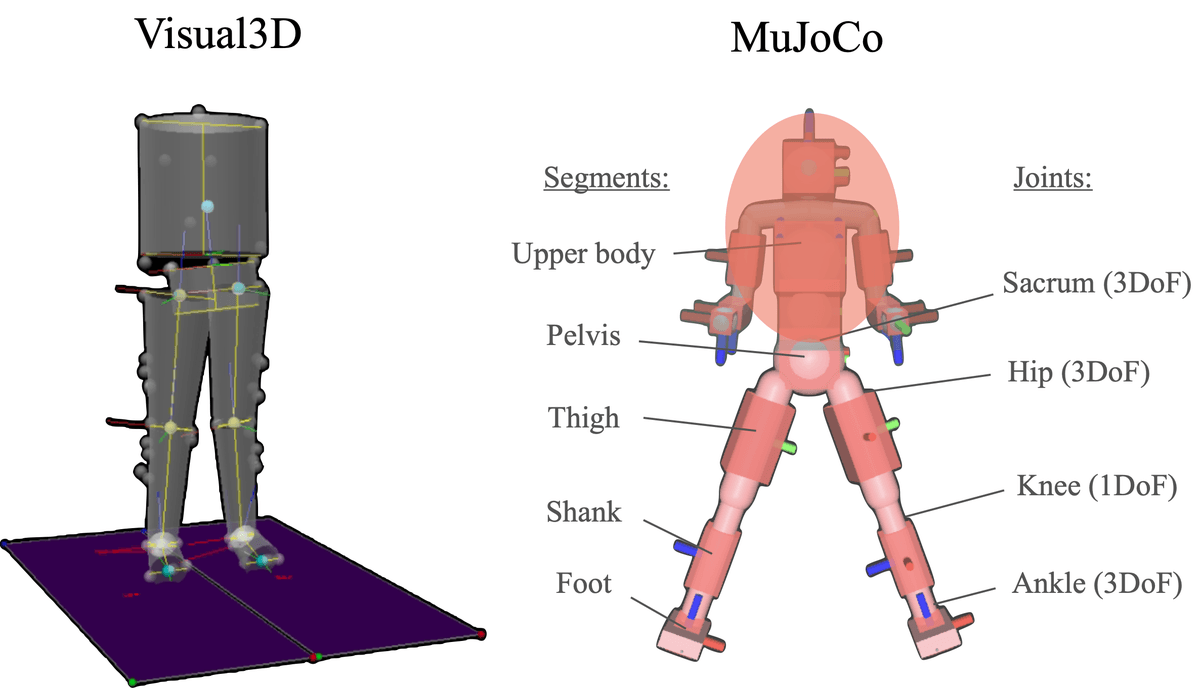
Everything else stays the same as a standard physics-based character animation stack. Forward dynamics runs in MuJoCo at 450 Hz over a control interval of 1/30 s, and joint torques come from an impedance control law with fixed stiffness and damping. The policy is a small two-layer MLP with 512 and 256 ReLU units trained with PPO.

The ablation, step by step
To isolate what each reward term actually contributes, the authors used a clean protocol:
- Collect motion capture and force plate data from one healthy adult walking on a split-belt instrumented treadmill at 1.2 m/s, using 42 reflective markers and Vicon at 120 Hz.
- Run inverse dynamics in Visual3D on the last 30 gait cycles to get ground-truth joint moments.
- Pre-train all agents for 700 episodes with the kinematic reward only, until MOIL can replicate the full trial without falls, then fine-tune for 200 more episodes under four reward conditions.
- Compare the four conditions: kinematic only (baseline MOIL), kinematic plus GRF, kinematic plus CoP, and the full KAIL with all terms.
The trick of starting from a shared pre-trained checkpoint is what makes the comparison honest. Every variant already walks; the question is only what happens to the underlying forces.
What the numbers say
The kinematic story is the same across conditions. The kinematic reward stayed between 0.93 and 0.95 out of a maximum of 1 across all four conditions, regardless of whether kinetics-aware rewards were added. From a pure motion tracking standpoint, adding GRF and CoP rewards costs nothing.
The kinetic story is very different. For center of pressure error, normalized as a percentage of foot length:
| Condition | CoP RMSE (% foot length) | Reduction vs baseline |
|---|---|---|
| Kinematic only (MOIL) | 38.3 | - |
| + GRF reward | 32.8 | 14.5% |
| + CoP reward | 21.8 | 43.2% |
| Full KAIL (both) | 21.4 | 44.3% |
Ground reaction force alignment improved similarly. Correlations between simulated and measured GRF vectors were significantly lower in the kinematic-only condition than in any condition that included kinetics-aware rewards, and the kinematic-only policies also showed significantly larger phase errors. Translation: MOIL got the timing and shape of the foot strike wrong, not just the magnitude.

For internal joint moments, which is what actually matters for clinical and wearable robotics applications, pair-wise comparisons showed statistically significant reductions in RMSE for hip, knee, and ankle moments when kinetic terms were included, and Pearson correlations with inverse dynamics moments were significantly higher for the knee and ankle.
Why this matters beyond the paper
The result formalizes something practitioners have suspected. MOIL can learn a simulation policy by allowing larger collision losses at heel strike to produce overly stable gait patterns, prioritizing robustness over biological fidelity. The policy is not lying about motion, it is finding a shortcut in force space that the reward function cannot see.
The downstream consequences are concrete. Roughly 1 cm errors in anterior-posterior CoP location translate to roughly 14% errors in sagittal plane joint moment estimates. If you are training an exoskeleton controller to minimize muscle effort based on a simulated model, those errors propagate into the assistance profile the device delivers to a real person.
The authors are careful about scope. They do not claim KAIL fully reproduces human joint kinematics and kinetics. The impedance-controlled skeleton still produces jerkier moments than a real musculoskeletal system, the foot contact model is a simplification, and the study only covers one walking speed on one subject.
When to use MOIL and when to reach for KAIL
The practical takeaway splits along the intended use case:
- Character animation, humanoid style transfer, video game locomotion: motion-only IL is fine. The output metric is visual plausibility, not force fidelity.
- Biomechanics digital twins, clinical gait analysis, exoskeleton co-design, muscle activation estimation: kinetics rewards are effectively mandatory. Without them, joint moments and by extension muscle forces are unreliable regardless of how good the motion tracking looks.
- Sim-to-real for wearable robotics: the foot-ground interaction model itself is still a bottleneck, so KAIL is necessary but not sufficient.
The paper does not release code or a model checkpoint, and the KAIL framework is built on top of the open-source Residual Force Control code from Yuan and Kitani. Adding the GRF and CoP reward terms to that pipeline is straightforward for anyone already running physics-based motion imitation, provided you have force plate data to train against.
The broader message is a corrective to the enthusiasm around using imitation learning as a drop-in replacement for biomechanical analysis. Motion data is abundant and cheap. Force data is not. This work is a reminder that the expensive measurement is the one carrying the physics.