
judgeWEL Builds a 5x Larger Luxembourgish AI Dataset Without Human Annotators
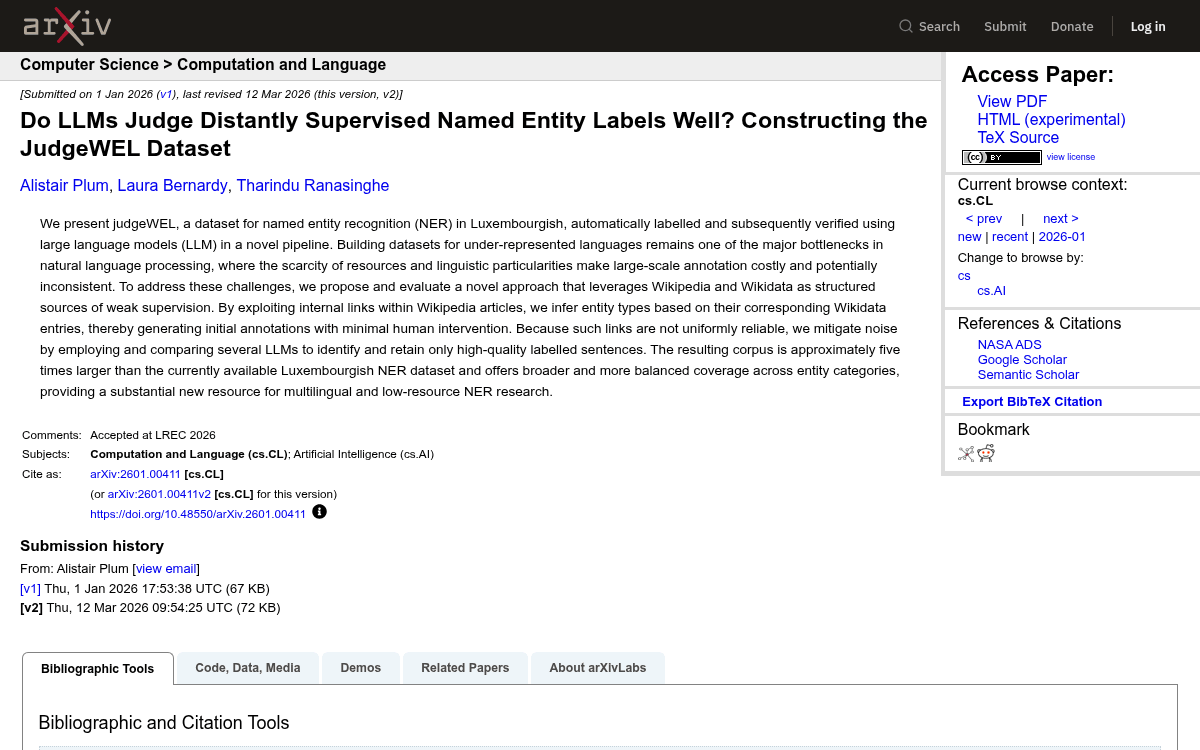
Researchers introduce judgeWEL, a Luxembourgish NER corpus five times larger than prior resources, built by using LLMs as binary quality judges over Wikipedia-derived labels.
 Pro
Takeaways
- judgeWEL is a new Luxembourgish NER dataset with 28,866 sentences across five entity types, released on GitHub.
- Pipeline uses Wikipedia hyperlinks plus Wikidata typing for weak labels, then LLMs as binary keep/discard judges.
- GPT-5 and GPT-5-mini produced identical judgments, reaching Cohen's kappa 0.62 versus 0.66 for humans.
- Encoder models (mBERT, XLM-R, LuxemBERT) hit 0.91-0.92 F1 and transfer cleanly to the older RTL-NER test set.
- Autoregressive LLMs failed at token-aligned BIO output, with LLaMA-3-8B dropping to 0.02 F1 cross-domain.
- Corpus is roughly five times larger than the prior Luxembourgish NER benchmark; paper details the full pipeline.
A team from the University of Luxembourg and Lancaster University has released judgeWEL, a new named entity recognition dataset for Luxembourgish that sidesteps the usual bottleneck of manual annotation. Instead of asking large language models to label text directly, the authors use them as binary judges that keep or discard weakly labelled sentences pulled from Wikipedia. The result is a corpus roughly five times larger than the previous Luxembourgish NER benchmark, with broader entity coverage and encoder models that transfer cleanly to human-annotated test data.
Why Luxembourgish is a hard case
Luxembourgish is under-represented in NLP compared to its larger neighbours German and French, though it shares deep historical and structural ties with both. Code-switching and borrowing are common, particularly in informal written communication, giving the language a dynamic character that further complicates computational treatment. Before this work, the main labelled NER resource was RTL-NER, manually annotated for Person, Organisation, Location, Geopolitical Entity, and Miscellaneous tags. The 5500 sentences were extracted from 450 RTL news articles. That is a small pool for training modern models, and the class balance is skewed heavily toward Person mentions.
The core idea: judges, not annotators
The methodological pitch is that current LLMs are more reliable at saying yes or no about an existing annotation than at producing token-level labels from scratch. The authors combine distant supervision from Wikipedia and Wikidata with LLM-based quality control, leveraging the ability of current large models to judge annotation consistency even in languages not officially supported. The pipeline never asks a model to invent BIO tags, which is exactly where autoregressive systems tend to drift.
The construction steps look like this:
- Parse the Luxembourgish Wikipedia dump (about 77k articles) with WikiExtractor, preserving hyperlinks.
- For each hyperlinked span, query Wikidata and map its
P31(instance-of) attribute to one of five target types: PER, ORG, LOC, DATE, or MISC. - Apply BIO tagging, then filter sentences for length, uniqueness, non-overlapping spans, and at most one negative example per article.
- Use a fine-tuned LuxGPT NER pass plus regex date matching to catch entities Wikipedia missed.
- Send batches of 20 sentences to an LLM with a prompt asking for a single 1 (keep) or 0 (discard) decision per sentence.
The resulting instruction is concise but explicit, guiding the model towards binary and decisive judgements. Sentences that survive the judge stage form the final corpus of 28,866 sentences, split roughly 80/10/10 into train, dev, and test.
Which judges actually work
The authors benchmarked seven systems against human consensus on 500 sentences, spanning proprietary, open-weight, and instruction-tuned families. GPT-5-mini and GPT-5 produce the exact same output, and clearly outperform all other systems, reaching a kappa value of 0.62, approaching the level of human inter-annotator agreement at 0.66. Open-weight models trail but not catastrophically: GPT-OSS-120B and Mistral-Medium-3.1 perform comparatively well, showing moderate and stable alignment with human judgements. At the bottom, Gemma-3-27B-IT and LLaMA-3.3-8B-Instruct exhibit near-zero or negative correlation with human ratings, confirming that instruction tuning alone does not ensure evaluative reliability in smaller open-weight systems.
The per-category breakdown is more interesting than the aggregate numbers. DATE-containing sentences are the most consistently handled across all models, with every system achieving its highest or near-highest F1 on this category, likely because temporal expressions provide reliable surface cues that LLM judges can exploit regardless of their general evaluative quality. MISC is the opposite: GPT-5 and GPT-OSS-120B achieve an F1 of zero, never retaining a MISC sentence that human annotators approved, which likely reflects how heterogeneous that class is in Luxembourgish. Gemma failed in a specific way worth flagging: it discarded every sentence containing no entities, treating absence of tags as an annotation failure.
Does it actually train useful models?
The dataset was tested with three multilingual encoders and three generative LLMs. On judgeWEL's own test split, all transformer-based encoders perform well, reaching F1-scores above 0.90. More importantly, models trained on judgeWEL and evaluated on the older human-labelled RTL-NER set held up:
| Model | Precision | Recall | F1 |
|---|---|---|---|
| mBERT | 0.93 | 0.91 | 0.92 |
| XLM-R | 0.92 | 0.91 | 0.91 |
| LuxemBERT | 0.92 | 0.92 | 0.92 |
| Aya-expanse-8b | 0.29 | 0.34 | 0.31 |
| LLaMA-3-8B | 0.02 | 0.01 | 0.02 |
Encoder models generalise almost losslessly, while autoregressive LLMs collapse. The issue appears structural rather than linguistic: autoregressive LLMs are not optimised for deterministic, token-aligned output, and thus struggle to reproduce the rigid labelling constraints that encoder-based architectures handle naturally. A zero-shot GPT-5 evaluation showed the same problem, producing mostly O tags.
What is honestly new here
The headline contribution is a reusable recipe, not just a Luxembourgish dataset. The open pipeline on GitHub takes any Wikipedia edition with reasonable coverage and turns it into an NER corpus through Wikidata typing plus binary LLM filtering. That matters because it decouples the hard part (deciding whether a label is correct) from the brittle part (producing structured token-level output), and it lets researchers substitute cheaper judges as they improve.
Some caveats to keep in mind before dropping this into a production stack:
- The corpus is limited to five coarse categories, so fine-grained entity subtypes are not captured.
- Results depend on Wikipedia coverage. Languages with sparse or inconsistent Wikipedias will yield fewer usable candidates.
- LLM judges are probabilistic and, as the paper notes, sensitive to prompt, temperature, and API version drift.
- MISC entities remain unreliable and residual annotation noise is present, so tasks needing high precision still need human-in-the-loop validation.
For anyone working on low-resource NER, this is a pragmatic middle path between fully manual annotation and end-to-end generative labelling. The full paper details the prompts, model list, and per-category error breakdown, and the code and dataset are released under open licences.