
Johns Hopkins' Meissa Beats GPT-5 on Medical AI Running 22x Faster Offline
Meissa is a 4B-parameter medical AI agent that matches GPT-class frontier models offline, at 22x lower latency and 25x fewer parameters
 Pro
Takeaways
- Meissa is a 4B-parameter offline medical AI agent that matches or beats GPT-class frontier models on 10 of 16 evaluation settings across 13 benchmarks.
- It runs fully on-premise with 22x lower latency than API-based systems like Gemini-3-flash + MedRAX (4.1s vs 87.2s per query).
- A three-tier stratified training pipeline teaches the model when to use tools (strategy selection) and how to execute multi-step interactions (strategy execution).
- Prospective-retrospective supervision pairs exploratory forward traces with hindsight-rationalized traces for stable agentic policy learning.
- The model operates across four agent environments: tool calling, visual reasoning with image feedback, multi-agent debate, and clinical simulation.
- Code, model weights, and the 40K trajectory dataset are open-sourced on GitHub; not intended for clinical use.
The dominant playbook for building capable medical AI agents today is simple: wire a large frontier model like GPT or Gemini to a suite of specialized tools, call the API repeatedly, and let the cloud do the heavy lifting. It works well enough in a lab. In a hospital, it falls apart. These systems rely almost entirely on proprietary frontier models whose API-based deployment incurs high cost, high latency, and privacy risks that conflict with on-premise clinical requirements. Patient data cannot leave the building, multi-step API calls add seconds to every query, and cloud dependency is a single point of failure for critical workflows.
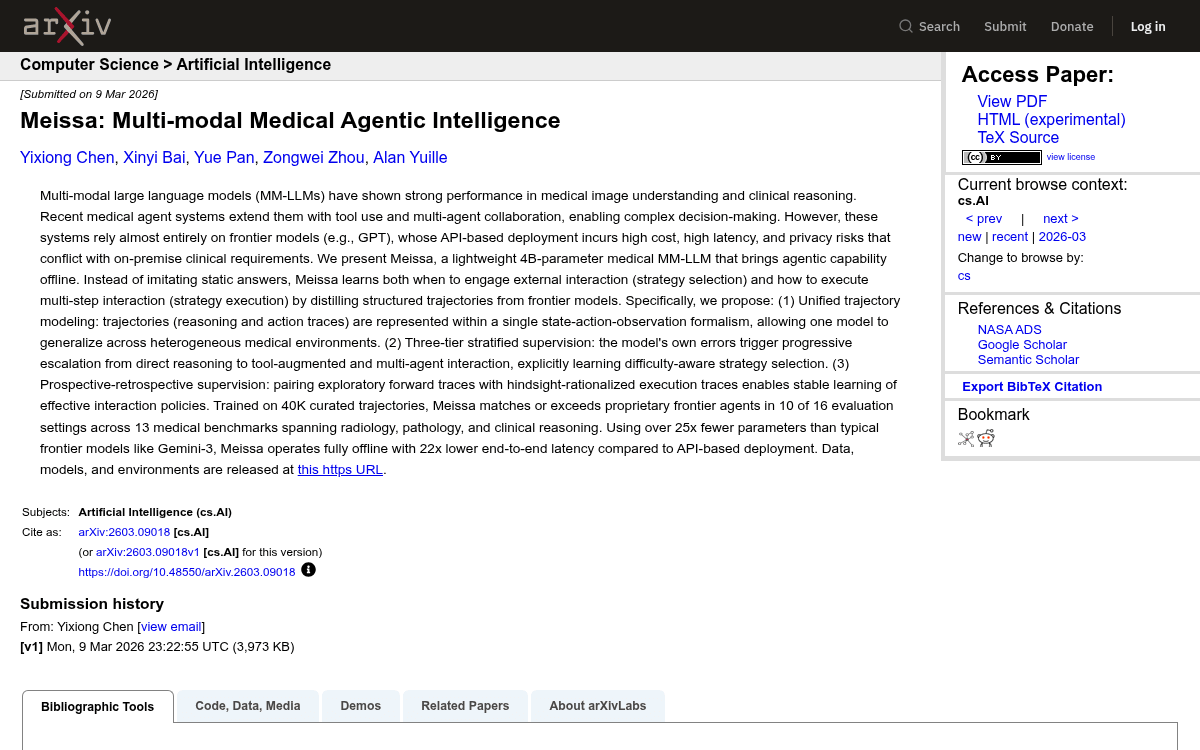
A team from Johns Hopkins University and Cornell has now published Meissa, a 4B-parameter multimodal medical agent designed to run entirely offline. Meissa is a lightweight 4B-parameter medical MM-LLM that brings full agentic capability offline. Instead of imitating static answers, Meissa learns both when to engage external interaction and how to execute multi-step interaction by distilling structured trajectories from frontier agent systems. The result is a model that competes with systems more than 25 times its size, at a fraction of the cost and latency.
Why the old approach hits a wall
Medical AI has made real progress on single-pass tasks: look at an X-ray, answer a question. But real clinical reasoning is rarely a single-pass problem. A radiologist reading a chest X-ray might zoom into a suspicious region, run a segmentation tool, cross-reference a report generator, and reconcile conflicting outputs before committing to a finding. Simulating that process requires an agent that can chain actions, observe results, and adapt.
Recent medical agent systems extend multimodal LLMs with tool use and multi-agent collaboration, enabling complex decision-making beyond single-pass inference. Systems like MedRAX (chest X-ray tool calling), Ophiuchus (visual reasoning with image feedback loops), MDAgents (multi-specialist debate panels), and AgentClinic (multi-turn clinical simulation) have demonstrated this capability convincingly. The catch is that every one of them requires a frontier model as its backbone. Swapping in a smaller open model causes performance to collapse.
The core problem is not just model size. It is the absence of training data that teaches a model how to behave as an agent. Existing benchmarks provide final answers, not the step-by-step reasoning and action traces that an agent needs to learn from. Existing agent systems generate agentic trajectories within isolated environments, each with its own format and protocol, making it difficult to construct unified supervision across heterogeneous interaction modes.
The three-part recipe

Meissa's training framework is built around a single insight: an agent needs to learn two distinct skills. It must know when to call external tools (strategy selection) and how to execute a multi-step interaction once it decides to act (strategy execution). The team addresses both with three coordinated innovations.
1. Unified trajectory modeling. All agent interactions, from a direct one-shot answer to a 12-turn clinical simulation, are represented in a single state-action-observation formalism. Each step in a trajectory is a tuple: the current context, an action (either a JSON tool call or a final answer), and the environment's response. This common language lets one model train across four completely different agent environments without environment-specific fine-tuning heads.
2. Three-tier stratified supervision. Rather than generating expensive agentic trajectories for every training sample, the pipeline uses the model's own errors as a curriculum signal:
- Tier 1 (Direct): Queries the base model (Qwen3-VL-4B) already answers correctly get simple direct-reasoning trajectories. No tools needed, no API calls. These teach the model when not to act.
- Tier 2 (Enhanced): Queries the base model fails but a stronger teacher model (Gemini-3-flash) can answer without tools get enhanced reasoning traces. These bridge the gap between easy and hard.
- Tier 3 (Agentic): The hardest residual queries, unsolvable by either model without external help, get full multi-step agentic trajectories generated by the teacher operating inside an agent environment.
The final dataset contains approximately 40K trajectories: 8.2K direct (Tier 1), 9.8K enhanced (Tier 2), and 23.9K agentic (Tier 3). The combined supervision teaches strategy selection as an emergent behavior: the model's first generated action at inference time implicitly determines which strategy it will use.
3. Prospective-retrospective supervision. For the hardest Tier 3 samples, the team generates two complementary training signals from each correct trajectory. A prospective trace is recorded during real-time inference, capturing exploratory decision-making under uncertainty. A retrospective trace re-narrates the same action sequence with clean hindsight reasoning, knowing the correct answer in advance. Training on both teaches the model to handle uncertainty during exploration (prospective) and to reason efficiently toward known goals (retrospective). Ablations confirm that each is necessary: prospective-only excels at out-of-distribution generalization, retrospective-only excels in-distribution, and the combination is optimal.
Four environments, one model

The Tier 3 trajectories are collected from four distinct agent environments, each representing a different mode of clinical reasoning:
- Continuous Tool Calling (MedRAX): The model calls a suite of 8 chest X-ray tools, including a DenseNet classifier, phrase grounding, segmentation, and report generation. Observations return structured text.
- Interleaved Thinking with Images (Ophiuchus): Tools like
ZoomIn,SAM2, andBioMedParsereturn new images injected back into the conversation, creating a multi-round visual reasoning chain. This is the most visually demanding environment. - Multi-Agent Collaboration (MDAgents): The model orchestrates a panel of specialist agents (e.g., cardiologist, radiologist, pathologist) through structured debate rounds and synthesizes their outputs into a final answer.
- Multi-turn Clinical Simulation (AgentClinic): The model plays a doctor, requesting physical exams and lab tests from a simulated patient to arrive at a diagnosis. Cases are drawn from MedQA and MIMIC-IV EHR records.
These environments are trajectory sources during training, not architectural components of Meissa itself. At inference, Meissa runs as a single model that can operate inside any of them.
Matching giants at a fraction of the cost
Meissa is ranked 1st or 2nd on 10 out of 16 evaluation settings, matching frontier models. This is measured across 13 benchmarks spanning radiology (MIMIC-CXR-VQA, ChestAgentBench), pathology (PathVQA), mixed medical VQA (SLAKE, VQA-RAD, OmniMedVQA), and clinical reasoning (MedQA, PubMedQA, NEJM, MIMIC-IV). Five of those benchmarks are strict out-of-distribution, with zero n-gram overlap with training data confirmed.
Some headline numbers from the evaluation:
- PathVQA: 78.2% accuracy, ranking first among all methods including GPT-5 (60.0%) and Gemini-3-flash (74.3%)
- MIMIC-CXR-VQA: 65.2%, first overall, versus Gemini-3-flash at 65.0%
- OmniMedVQA (OOD): 82.8%, versus Ophiuchus-7B at 78.6% and Gemini-3-flash at 77.4%
- MIMIC-IV clinical simulation: 84.4%, versus Gemini-3-flash at 70.6%
- ChestAgentBench (OOD): 62.8%, matching GPT-4o+MedRAX at 63.1%
Meissa surpasses Qwen3-VL-4B by 17.3 points and the answer-only tuned Qwen3-VL-4B direct inference baseline by 6.1 points on average, showing that trajectory supervision conveys substantially richer learning signal than data exposure alone.
The latency story is equally striking. Gemini-3-flash averages 87.2s per query due to multiple API calls and remote tool execution, while Meissa averages 4.1s, a approximately 22x speedup. And because Meissa runs on a single NVIDIA A6000 GPU, the entire system can live inside a hospital's firewall.
The routing breakthrough
One of the most technically interesting results is how well Meissa learned to route queries. The team compared Meissa's learned routing against fixed strategies and an oracle router that always picks the best strategy per query. Learned routing closes the gap to oracle, demonstrating near-optimal strategy selection: 72% of queries are routed to direct reasoning and 28% to agentic interaction.
Critically, the always-agentic strategy actually hurts performance. The always-agentic strategy degrades average accuracy relative to always-direct, because overlong contexts and occasionally misleading tool outputs hurt easy queries that require no external information. The model learned something real: knowing when to stop is as important as knowing how to act.
The routing distribution by difficulty tier confirms the model internalized the curriculum:
- Easy queries: 96% routed to direct reasoning, 4% to tools
- Medium queries: 62% direct, 38% agentic
- Hard queries: 3% direct, 97% agentic
The team also verified that Meissa learned genuine causal reasoning rather than pattern matching. When visual feedback from tools was replaced with blank images, accuracy dropped by 6.8 points. When replaced with random images, it dropped 13.9 points. Paraphrased tool outputs cause minor drops (-0.8), while replacing visual feedback with blank or random images causes much larger drops, confirming that the model actively perceives tool-generated observations.
Where it struggles
Meissa's limitations are real and worth understanding before deploying it. On MedQA (Framework III), it reaches only 57.2% against GPT-4V's 88.7%. On MedXpertQA, it achieves 36.0% against Gemini-3-flash's 69.2%, trailing even Ophiuchus-7B (39.3%). These are tasks that require deep parametric medical knowledge, the kind encoded in billions of parameters that a 4B model simply cannot match.
There are also known failure modes in the tool-calling environments. The qualitative analysis identifies four recurring patterns:
- Over-invocation: The model calls tools on simple questions where direct reasoning would suffice, accumulating context that confuses rather than helps.
- Infinite loops: On questions that imply the absence of a finding, the model can get stuck searching for something that is not there.
- False positive trust: Segmentation tools like BioMedParse return non-zero area for almost any text query. The model sometimes mistakes a large segmented area for confirmation of the queried structure.
- Mild negative transfer: Mild negative transfer also appears on MedQA Ext. (-3.3% relative to the base), confirming that agentic trajectory training competes with parametric knowledge retention in lightweight models.
The authors are also explicit that Meissa is not ready for clinical deployment. The model is a research prototype and is NOT intended for clinical use. The model may produce incorrect or hallucinated medical information. Integrating uncertainty estimation and abstention mechanisms is listed as future work.
Why SFT instead of RL, and why it matters
A notable design choice is that Meissa is trained entirely with supervised fine-tuning (SFT), not reinforcement learning. Most recent agentic models, including Ophiuchus-7B (the closest competitor), use RL to sharpen stopping behavior and tool selection. The Meissa team argues this is a practical advantage: existing RL approaches are each tied to a single agent framework; none can jointly learn policies across the four heterogeneous environments Meissa operates in. RL also requires extensive online rollouts with live tool environments, adding compute cost and training variance.
Stratified SFT achieves near-oracle routing with deterministic, compute-efficient training (approximately 12 GPU-hours), and naturally scales across environments through trajectory unification. Despite having nearly half the parameters of Ophiuchus-7B, Meissa matches or exceeds it on 3 of 5 shared benchmarks.
The team also tested whether the specific teacher model matters. Replacing Gemini-3-flash with the open-source Qwen3-VL-32B as the trajectory generator costs only 3.3 points overall, suggesting that organizations preferring a fully open-source pipeline can use it without significant quality loss.
What's available
Meissa is a multi-modal medical agent built on a trajectory-based agentic behavior distillation framework. The released model is trained with LLaMA-Factory using LoRA on Qwen3-VL-4B-Instruct. The GitHub repository releases the model weights, the 40K curated trajectory dataset, and all four agent environments. Training takes approximately 12 hours on 8 A6000 GPUs. Inference runs on a single A6000 via vLLM, with most queries completing in under 3 seconds.
For teams building clinical AI systems that need to stay on-premise, Meissa represents a meaningful step: a model small enough to run locally, capable enough to handle multi-step agentic tasks, and honest enough about where it still falls short.