
Johns Hopkins Fixes dVRK-Si's Gravity Sag, Cutting Surgical Robot Drift by 84%
A new kinematic and dynamic model plus open-source pipeline cuts steady-state drift on the next-generation da Vinci research platform by up to 84 percent.
 Pro
Takeaways
- First complete kinematic and dynamic model tailored to the dVRK-Si patient side manipulator.
- Gravity compensation cuts steady-state joint errors 68-84% and tip drift from 4.2 mm to 0.7 mm.
- Computed-torque feedforward reduces sinusoidal tracking error by 35% vs gravity-only, 40% vs PID.
- Convex optimization identification with Fourier excitation trajectory and physical feasibility constraints.
- Open-source pipeline at jhu-dvrk/dvrk_psm_dynamics_identification; simplified variant already in dVRK stack.
- Limitations: single arm tested, wrist joint NRMSE 45-87%, computed-torque path limited to 100 Hz.
Surgical robotics researchers working with Intuitive's da Vinci hardware have run into a stubborn problem: the newer dVRK-Si patient side arm sags. Unlike the older, well-counterweighted first-generation arm that most published modeling work targets, the Si-generation manipulator carries substantially larger gravity loads that pull it out of position when the controller does not know how to fight back. A new paper from Johns Hopkins, WPI and Vanderbilt closes that gap with the first complete kinematic and dynamic model of the dVRK-Si patient side manipulator (PSM), plus an open-source identification pipeline.
Why the Si arm broke the old playbook
The da Vinci Research Kit is an open platform built from retired clinical da Vinci systems and shared with more than 40 institutions. The original dVRK, released to the research community in 2012 and now installed at more than 40 institutions worldwide, is based on the first-generation da Vinci system released in 2000. Last year the group behind the platform introduced dVRK-Si, which extends support to decommissioned second/third generation da Vinci S/Si patient-side robots.
The catch is mechanical. Both da Vinci PSM generations use brushed DC motors on all joints. However, the da Vinci Si PSMs feature a mechanical design less balanced by counterweights. Without those counterweights, gravity torques on joints 1 through 3 become significant, producing steady-state position errors, drift during static holds, and sluggish response, exactly the issues that break teleoperation and any imitation-learning policy trained assuming the arm holds still when commanded to hold still.

What the paper actually delivers
The authors build the model from scratch for the Si geometry rather than porting Classic parameters, which is the correct move because tendon routing, link masses, and the parallelogram linkage all differ. Their contribution has three parts:
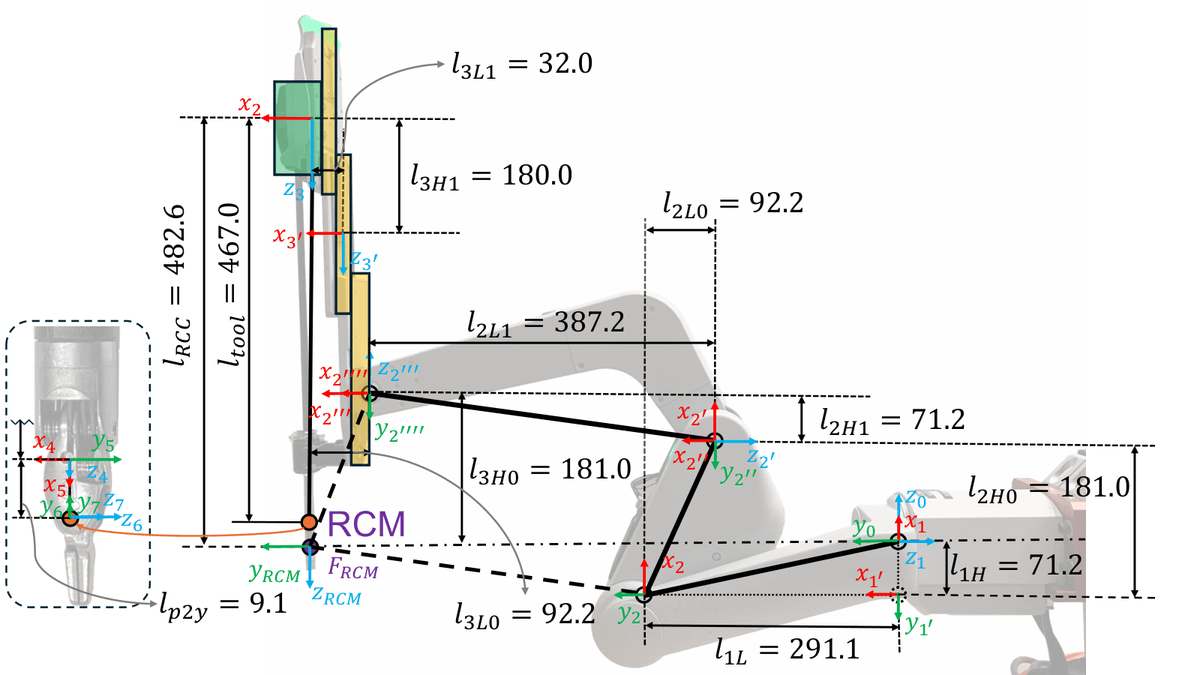
- A modified Denavit-Hartenberg kinematic model that captures the closed-chain parallelogram mechanism and the remote-center-of-motion constraint.
- An Euler-Lagrange inverse dynamics formulation written in linear-in-parameters regressor form, covering link inertias, motor inertia, viscous and Coulomb friction (smoothed with tanh instead of a signum function to survive velocity noise), and cable spring stiffness.
- A convex-optimization identification pipeline driven by a Fourier-series excitation trajectory whose coefficients are optimized to minimize the log condition number of the regressor matrix, with physical feasibility constraints (positive masses, centers of mass inside link bounding boxes, positive definite inertia tensors).
They then deploy the identified model in two ways: pure gravity compensation (assume zero velocity and acceleration, output only the G(q) term), and full computed-torque feedforward that also accounts for inertial and Coriolis effects. A stripped-down statics-only variant, using only the first three joints and ignoring friction and springs, is baked into the dVRK C++ stack to run at kilohertz servo rates.
The numbers
Experiments on a physical dVRK-Si with a Large Needle Driver instrument show clear wins across static holding and tracking:
- Gravity compensation reduces steady-state joint errors by 68-84% and decreases end-effector tip drift during static holds from 4.2 mm to 0.7 mm.
- For sinusoidal tracking, computed-torque feedforward cut position errors by roughly 35% versus gravity-only feedforward and 40% versus PID alone.
- Inverse-dynamics evaluation takes about 0.273 ms on a Ryzen 9 5950X, well inside a real-time budget.
- Torque prediction NRMSE is 7-22% on the load-bearing joints 1-3, but climbs to 45-87% on the low-torque wrist joints where friction and transmission nonlinearities dominate.
What it is good for, and what it is not
The model is production-ready for anyone running static holds, teleoperation, or slow trajectory tracking on a dVRK-Si, and the simplified gravity compensation has actually been shipping in the dVRK software since early 2025. It is also a prerequisite for high-fidelity simulation and for imitation-learning stacks like the patient side manipulator of da Vinci Research Kit Si which provides six degrees of freedom for motion, developed based on the da Vinci Si robot outfitted with a control system specifically designed for research purposes, where sim-to-real gaps often trace back to unmodeled gravity.
The honest limits: everything was measured on a single arm at zero-degree mounting inclination with one instrument, the wrist joints are still poorly predicted, and the Python-based computed-torque path runs at 100 Hz rather than servo rate. The authors suggest porting inverse dynamics to Pinocchio to close that gap.
Code
The full identification and modeling pipeline is released at jhu-dvrk/dvrk_psm_dynamics_identification, and the simplified gravity compensation is already merged into the dVRK software stack. This work extends an earlier Hamlyn Symposium preliminary version with the full derivation, computed-torque feedforward, and expanded experiments.