
Johns Hopkins Finds Cheaper Way to Evaluate RAG Without Running Full Pipelines
A Johns Hopkins study proves that coverage-focused retrieval metrics reliably predict RAG output quality, potentially cutting the cost of end-to-end evaluation
 Pro
Takeaways
- Coverage-based retrieval metrics (alpha-nDCG, StRecall) strongly predict RAG generation quality, with system-level correlations up to r=0.88 for simple pipelines.
- Relevance-based nDCG showed near-zero correlation with generation quality on complex information needs, making it a poor proxy for RAG evaluation.
- Study tested 15 text and 10 multimodal retrieval stacks across 4 RAG pipelines on TREC NeuCLIR 2024, TREC RAG 2024, and WikiVideo benchmarks.
- Iterative RAG pipelines (e.g., LangGraph) decouple generation quality from retrieval, showing near-zero correlation -- shifting the bottleneck to LLM-retrieval interaction.
- In multimodal RAG, retrieval quality predicts factual accuracy rather than coverage, as LLMs rely on parametric memory for known events.
- Findings support using retrieval metrics as cheap proxies for end-to-end RAG evaluation, reducing costly LLM-judge annotation runs. Paper
Evaluating a RAG system end-to-end is expensive. You run the full pipeline, generate responses, then pay an LLM or human assessors to judge whether those responses actually covered what they should have. A new paper from Johns Hopkins asks a simpler question: can you skip most of that and just measure the retrieval step instead?
The answer, it turns out, is largely yes -- but only if you measure retrieval the right way.
The gap nobody had formally measured
RAG systems have two jobs: retrieve the right documents, then synthesize them into a coherent response. The assumption that better retrieval leads to better generation has always felt obvious. But the paper, accepted at ICTIR 2026, is the first systematic study to actually measure this relationship across multiple pipelines, benchmarks, and evaluation frameworks.
The core problem motivating the work is cost. End-to-end RAG evaluation is noisy and expensive for a few compounding reasons:
- Running complete pipelines for every retrieval variant is computationally heavy.
- Judging generated responses requires new human or LLM annotations that cannot be reused across experiments.
- Different LLMs produce divergent outputs from identical retrieved context, making it hard to isolate what the retrieval component actually contributed.
If retrieval metrics could serve as reliable proxies for final generation quality, teams could iterate on their retrieval stack much faster, without spinning up the full generation pipeline each time.
Relevance vs. coverage: the metric that actually matters
The key insight is a distinction between two families of retrieval metrics. Relevance-based metrics like standard nDCG ask: did you retrieve documents that are relevant to the query? Coverage-based metrics ask: did your retrieved set collectively cover all the distinct informational facets the query requires?
Coverage metrics penalize redundancy. If your top-10 results all say the same thing about one aspect of a complex question, a coverage metric like alpha-nDCG will dock you for it. A relevance metric will not. The distinction matters enormously for RAG, where the LLM needs diverse, non-redundant source material to produce a complete response.
Three coverage metrics were compared in the study:
- alpha-nDCG: Discounts documents by rank and reduces gain when a nugget (an atomic unit of information) has already appeared in a higher-ranked document. Most robust across pipeline types.
- Nugget-based nDCG: Credits documents containing nuggets but does not penalize redundancy, so it can overestimate a retrieval stack's usefulness.
- Subtopic Recall (StRecall): A set-based measure that simply counts what fraction of nuggets were covered, ignoring rank order. Surprisingly strong because it mirrors how generation pipelines actually consume retrieved documents.
How the study was run
The team tested 15 text retrieval stacks and 10 multimodal retrieval stacks across four RAG pipelines. Retrieval architectures ranged from BM25 to Qwen3-8B dense embeddings and Rank1-7B reasoning rerankers. Pipelines ranged from simple retrieve-then-generate to iterative systems that loop between retrieval and generation.
Two text benchmarks were used:
- TREC NeuCLIR 2024: A multilingual report generation task with rich, paragraph-length information needs across 19 topics, drawing from 10+ million news articles in Chinese, Persian, and Russian.
- TREC RAG 2024: A question-answering task with 55 shorter, more factual queries over MS MARCO Segment v2.1.
A third, multimodal benchmark -- WikiVideo -- tested whether the findings held for video-based RAG, using 57 event-centric topics where the system had to generate Wikipedia-style articles from retrieved video clips.
Generation quality was measured using two evaluators: Auto-ARGUE, which scores how many nugget-based QA pairs a response answers correctly, and MiRAGE, a multimodal framework that measures both information recall and citation support.
What the numbers show
At the topic level (does better retrieval on query X lead to a better response for query X?), alpha-nDCG consistently showed the highest Pearson correlation with downstream nugget coverage across all pipelines. For the simplest pipeline (GPT-Researcher with one query), the correlation reached r = 0.56 on NeuCLIR24. Relevance-based nDCG, by contrast, showed near-zero correlation (r = 0.14) on the same benchmark -- essentially useless as a predictor for complex information needs.
At the system level (does a retrieval stack that scores well on average produce a better RAG system on average?), the correlations were even stronger. Coverage-based metrics hit r = 0.81 to 0.88 for simple linear pipelines. This is the number that matters most for practitioners choosing between retrieval architectures.
The findings held across both evaluation frameworks and extended to multimodal RAG, where retrieval quality strongly predicted the factual accuracy of video-based generated articles.
The pipeline complexity catch
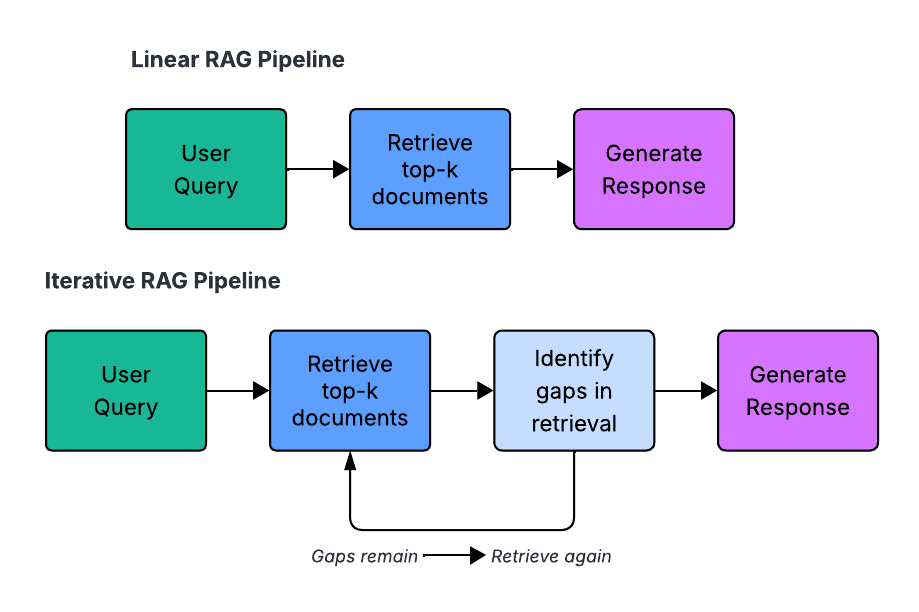
The relationship weakens as pipelines get more iterative. LangGraph -- the most complex pipeline tested, which loops between retrieval and generation, identifies knowledge gaps, and issues new queries -- showed near-zero correlation with retrieval metrics at the system level (r = 0.09) when evaluated on a mismatched benchmark.
This is not necessarily bad news. It means iterative pipelines can partially compensate for a weaker retrieval stack by adapting their queries to what the retrieval model can handle. But it shifts the performance bottleneck: instead of improving the retrieval model, you now need to improve how the LLM interacts with it -- a harder and more expensive problem.
The practical takeaway from the authors is direct: for most applications, a simpler linear pipeline that benefits directly from retrieval improvements is preferable, since improving a retrieval model is generally more economical than fine-tuning an LLM for a specific task.
What this unlocks in practice
The implications for anyone building or evaluating RAG systems are concrete:
- Use coverage metrics, not relevance metrics, when benchmarking retrieval for RAG. Standard nDCG against a relevance qrel is a poor proxy for whether your RAG system will produce complete answers.
- Retrieval benchmarks can substitute for end-to-end evaluation during development, as long as the retrieval task matches the generation objective. Cross-task correlations are still meaningful but weaker.
- Simple pipelines are easier to optimize. If your retrieval stack improves, a linear pipeline will reflect that improvement directly in generation quality. An iterative pipeline may not.
- For multimodal RAG, retrieval quality predicts factual accuracy rather than coverage -- because LLMs tend to rely on parametric knowledge for well-known events rather than retrieved video content.
No code or model weights are released alongside this paper, but the retrieval serving infrastructure used in the experiments -- RoutIR -- is described in a companion ECIR 2026 paper. The benchmarks (TREC NeuCLIR 2024, TREC RAG 2024, and WikiVideo) are all publicly available.
The bottom line: if you are spending significant compute evaluating RAG end-to-end during retrieval development, this paper gives you empirical grounds to stop. Measure alpha-nDCG or subtopic recall against nugget-based labels instead, and save the expensive generation evaluation for final system comparisons.