
Johns Hopkins' ELLA Robot Teaches Kids Vocabulary Autonomously in Real Homes
Johns Hopkins researchers built an autonomous LLM-driven storytelling robot, put it in ten homes for eight days, and measured what preschoolers actually learned.
 Pro
Takeaways
- Johns Hopkins built ELLA, an autonomous LLM-powered storytelling robot for children ages 4-6 at home.
- GPT-5 generates 200-word stories around parent-selected target words and personalized themes; GPT-OSS 120B drives live dialogue.
- Xpress3D pipeline plans time-aligned facial expressions and body gestures from story transcripts using code generation.
- Eight-day deployment with 10 children: 5.9 days active, 13.9 stories on average, statistically significant vocabulary gains.
- Llama-Guard-4-12B moderates generated responses; VAD plus semantic turn-end detection handles conversational timing.
- System is open source with a no-code interface for parents to generate targeted educational content.
Most classroom research on social robots for kids has run on pre-scripted dialogue, a Wizard-of-Oz operator behind a curtain, or a tightly controlled lab setup. A team at Johns Hopkins wanted to see what happens when you drop a fully autonomous, LLM-driven storytelling robot into a family living room and let a four-year-old talk to it for a week. The result is ELLA (Early Language Learning Agent), and the paper is one of the more grounded looks at what generative-AI robotics actually feels like in a real home.
The word gap problem, restated for AI
Vocabulary at age four is a strong predictor of later reading comprehension, and there is a well-known gap between children from different socioeconomic backgrounds. The widely cited word gap illustrates this disparity: by age four, children from lower-income families are exposed to as many as 30 million fewer words than their higher-income peers. Human-led vocabulary interventions work, but they don't scale, which is exactly the gap the authors are trying to fill with an autonomous robot that can run in a home unattended.
Prior robot tutors have leaned on fixed curricula and canned Q&A routines. This limits the scalability of robot-driven interventions and restricts the robot's ability to generate expressive, contextually relevant content and to adapt interaction in response to children's communication and support expressive language use. ELLA's pitch is that generative models finally make open-ended, personalized dialogue feasible on a small home robot.
What ELLA actually is
ELLA is a custom 3D-printed social robot with an animated face and five servo motors driving base rotation, head tilt and rotation, and two arms. Parents pick four target vocabulary words and a set of story themes matched to their child's interests (Minecraft, Rapunzel, dolphins, whatever works). The robot tells at most four stories per day upon request with a goal of teaching four target words per day determined by parents. Each session runs roughly five to six minutes.

Under the hood, content generation is a two-step LLM pipeline. A GPT-5 prompt writes a 200-word story around a fixed exposition-conflict-resolution arc, constrained so the target word appears at least three times and gets both an implicit demonstration and a child-friendly in-story definition. A second GPT-5 call converts that story into a script with three questions in a fixed order: a low-pressure perception question, a story-recall question, and a vocabulary-practice question that pushes the child to use the word in their own life.
Behaviors, not just text
The interesting engineering work is in getting the robot to move and emote in sync with the narration. The team extended their earlier Xpress system into a pipeline called Xpress3D that takes a word-level timestamped transcript and, segment by segment, plans facial expressions and body gestures. A GPT-5 model identifies gesture opportunities (emotion, action, emphasis, spatial language), then compiles high-level descriptions into executable anime.js programs for the face and a time-indexed joint trajectory for the body, with hard limits and minimum-duration constraints so nothing jerks or overshoots.

Live conversation runs on a different model. For each child turn, a GPT-OSS 120B model produces a structured behavior plan choosing a scaffolding strategy plus utterance chunks that each specify text, facial expression with intensity, and a gesture primitive. Constraining the LLM to a banked library of expressions and gestures keeps planning fast and predictable. For safety, generated responses run through Llama-Guard-4-12B, and any unsafe output triggers a regeneration.
Turn-taking is where the team burned a lot of iteration. Early versions had roughly ten-second response latency and kids either talked over the robot or wandered off. The final design combines voice-activity detection with a semantic turn-end detector: ELLA waits up to ten seconds for speech onset, ends the turn after 1.5 seconds of silence, and adds a 0.5-second grace period if the turn-end detector fires. Text-to-speech is chunked so playback starts on the first audio segment.
What happened in ten homes
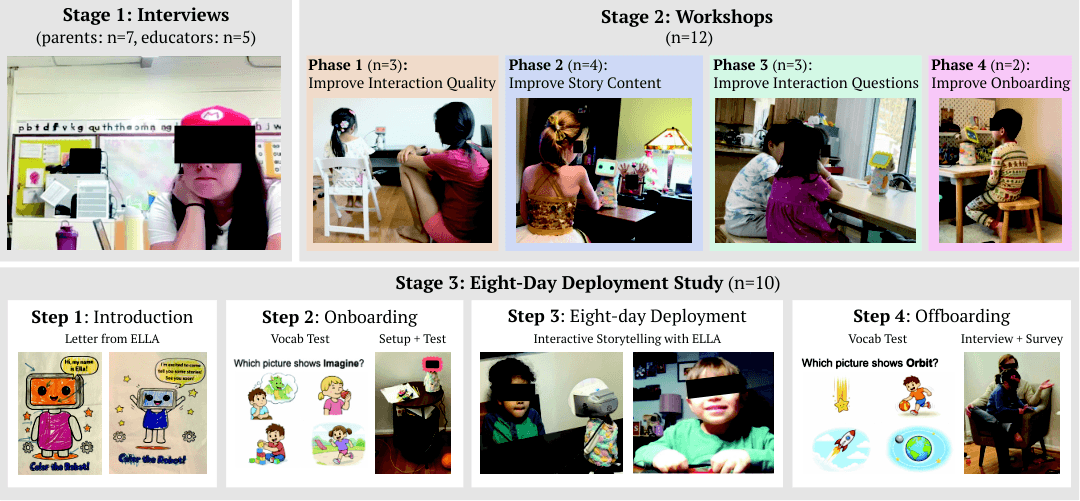
The deployment ran with ten children ages 4 to 6 for eight consecutive days. Children interacted with ELLA on average for 5.9 out of 8 days (SD=2.02, min=2, max=8), and each child engaged with 13.9 stories on average (SD=6.95, min=4, max=30), corresponding to 2.56 stories per active day on average.
Learning outcomes were measured with a Peabody Picture Vocabulary Test-style assessment before and after deployment. On average, each child correctly recognized 2.8 words on the post-deployment PPVT-style assessment (SD = 1.23, Mdn = 3). The pre-to-post gain was statistically significant (Wilcoxon signed-rank, p=.001). Children also grew more verbose over the deployment, with average words per turn rising significantly between days 1-4 and days 5-8.

Where it breaks
The failure modes are worth reading if you're building anything conversational for kids. Speech recognition was the dominant source of interaction breakdowns:
- ELLA would say goodbye and shut down after a child requested another story that the ASR missed.
- The robot occasionally told a child they were wrong when they'd answered correctly.
- Background noise, siblings talking, and multi-speaker households degraded recognition badly enough that some families moved the robot to a bedroom.
- Children read speech-recognition failures as social rejection. One child concluded, in his own words, that ELLA didn't want to talk to him.
Question design also mattered more than expected. Recall questions that referenced earlier story events overwhelmed some four-year-olds. Abstract targets like justice or legal transferred poorly to daily life. And prompts that asked a child to physically demonstrate the target word occasionally suggested unsafe actions (asking a child to demonstrate a somersault indoors), which the researchers had to filter manually.
What is actually new here
Three things stand out beyond the headline of a talking storytelling robot:
- It runs fully autonomously in a real home for eight days, not in a lab with a hidden operator.
- Content is generated per-child from parent-selected targets and themes rather than pulled from a fixed curriculum.
- Behavior generation is decoupled into offline (Xpress3D for storytelling) and online (GPT-OSS 120B with a bounded behavior library for live dialogue), which is a pragmatic way to get expressive multimodal output without runaway latency.
The authors have released the system as open source, along with a no-code interface for generating stories and interaction content. Supplemental materials containing the prompts used by ELLA and additional experimental details are available on the project page. For anyone working on conversational agents for young children, the design opportunities the paper distills, especially around treating multi-party presence as a feature rather than an edge case, and making robot state legible to kids who read latency as rejection, are the most transferable takeaways.