
Johns Hopkins' CorrectionPlanner Cuts Self-Driving Collisions by 20% With Motion Reasoning
A new autonomous driving planner borrows self-correction from LLMs, iteratively rejecting unsafe moves to cut collisions by more than 20%.
 Pro
Takeaways
- CorrectionPlanner adds a propose-evaluate-correct loop to autonomous driving planners, borrowed from LLM self-reflection.
- Corrections happen in motion-token space, using a 1024-token vocabulary of 0.5-second trajectory segments.
- A learned collision critic flags unsafe tokens; rejected ones form a correction trace conditioning the next proposal.
- Trained with imitation learning then RL rollouts inside a frozen reactive world model built on SMART.
- Cuts collision rate over 20% on Waymax and hits state-of-the-art planning scores on nuPlan.
- Code will be released at the authors' GitHub repository upon acceptance.
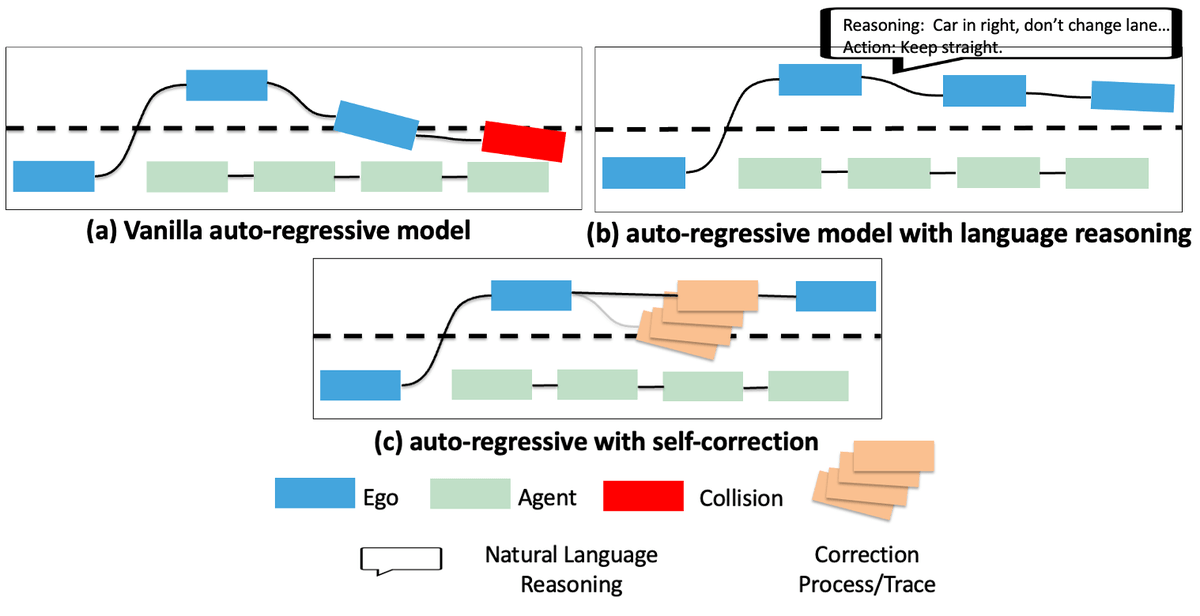
Autonomous driving planners have a blind spot: once the model commits to an action, there is usually no built in way to catch and revise a dangerous one before the car executes it. A team from Johns Hopkins and XPENG Motors is proposing a fix borrowed from the LLM playbook. Their planner, CorrectionPlanner, treats driving as token generation and adds a propose, evaluate, and correct loop that acts like a reasoning trace, but in motion space rather than language.
The results are meaningful. Closed-loop evaluations show that CorrectionPlanner reduces the collision rate by over 20% on Waymax and obtains state-of-the-art planning scores on nuPlan. The code will be released at the authors' GitHub repository.
The gap between predicting and second-guessing
Most learning-based planners work in one shot. They ingest scene context, agents, maps, navigation, and emit either a next action or a full trajectory. These models often lack an internal mechanism to evaluate and correct unsafe actions before execution. If the predicted action would cause a crash, nothing inside the model catches it.
LLM research has been moving in the opposite direction, using explicit chains of thought and self-reflection to catch bad outputs before committing to them. The catch is that such methods mostly perform reasoning and self-reflection in the language space. However, using human language as a medium might not be optimal, as it may not accurately reflect the physical world or lead to redundant reasoning. Natural language is a clunky substrate for describing steering angles and yield decisions.
Reasoning in motion tokens
CorrectionPlanner sidesteps language entirely. Trajectories are discretized into motion tokens, half-second movement segments drawn from a vocabulary of 1024. Continuous trajectories are discretized into motion tokens by segmenting them into 0.5-second intervals and clustering motion segments using a K-disk algorithm based on their average corner distance. This yields a discrete 1024-token vocabulary, where each token encodes a one-step change in position and heading. Planning becomes next-token prediction, in the same spirit as SMART, which the authors build on top of.

The self-correction loop runs at every planning step:
- The policy proposes an ego motion token conditioned on scene history, map, navigation, and predicted agent motions.
- A learned collision critic predicts whether that token will cause a collision within a short horizon (about 2.5 seconds).
- If flagged unsafe, the token is not executed. It is appended to a growing correction trace of rejected tokens.
- The policy generates a new proposal conditioned on the trace, encoded through a self-attention block, and the loop repeats.
- Once the critic gives an all-clear or the correction budget is exhausted, the final token is executed.
The important detail is what happens on step 4. A rejection sampling baseline would just draw again from the same distribution, which tends to land close to the original unsafe token. Here the correction trace itself becomes part of the input, so the correction process changes the conditional distribution of future tokens based on past failures, analogous to multi-step reasoning in LLMs but performed in motion-token space.
Two-stage training with a reactive world model
Pure imitation learning cannot teach a planner how to recover from unsafe proposals because expert data rarely contains recoveries. The authors train in two stages. The first is imitation learning with next-token prediction, which also explicitly exposes the policy to collision scenarios so it starts learning the shape of a correction. The second is model-based reinforcement learning using a frozen world model.
The world model matters. Naive solutions like replaying log trajectories for the agents or predicting all future trajectories first and then planning the ego are non-reactive simulations that ignore the ego's interventions into the agents. They fall apart precisely when self-correction changes the ego's plan. CorrectionPlanner uses SMART as a reactive multi-agent world model so agents realistically respond to the ego's corrected behavior during RL rollouts.

The reward is deliberately spartan: progression relative to the expert trajectory, penalized to zero on any collision. Optimization uses REINFORCE with a KL divergence penalty against the imitation-learned policy, and gradients apply only to the executed token, not the rejected ones in the trace.
What the numbers show
On the Waymo Open Motion Dataset with the Waymax simulator, CorrectionPlanner cuts collision rate to 1.68% in reactive mode and 2.43% non-reactive, against baselines like SMART (2.36 / 4.30), LatentDrive (3.27 / 3.11), and PlanT (2.94 / 3.02). On nuPlan across Val14, Test14-random, and Test14-hard, it edges out DiffusionPlanner and SMART on most splits and settings.
The ablation studies are where the design choices become concrete:
- Turning off self-correction at inference brings collisions back up to the RL-only baseline, confirming that the gains come from the correction loop rather than a stronger backbone.
- Rejection sampling from the original distribution barely helps because repeated actions drawn from the same token distribution tend to remain in a similar region, close to the original unsafe token, so collisions still exist.
- Candidate selection, sampling 10 trajectories and picking the safest with the highest progression, also underperforms the correction trace approach.
- The best trade-off comes at a critic threshold of 0.75 and a correction budget of 5 tokens per step, adding only about 77 ms of latency on an H800 over the base policy.
Where it helps and where it does not
The qualitative behavior is more interesting than pure braking. The planner learns to make wider left turns in advance, yield to right-turning vehicles then re-accelerate, and abort aggressive lane changes. There is a real cost though: progression drops slightly compared to top baselines, because yielding and slowing to avoid collisions is by definition a hit to average speed. The authors argue this is the correct trade-off for safety-critical planning.
The method also has limits. At high critic thresholds, recall drops to 31% and most collisions are missed with too little time to react. At threshold zero, correction fires every step and progression collapses. And the planner can still get stuck in local unsafe regions where no correction budget escapes an unavoidable not-at-fault collision. The critic itself is a binary classifier and the paper flags that a better-calibrated collision predictor is future work.
The broader idea is worth watching regardless of whether this exact planner ships. Reasoning traces in motion-token space give a physically grounded analog to chain of thought, and the same recipe of propose, evaluate, correct could plausibly extend to any robotics setting with a discrete action vocabulary and a learned safety critic.