
Johns Hopkins and NVIDIA's SAW Doubles Rare Surgery Action Recognition With Generated Video
Johns Hopkins and NVIDIA researchers built a surgical video generator steered by tool trajectories, cutting temporal artifacts by more than half versus prior work.
 Pro
Takeaways
- SAW generates surgical action videos from language, one reference frame, an affordance mask, and 2D tool-tip trajectories.
- It cuts CD-FVD to 199.19 versus 546.82 for SurgSora, the previous trajectory-conditioned baseline.
- Built by fine-tuning LTX-Video with IC-LoRA on 12,044 curated laparoscopic clips on a single A100.
- A depth consistency loss using Depth Anything V2 enforces geometry at training time with no depth input at inference.
- Synthetic rare-action clips lifted clipping F1 from 20.93 to 43.14 and cutting F1 from 0.00 to 8.33 on real test data.
- Paper is under review at arXiv; no code or weights released yet.
Training AI to understand or automate laparoscopic surgery runs into the same wall every time: there isn't enough labeled video, and the rare actions that matter most, like clipping a vessel or cutting tissue, barely appear in public datasets. A team from Johns Hopkins and NVIDIA is proposing a way around that with Surgical Action World (SAW), a video diffusion model that generates realistic laparoscopic clips from a handful of lightweight control signals, and then uses those clips to fix long-tail gaps in downstream perception models.
The headline result: SAW achieves state-of-the-art temporal consistency (CD-FVD: 199.19 vs. 546.82) and strong visual quality on held-out test data. CD-FVD is a variant of Fréchet Video Distance designed to penalize temporal inconsistencies rather than reward pretty single frames, so a large drop here means the generated tools and tissue actually move coherently instead of morphing frame-to-frame.
The annotation tax on surgical video models
Prior surgical video generators traded scalability for control. Current video generation methods, the very core of such surgical world models, require expensive annotations or complex structured intermediates as conditioning signals at inference, limiting their scalability. Other approaches exhibit limited temporal consistency across complex laparoscopic scenes and do not possess sufficient realism. HieraSurg leans on per-frame segmentation masks, SG2VID needs spatio-temporal scene graphs, and SurgSora, the closest trajectory-conditioned baseline, has a short 21-frame inference window and drifts on longer laparoscopic dynamics.
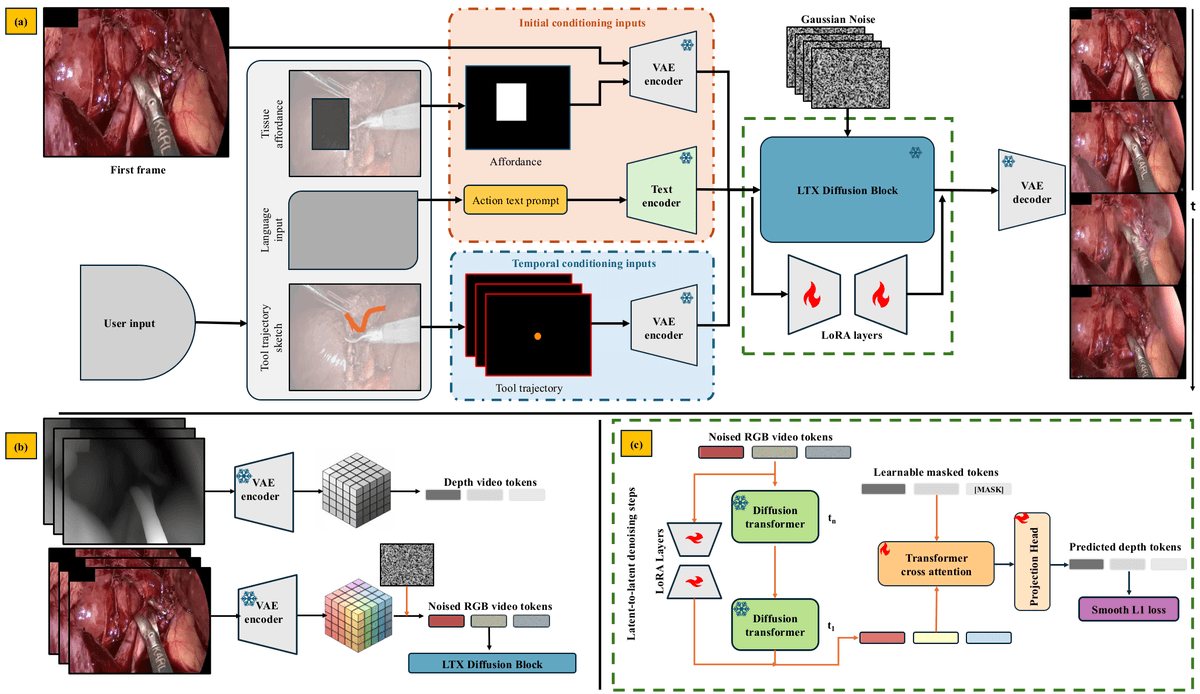
SAW's pitch is that you shouldn't need any of that at inference. The model is conditioned on four signals a user (or a simulator) can plausibly supply:
- A structured language prompt naming the tool and action (e.g. grasper performing dissecting during a cholecystectomy)
- A single reference frame anchoring the scene's appearance
- A 2D binary tissue affordance mask marking where interaction should happen
- A sequence of 2D tool-tip trajectory points across the clip
How the pipeline is wired
Under the hood, SAW fine-tunes LTX-Video, Lightricks' transformer-based latent diffusion backbone, using In-Context LoRA. Each conditioning signal is encoded into the same latent space the RGB video lives in: the affordance map and the trajectory-as-images sequence both go through the VAE encoder, the reference frame anchors the first-frame slot, and the prompt hits LTX's native text pathway. Denoising runs for 50 steps with a guidance scale of 3.5, producing 81-frame clips at 1024x576.
The most interesting design choice is a depth consistency loss that operates only during training. Because all four conditioning signals are 2D, the model has no explicit way to reason about depth, which matters when a scalpel is millimeters from a bile duct. The team generates depth videos for the training set with Depth Anything V2, encodes them into latents, and adds a small cross-attention head that tries to reconstruct masked depth tokens from the denoised RGB tokens. A Smooth L1 loss penalizes mismatches. At inference, no depth input is needed, but the RGB latents have been pushed to encode geometrically plausible motion.

Dataset and numbers
The training corpus is a custom-curated set of 12,044 laparoscopic clips with lightweight spatiotemporal conditioning signals, pulled from 101 source videos across HeiChole, Cholec80, SurgVU, CRCD, and YouTube. Every clip is annotated with the tool, the action (clipping, grasping, cutting, or dissecting), tissue affordance regions, and per-frame tool-tip coordinates. The whole thing is trained on a single NVIDIA A100.
Against baselines, SAW cuts FVD to 224.28 (from LTX-Video's 319.37 and SurgSora's 541.61) and roughly halves CD-FVD versus every competitor. Ablations show trajectory conditioning and first-frame anchoring do the heavy lifting; removing the first frame blows CD-FVD up to 338.75, and dropping the depth consistency loss also degrades temporal metrics even though single-frame FVD looks slightly better.
Where it actually pays off
Two downstream experiments justify the work. First, using SAW to synthesize 287 rare-action clips (110 clipping, 177 cutting) and adding them to the training set for an action recognition model. On a real held-out test set, a spatiotemporal CNN's clipping F1 jumps from 20.93 to 43.14, and cutting F1 rises from 0.00 to 8.33. A ViT baseline sees cutting F1 climb from 30.77 to 47.06. Common classes (grasping, dissection) are unchanged, which is the desired behavior for long-tail augmentation.
Second, the team wires SAW into an Isaac Lab physics simulator. The simulator produces tool segmentations and trajectory points in an empty scene; those are Poisson-blended onto a real background frame and fed to SAW as conditioning. The output is a photorealistic video of the simulated motion interacting with tissue, a step toward closing the sim-to-real gap for surgical robotic policies without hand-modeling deformable tissue physics.

What SAW is not, yet
The paper is explicit about limitations. Clips are fixed at 81 frames, inference is not real-time, and the model doesn't yet enforce instrument joint kinematics, so a fully articulated shaft-and-jaw mechanism isn't guaranteed to move in a mechanically valid way. The training corpus is dominated by cholecystectomy footage, and the demonstrated action vocabulary is four verbs across four tool classes. There is also no public code or model release attached to the preprint, which is currently under review. Follow-up work from the same lineage, such as SurgWorld and Cosmos-H-Surgical, is already extending these ideas toward joint video-action prediction for surgical robot control.
For anyone building surgical perception systems today, the takeaway is that a controllable video generator conditioned on cheap 2D signals is now good enough to move the needle on rare-class recognition. That is a materially different tool than earlier surgical generators that required per-frame masks or scene graphs to run.