
Jilin University's ECHO Beats Neural Solvers and Runs 100x Faster on Fleet Routing
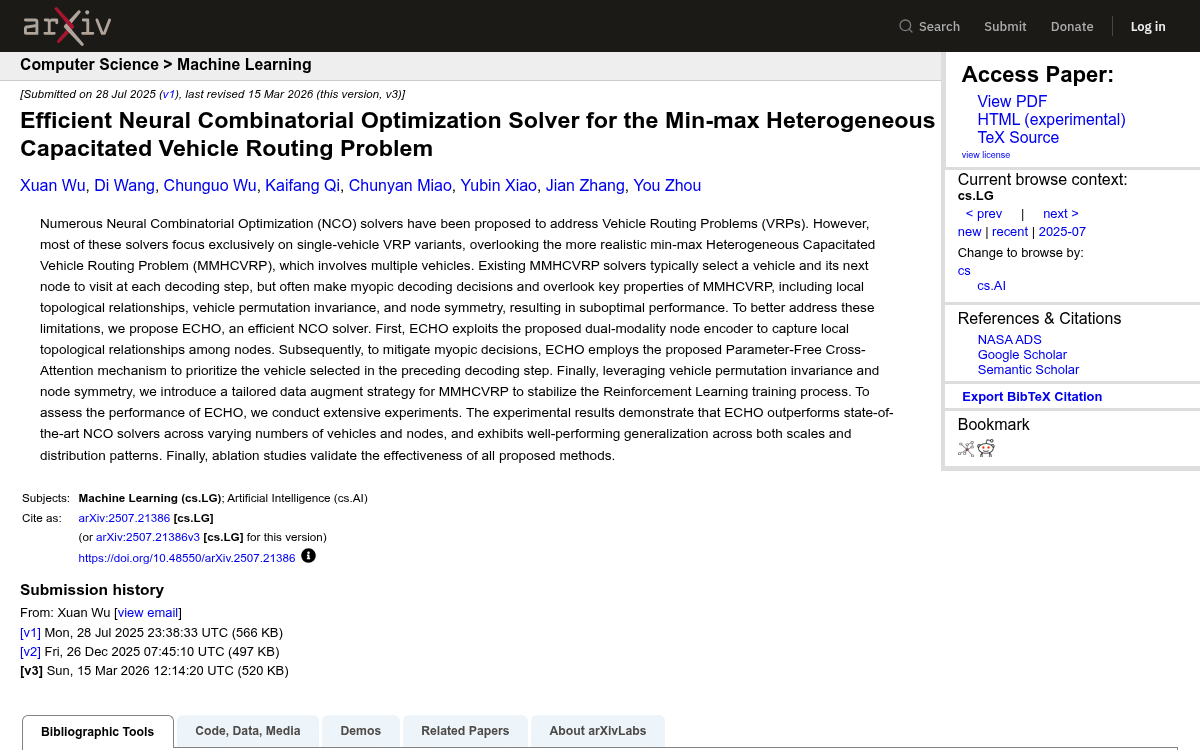
ECHO is a neural solver for min-max heterogeneous vehicle routing that beats prior state of the art by about 3% while running 100x faster than top heuristics.
 Pro
Takeaways
- ECHO is a new neural solver for the min-max heterogeneous capacitated vehicle routing problem, paper here.
- It cuts the average optimality gap by about 3% versus the prior best learned solver PARCO across all tested scales.
- Reaches roughly 1% gap to the SISR heuristic while running over 100x faster per instance.
- Introduces Parameter-Free Cross-Attention that injects the previously selected vehicle into node embeddings to reduce myopic decisions.
- Adds a data augmentation combining eight node reflections with random vehicle-index permutations to stabilize REINFORCE training.
- Code and models are open source at github.com/wuuu110/echo.
Routing a fleet of trucks with different speeds and capacities so that the slowest one finishes as early as possible is one of those problems that looks trivial until you try to solve it. It is called the Min-Max Heterogeneous Capacitated Vehicle Routing Problem (MMHCVRP), and it shows up whenever a dispatcher cares about the last delivery, not the average one. A team from Jilin University and NTU has released ECHO, a neural solver that beats the current best learned methods and gets within roughly one percent of a top classical heuristic while running over one hundred times faster.
Why multi-vehicle routing keeps breaking neural solvers
Neural Combinatorial Optimization (NCO) has become a popular way to attack routing problems. A network learns from many instances, then constructs solutions node by node using GPU parallelism. Most existing NCO solvers focus on either the unconstrained Traveling Salesman Problem or the Capacitated Vehicle Routing Problem with only basic capacity constraints, which strips away the messy parts of real logistics.
MMHCVRP adds two twists that break those assumptions. Vehicles are heterogeneous, each with its own capacity and speed, and the objective is min-max rather than min-sum: fleet operators commonly aim to minimize the longest travel time among all vehicles rather than the total time traveled by the entire fleet. Prior learned solvers for this problem fall into two camps. Autoregressive (AR) solvers like 2D-Ptr pick one vehicle-node pair per step. Parallel autoregressive (PAR) solvers like PARCO let every vehicle pick a node simultaneously, but the resulting high-dimensional joint action space complicates training and may produce suboptimal solutions, and vehicles can collide by choosing the same node.
The authors identify three properties both camps ignore: local topological structure among nodes, the fact that swapping vehicle indices should not change the answer (permutation invariance), and geometric symmetries of the node layout.
Three ideas stitched into one architecture

ECHO is an AR solver with three targeted additions. The reference implementation is available on GitHub.
- Dual-modality node encoder. Instead of embedding only node coordinates and demands, ECHO also embeds the pairwise Euclidean distance matrix and fuses the two via cross-attention. This edge embedding mechanism does not introduce parameters that scale with the number of nodes N, so the same weights transfer to instances of different sizes without padding.
- Parameter-Free Cross-Attention (PFCA). A tiny, weight-free attention block that injects the embedding of the vehicle chosen at step t-1 into the node embeddings at step t. It is essentially
softmax(N Ms^T / sqrt(d)) Ms + N, no new parameters. This nudges the decoder to keep extending the current vehicle's route when that is sensible instead of thrashing between vehicles based on cumulative time alone. - Symmetry-aware data augmentation. Each training instance is expanded eight ways by reflecting coordinates, then vehicle indices are randomly permuted while keeping their intrinsic capacities and speeds intact. This stabilizes REINFORCE with a shared baseline.
What the numbers say
ECHO was benchmarked on instances with 3, 5, and 7 vehicles and 60 or 100 nodes against DRL, 2D-Ptr, PARCO, and classical heuristics including the state of the art SISR. Gap is measured against SISR. Under sampling decoding with 1,280 candidates, ECHO reduces the average gap to 3.65% and 2.54% relative to the AR-based 2D-Ptr and PAR-based PARCO solvers, respectively.
A concrete slice at M=7, N=100: 2D-Ptr lands at a 5.17% gap, PARCO at 2.92%, ECHO at 0.91%. Even under greedy decoding, ECHO matches PARCO's performance in gap achieved with sampling. Compared to the SOTA heuristic SISR, ECHO exhibits an average gap of approximately 1%, while running over 100x faster, taking roughly a second per instance where SISR needs several minutes.
Ablations confirm every piece pulls its weight. Removing the dual-modality encoder inflates the gap from 1.00% to 1.82%, dropping PFCA pushes it to 1.18%, and skipping the vehicle-side augmentation lands at 1.12%.
Generalization and where it breaks
Cross-scale tests are encouraging. Trained on 5 vehicles and 60 nodes, ECHO still hits an objective of 6.78 on the 3-vehicle 60-node setting, essentially matching a 2D-Ptr model trained directly on that configuration. It also holds up when node distributions shift from uniform to clustered or explosion patterns, which the authors attribute to the edge-aware encoder capturing local topology rather than absolute positions.
The honest caveats are worth flagging. ECHO is trained on synthetic uniform instances, and their performance may degrade on real-world instances, because they are predominantly trained on synthetic data with predefined distributions that can be accurately modeled. It also assumes Euclidean distances, which is a poor fit for urban grids where Manhattan distance is more realistic. Anyone deploying this on a real fleet should plan to retrain on route-cost distributions that match their operating environment.
Where it fits in a stack
If you already use classical solvers like OR-Tools or SISR for last-mile fleet planning, ECHO is interesting as a fast approximator that could power real-time re-optimization, what-if simulations, or the inner loop of a larger dispatch system where sub-second decisions matter more than the last percent of optimality. For research work on multi-agent construction policies, PFCA is the cleanest takeaway: adding a parameter-free memory of the previously chosen agent is a small change with an outsized effect on myopic decoding.