
Jiangnan University's GMSF-Net Beats GrNet by Building Subspaces That Pick Themselves
A new Grassmannian deep network dynamically fuses multiple subspaces on a curved manifold, beating single-subspace baselines across action recognition, EEG, and graph tasks.
 Pro
Takeaways
- GMSF-Net replaces static single-subspace Grassmannian networks with adaptive multi-subspace fusion using Fréchet mean optimization.
- Topological convergence proofs guarantee stable Riemannian gradient descent under the projection metric.
- Hits 91.22% on FPHA hand action recognition, beating GrNet by 12.43 points at 5x smaller model size.
- Improves MAMEM-SSVEP-II EEG classification to 66.87%, outperforming EEGNet, MATT, and GDLNet baselines.
- Ablations show random or fixed subspaces drop FPHA accuracy by 8 to 18 points, confirming adaptivity matters.
- Code is open source at github.com/Xua-Yu/GMSF-Net.
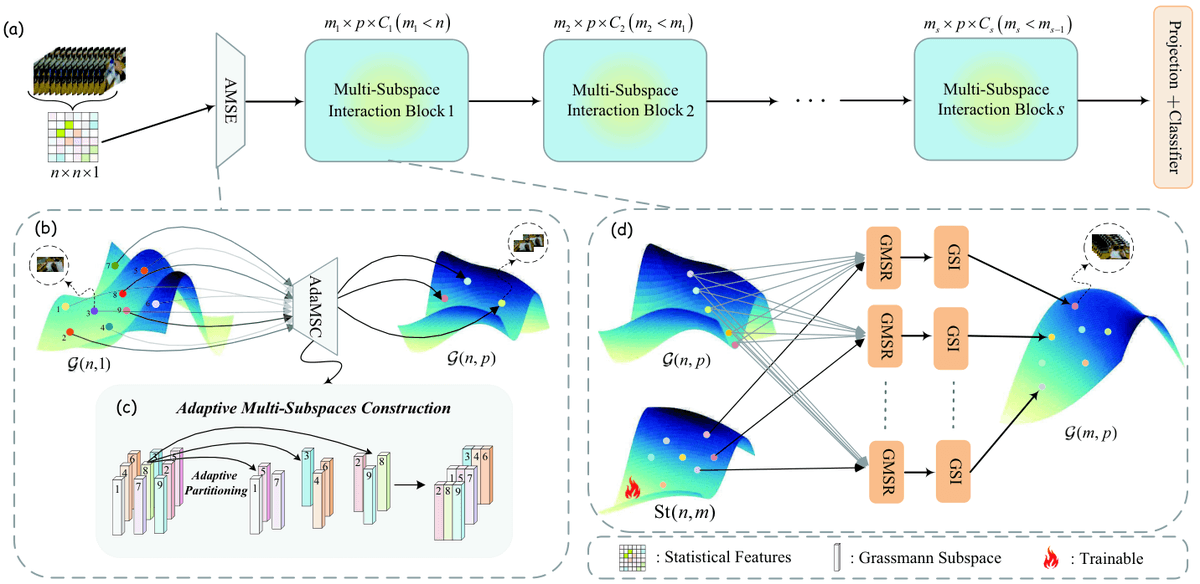
Most deep learning lives comfortably in Euclidean space, where dot products measure similarity and gradients flow through linear layers. But some problems, like comparing video clips of hand gestures or EEG covariance matrices, are better represented as linear subspaces than as vectors. That is the domain of Grassmannian networks, and a new paper from researchers at Jiangnan University argues the field has been leaving performance on the table by relying on a single static subspace per input. Their answer is GMSF-Net, a topology-driven framework that builds many subspaces adaptively and fuses them directly on the manifold.
Why single-subspace models were leaving accuracy on the table
The Grassmannian manifold G(n, p) is the set of all p-dimensional linear subspaces of an n-dimensional space. It has been a useful representation for tasks where the data is inherently a collection of directions rather than a point, including activity recognition, emotion recognition, face verification, and time-series classification in brain-computer interfaces. The dominant approach, established by GrNet, which projects data onto the Grassmannian and follows the manifold's geometric properties to design network layers such as FRMap, OrthMap, and ProjMap, models each input as one fixed subspace.
The authors argue this is limiting. A fixed single-subspace assumption fails to capture local geometric variations and multi-modal distribution, limiting the expressiveness and adaptability of the model in structurally diverse or heterogeneous task scenarios. In Euclidean networks, the whole reason convolutional nets work is that stacking layers with multiple channels lets features interact and specialize. That multi-channel philosophy has not really been ported to manifold-based networks.