
JD Explore Academy's FiberPO Fixes the Math That Breaks LLM Reinforcement Learning
Researchers introduce FiberPO, a policy optimization algorithm that uses fiber bundle mathematics to simultaneously control trust regions at the token, trajectory, domain, and prompt-group levels during LLM reinforcement learning.
 Pro
Takeaways
- Researchers prove the TRPO Vanishing Theorem: classical trust-region guarantees collapse to zero at discount factor γ=1, which is required for LLM training. [paper]
- APC-Obj is derived as the first exact unconstrained reformulation of sample-based TV-TRPO, proving clipping-based surrogates and trust-region optimization are dual formulations of the same problem.
- Fiber Bundle Gating (FBG) organizes sampled RL data as a fiber bundle, decomposing ratio gating into orthogonal trajectory-level (base) and token-level (fiber) components with provable first-order agreement.
- FiberPO introduces a restorative rollback gradient absent in PPO/GRPO/GSPO, with a block-diagonal Jacobian over trajectories and better token efficiency from mean-centered fiber residuals.
- FiberPO-Domain extends the framework to four hierarchical levels (domain, prompt group, trajectory, token) using the algebraic compositionality of fibrations — no new primitives required.
- FiberPO was used in production to train JoyAI-LLM Flash, a 48B MoE model, showing monotonically improving curves even in low-entropy post-alignment settings.
Reinforcement learning for large language models has a dirty secret: the theoretical foundations it borrows from classical RL quietly break down the moment you set the discount factor to 1 , which is exactly what you must do when rewards only arrive at the end of a response. A new paper from researchers at JD Explore Academy and Carleton University confronts this problem head-on, and their solution reaches all the way into algebraic topology to do it.
The discount factor problem nobody talks about
The standard theoretical guarantee behind trust-region policy optimization (TRPO) , the idea that each policy update is provably safe , depends on a discount factor γ strictly less than 1. The trust-region radius is proportional to (1−γ), so as γ→1, the permitted update shrinks to zero. The paper formalizes this as the TRPO Vanishing Theorem: at γ=1, both TV-based and KL-based TRPO trust regions collapse to a single point , the reference policy itself. No update is allowed.
This isn't a minor technicality. LLM tasks like math reasoning and code generation are episodic: a response is either correct or it isn't, and the reward lands only at the end. You cannot discount later tokens without destroying the training signal. So every practical method , PPO, GRPO, GSPO , implicitly operates in a regime where classical theory offers no guarantees.
Unifying the family tree of RL objectives
Before building their new method, the authors establish a common language. They introduce the Ratio Gating Formalism (RGF), a framework that expresses any proximal policy objective as a weighted sum of per-token advantage estimates, where the only design freedom is a ratio gating map that transforms importance-sampling ratios before multiplying by the advantage. PPO, GRPO, and GSPO all fit this template , they just make different choices for that map.
From this vantage point, the authors derive the Aggregational Policy Censoring Objective (APC-Obj), which they prove is exactly equivalent to sample-based TV-TRPO. This is the first time clipping-based surrogate design and trust-region optimization have been shown to be dual formulations of the same problem. APC-Obj then becomes the analytical anchor from which PPO, GRPO, and GSPO can each be derived via identified relaxation steps , making each method's departure from the trust-region optimum explicit and traceable.
The structural gap: single-scale gating
The APC-Obj analysis reveals a shared weakness in all existing methods. Token-wise objectives like PPO and GRPO clip each ratio independently, with no direct control over trajectory-level drift. Sequence-wise objectives like GSPO collapse each trajectory to a single aggregate ratio, suppressing within-trajectory variation. Neither paradigm couples the two scales. The relevant stability criterion , trajectory-level TV divergence , is inherently global, yet gradient information is inherently local.
This is the gap FiberPO is designed to close.
Fiber bundles as a gating architecture
A fiber bundle is a mathematical structure that organizes a space into a base (global contexts) and fibers (local data attached to each context). In the FiberPO framework, sampled RLHF data is organized as a fiber bundle where:
- The base space B consists of trajectory indices paired with sign channels (±1 for tokens whose log-ratio is positive or negative)
- The total space E consists of individual tokens, each attached to its trajectory context
- The bundle projection π_E maps each token to its trajectory
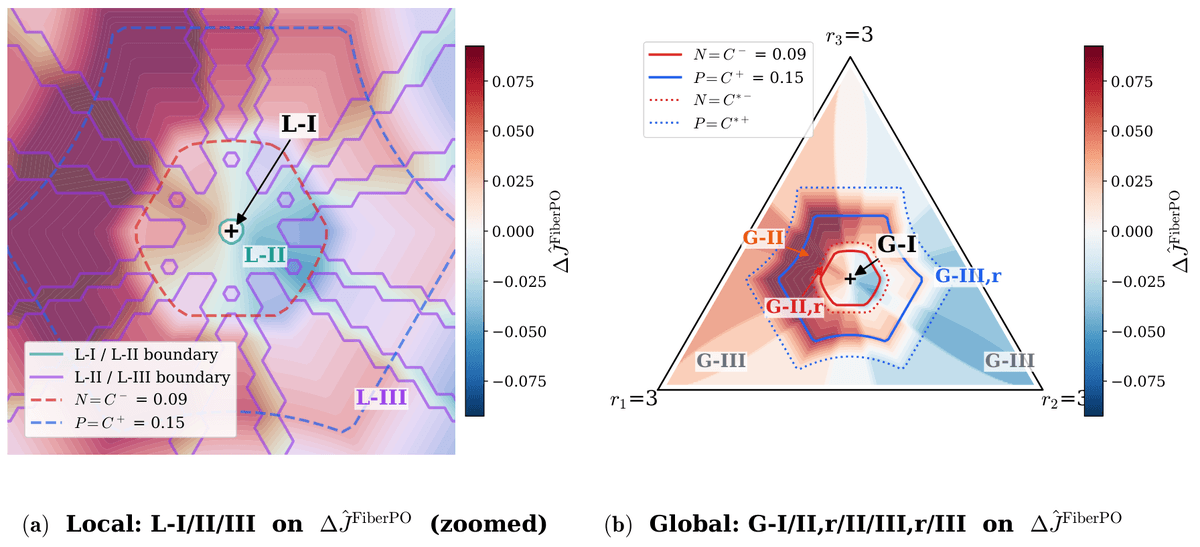
The key operation is Fiber Bundle Gating (FBG): a density-based gating operator that decomposes the ratio signal into orthogonal global and local components. The global component is pushed forward to the base, gated by a trajectory-level gate, and reflected back via a Markov kernel K. The local component is the residual after subtracting the global contribution , pure within-trajectory variation, gated independently by a fiber-level gate. The reflecting condition π_E∗ ∘ K = id_B ensures these two components never double-count: the residual carries zero base-level information.
The paper proves that any FBG instance with atomic gates that reduce to identity at the on-policy point satisfies first-order agreement with the true RL objective , meaning the surrogate has the same gradient as the true objective at the reference policy.
FiberPO: the concrete algorithm
FiberPO is derived from APC-Obj through four controlled steps: δ-relaxation (replacing the vanishing TRPO radius with a tunable hyperparameter), logarithmic approximation (working in log-ratio space for positivity and algebraic convenience), sequence-level aggregation (restricting cross-token coupling to within each trajectory), and clipping decomposition (splitting the single coupled clip into a base gate and a fiber gate).
The resulting per-token gated ratio has a clean multiplicative structure:
# Pseudocode for FiberPO gated ratio at token i in trajectory τ
log_s_plus  = mean(max(log_r, 0))   # positive channel aggregate
log_s_minus = mean(max(-log_r, 0))  # negative channel aggregate
# Base weight: trajectory-level gate (shared across all tokens in τ)
base_weight = exp(g_agg(log_s_plus, C_plus, T_tau)) / \
              exp(g_agg(log_s_minus, C_minus, T_tau))
# Fiber residual: per-token deviation from trajectory mean (sign-channel aware)
fiber_residual = logclip((s_tau_same_sign ** -l_i) * r_i, epsilon) / \
                 logclip((s_tau_opp_sign ** -l_i),        epsilon)
gated_ratio = base_weight * fiber_residual
The aggregate gate g_agg has three regimes: pass-through when trajectory drift is within budget, a rollback regime with negative slope that actively opposes drift, and a zeroed regime when the budget is exhausted. The rollback regime , absent in PPO, GRPO, and GSPO , produces a restorative gradient that pushes drifting trajectories back toward on-policy. The fiber gate clips each token's deviation from the trajectory mean rather than its absolute log-ratio, so well-behaved tokens retain their full gradient signal even when the overall trajectory has drifted substantially.
The Jacobian of the FiberPO ratio transform is block-diagonal over trajectories (no cross-trajectory gradient coupling), reduces to identity at on-policy (first-order agreement), and exhibits the restorative rollback structure described above.
Scaling to arbitrary hierarchy: FiberPO-Domain
Because fibrations compose algebraically, the same two-level construction extends to arbitrary depth without new primitives. The paper introduces the Fibration Gating Hierarchy (FGH) and demonstrates it with FiberPO-Domain, a four-level instantiation:
- Domain level , independent trust-region budget per training domain (math, code, instruction following)
- Prompt group level , budget for each prompt group's deviation from its domain aggregate
- Trajectory level , budget for each trajectory's deviation from its prompt group aggregate
- Token level , per-token residual clipping
Each level gates only the residual drift not already accounted for by coarser levels, so the budgets are orthogonal and non-interfering. This is the first method to provide per-domain and per-prompt-group trust-region control simultaneously.
Real-world validation
The algorithm has already seen production use. JoyAI-LLM Flash, a 48B-parameter MoE model from JD.com, uses FiberPO as its RL training algorithm. The team evaluated FiberPO in a single-domain math RLVR setting and performed a pure algorithmic comparison against GRPO and GSPO, with no additional stabilizers , no curriculum learning, no overlong reward shaping or filters. FiberPO's training and validation curves both rise monotonically in the latter half of training, a behavior that is notably difficult to achieve in low-entropy regimes after extensive SFT and DPO alignment.
What this means in practice
FiberPO is most valuable in three scenarios:
- Multi-domain training , when a single model is trained on math, code, and instruction following simultaneously, different domains drift at different rates; FiberPO-Domain gives each its own budget
- Long-context or agentic pipelines , where trajectory-level drift is structurally more likely and per-token clipping misses it entirely
- Low-entropy models , post-SFT/DPO checkpoints where the policy has little room to move; the restorative gradient helps avoid collapse
The paper does not report benchmark numbers for FiberPO in isolation (the arxiv preprint is theory-focused), and no standalone code repository has been released. The practical hyperparameter surface is also wider than PPO or GRPO: users must choose ε (fiber clip), C⁺ and C⁻ (per-channel budgets), and their ratio. The authors recommend C⁻ < C⁺ to compensate for the intrinsic asymmetry between positive and negative log-ratio channels, but concrete tuning guidance is limited.
The deeper contribution is architectural: by making explicit the fiber bundle structure that already implicitly underlies any method that aggregates per-token quantities into context-level statistics, the paper provides a principled foundation for reasoning about multi-scale stability in LLM RL , one that composes cleanly to arbitrary hierarchical depth.