
Japan's TastePrint 3D Printer Embeds Different Flavors in Each Layer
A programmable airbrush sprays liquid flavors between 3D-printed food layers, letting a single dish carry different tastes in different regions.
Takeaways
- TastePrint airbrushes liquid seasoning between 3D-printed food layers, giving one object multiple flavor regions. Paper
- Custom G-code synchronizes solenoid valves with extrusion paths via a Raspberry Pi 4 controller.
- Python and PyQt6 GUI lets users assign spray positions and intensities per sliced layer.
- Spray-resolution model hit R² = 0.86, spray-amount model hit R² = 0.99 on calibration.
- Tasters correctly localized centralized seasoning patterns in 27 of 40 trials, or 67.5%.
- Validated on edible mashed potato; small user study with three home cooks. Project page
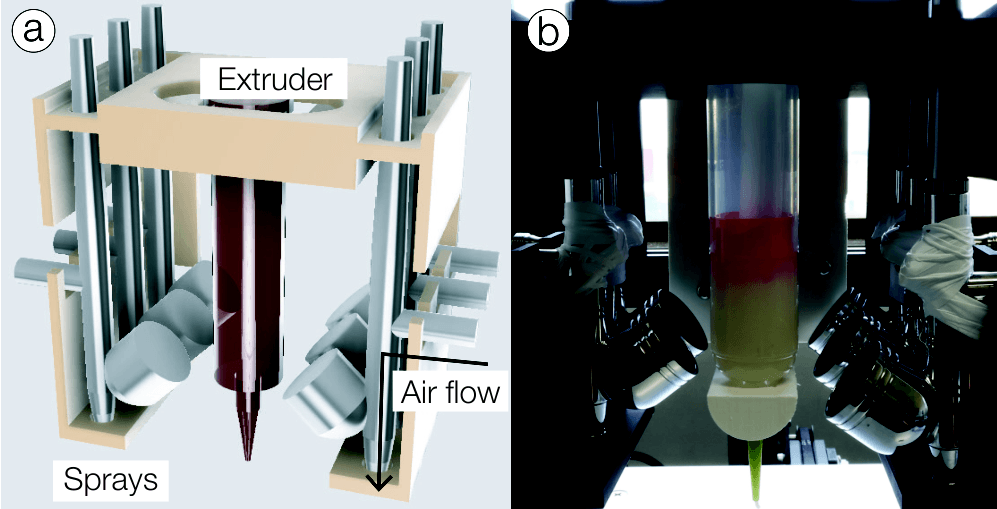
3D food printers can shape food into almost any geometry, but once you bite into the result it usually tastes the same everywhere. A pair of researchers from Japan want to change that with TastePrint, a printing system that fires liquid seasoning through a programmable airbrush between layers so a single printed object can carry different flavors in different regions.
The work, from Yamato Miyatake and Parinya Punpongsanon, treats taste as another parameter you can address in a slicer, much like infill density or wall thickness. According to the project page, the goal is to distribute flavor layer by layer within a single piece of food, decoupling geometry from taste design.
Why uniform flavor is a real limitation
3D food printing lets you customize shape and texture, but it usually produces a single flavor profile because so few printable materials exist. Dual-extrusion setups can swap between two pastes, but mixing many edible inks is messy, slow, and constrained by rheology. That leaves a strange gap: printed food can look sophisticated while tasting flat.
TastePrint sidesteps the ink problem entirely. Instead of blending flavor molecules into the printing paste, it sprays them onto the surface of each freshly deposited layer, then buries them under the next pass of extrusion. The seasoning ends up spatially embedded inside the food.