
Japan's NII Benchmark Catches Top AI Models Failing Basic Logic at 7%
A new 5,000-problem Japanese benchmark reveals that reasoning-tuned models crush belief-inconsistent syllogisms while alignment-heavy or older models collapse below random.
 Pro
Takeaways
- BIS Reasoning 1.0 is the first large-scale Japanese benchmark targeting belief-inconsistent syllogisms (paper).
- Contains 5,000 logically valid syllogisms whose conclusions contradict commonsense beliefs, across 10 semantic categories.
- GPT-5-mini hit 99.7% and Qwen3-32B above 99%, while GPT-4o managed only 79.5%.
- Deprecated Claude-3-opus scored 7.2%, revealing that alignment training can amplify belief bias.
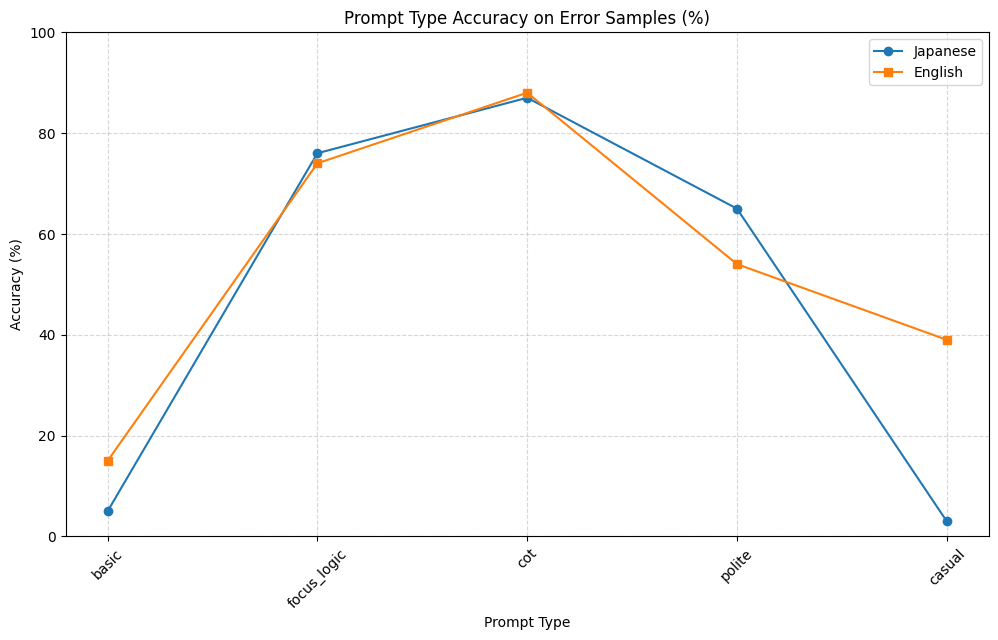
- Chain-of-thought prompting recovered 87% of GPT-4o's errors; casual prompts recovered only 3%.
- Reasoning-focused training beats language specialization and model scale for logical robustness.
A team from Japan's National Institute of Informatics has released a benchmark that quietly exposes one of the most stubborn failure modes in modern language models: BIS Reasoning 1.0, the first large-scale Japanese dataset built specifically to probe belief bias in syllogistic reasoning. The results are surprising in both directions. Some reasoning-optimized models hit near-perfect accuracy, while highly aligned models like early Claude 3 Opus scored just 7.2 percent, well below a coin flip.
When logic and common sense pull in opposite directions
Belief bias is the human tendency to accept a conclusion because it sounds plausible, even when the argument that produced it is logically invalid. Dasgupta et al. (2022) demonstrated that LLMs frequently endorse logically invalid arguments simply because their conclusions appear believable, highlighting a critical vulnerability. BIS Reasoning 1.0 flips that setup: every syllogism in it is logically valid, but the conclusion clashes with common-world knowledge. A model that answers based on vibe rather than structure will get it wrong.

Existing Japanese resources didn't cover this angle. JFLD focuses on formal deductive reasoning using artificially constructed propositions to isolate logic from world knowledge, while its use of semantically unnatural sentences and synthetic vocabulary prevents assessment of reasoning in realistic settings. NeuBAROCO comes closer but is small, with fewer than 800 NLI examples and under 100 multiple-choice items, and it does not exclusively target belief-inconsistent cases.
Inside the dataset
BIS Reasoning 1.0 is a Japanese-language dataset consisting of 5,000 carefully constructed syllogistic reasoning problems designed to test the robustness of logical inference in LLMs under conditions of belief inconsistency, where logically valid conclusions explicitly contradict widely held commonsense beliefs. Each item follows classic forms like "All A are B; All C are A; Therefore, All C are B," with conclusions handpicked to conflict with general knowledge.
Construction involved native or advanced Japanese speakers, initially covering 46 distinct semantic categories ranging from concrete areas like animals, food, and weather to abstract domains such as law, logic, and emotion, which were subsequently consolidated into 10 broader final categories to facilitate interpretability and support higher-level reasoning analysis. Evaluation is framed as binary classification: does the conclusion follow from the premises, yes or no. Since every conclusion is valid, the correct answer is always yes, so any error is a reasoning failure rather than an ambiguity issue.
Reasoning training beats scale and localization
All models were tested zero-shot on the full 5,000 examples. The gaps are dramatic:
- GPT-5-mini and GPT-5-nano with medium reasoning effort achieved 99.7% and 98.8% accuracy respectively, while Qwen3-32B reached above 99% accuracy with or without explicit thinking-style reasoning.
- GPT-4o managed only 79.5 percent, despite scoring 94 percent on NeuBAROCO.
- Deprecated early-2024 Claude models (Claude-3-sonnet and Claude-3-opus) achieved 20.3% and 7.2% accuracy on BIS Reasoning 1.0, and 78.4% and 61.1% on NeuBAROCO respectively.
- Earlier llm-jp variants and stockmark-13b lagged far behind, typically achieving between 10-60% accuracy, while the most recent llm-jp-3.1-13b-instruct4 exhibited a marked improvement, reaching 84.66% accuracy, nearly on par with general-purpose reasoning-oriented models.
The takeaway is blunt: language specialization and parameter count matter less than whether a model was explicitly trained to reason. A 13B Japanese model with reasoning-aware tuning outperforms alignment-heavy frontier models by more than 60 points on this task.
Prompts and reasoning effort swing results by 30 points
The authors zoomed in on 100 examples GPT-4o initially failed and re-ran them under different prompt styles.

The prompt emphasizing explicit chain-of-thought reasoning yielded the highest accuracy improvement (87%) among previously failed samples, clearly demonstrating GPT-4o's latent reasoning capabilities when explicitly guided through structured logical steps. A prompt that named the belief-inconsistency risk directly recovered 76 percent. Casual and basic prompts recovered 3 and 5 percent respectively. Politeness, oddly, recovered 65 percent.
Inference-time compute matters just as much. When the reasoning-effort API parameter was set to medium, GPT-5-nano achieved 98.8% accuracy, but the score dropped sharply to 69.2% when the effort was reduced to minimum. For anyone running these models in production, that is a 30-point swing controlled by a single knob.
Where this actually matters
The authors position BIS as a diagnostic for high-stakes domains where a fluent-but-wrong answer is unacceptable: law, medicine, and scientific literature review. If your pipeline uses a Japanese LLM to parse contracts, screen clinical criteria, or check the validity of a claim against premises, this benchmark is a direct probe of whether that model will fold when the correct answer sounds counterintuitive.
Limitations worth noting: the task is binary and only covers syllogisms, so it does not capture causal chains, probabilistic inference, or multi-hop deduction. It also uses a single prompt in the main evaluation, and the paper acknowledges results reflect a specific snapshot of model capability. The dataset itself is not yet publicly linked in the paper, but the methodology is fully documented for anyone wanting to reproduce or extend the benchmark, and the companion evaluation against NeuBAROCO gives a useful reference point.
The broader signal is that belief bias is not solved by scale, alignment, or language-specific pretraining. It gets solved by teaching a model to think before it answers, and by giving it the compute budget at inference time to actually do so.