
James Cook University's AI Catches Coral Bleaching Alerts Overstating Reef Stress by 75%
A physics-informed neural network fuses satellite temperatures with sparse underwater loggers, revealing that coral bleaching alerts overestimate stress at depth.
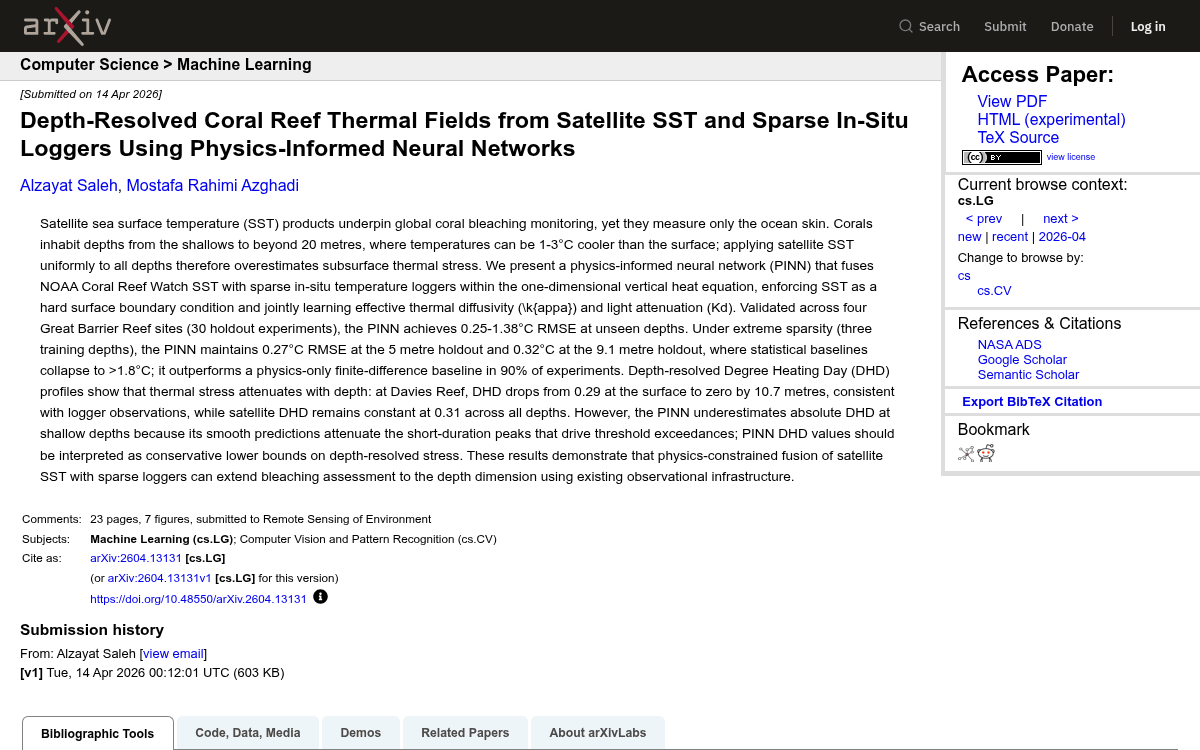
Takeaways
- Physics-informed neural network reconstructs coral reef temperatures at unseen depths from satellite SST plus sparse loggers.
- Achieves 0.25 to 1.38°C RMSE across 30 holdout experiments on four Great Barrier Reef sites.
- Holds 0.32°C RMSE with only 3 training depths where statistical baselines collapse past 1.8°C.
- Outperforms a physics-only finite-difference model in 90% of experiments; learned diffusivities match published reef values.
- Depth-resolved Degree Heating Days show thermal stress vanishes below 10.7 m at Davies Reef, invisible to NOAA Coral Reef Watch SST.
- Underestimates absolute stress at shallow depths due to smoothing, so profiles should be read as conservative lower bounds.
Every coral bleaching alert you have seen on the news traces back to the same source: satellite readings of the ocean's skin. Corals do not just live on the skin, though. They live from the reef flat down to walls beyond 20 metres, where the water can be 1 to 3°C cooler. A new paper argues that applying satellite sea surface temperature (SST) uniformly across those depths systematically overestimates thermal stress on subsurface reefs, and it proposes a fix: a physics-informed neural network trained on a handful of underwater loggers.
The work from researchers at James Cook University targets a concrete gap in operational reef monitoring. NOAA Coral Reef Watch delivers daily 5 km SST for every reef on Earth, and its Degree Heating Week product is the backbone of global bleaching alerts. That product only sees the surface, however, and in-situ loggers on the Great Barrier Reef consistently record cooler temperatures below.
Anchoring a neural net to physics
The core idea fuses two data sources through the one-dimensional vertical heat equation, which says that temperature at depth evolves through a balance of turbulent diffusive mixing and depth-attenuated solar heating. A physics-informed neural network (PINN) has that equation baked into its loss function as a soft constraint, penalising predictions that violate the physics.
Two design choices are worth calling out. Satellite SST is enforced as a