
JAIST's VCRW Robot Walker Lets a Passive Wheel Ride an Active One
A JAIST team proposes viscoelastically-combined rimless wheels, a passive walker built from two cross-shaped frames linked by springs and dampers, with a simulated actuated extension for level ground.
 Pro
Takeaways
- JAIST group proposes VCRW, a passive walker made of two cross-shaped frames linked by eight viscoelastic elements. Read the paper
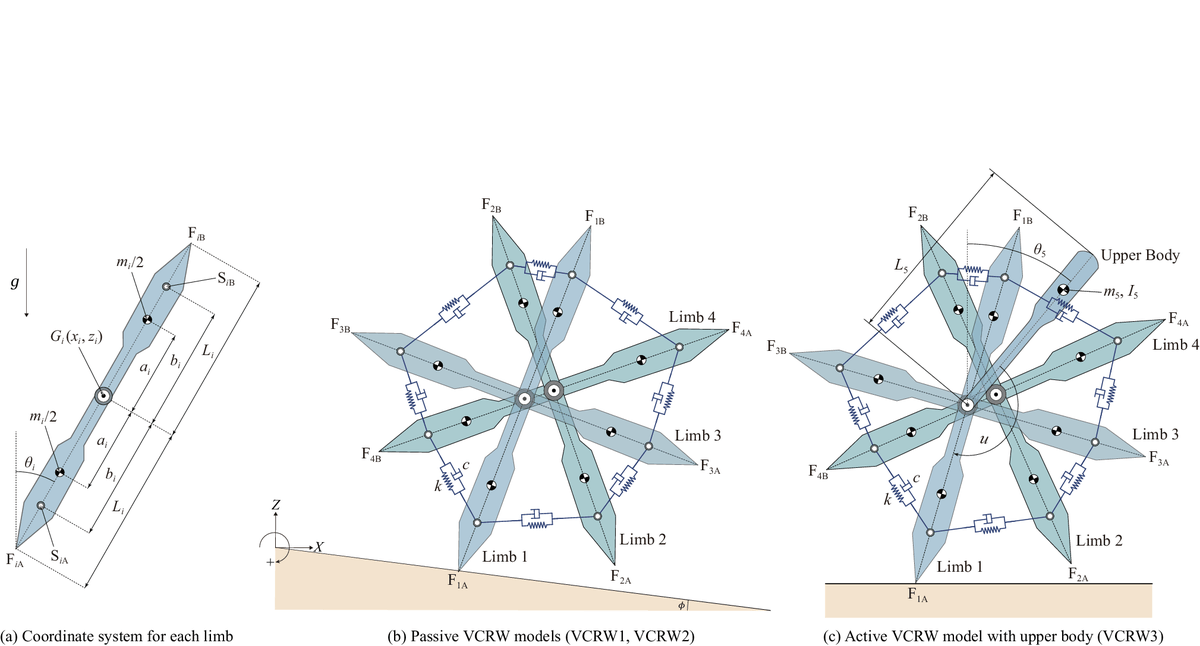
- Two variants studied: VCRW1 uses rigid Greek-cross frames, VCRW2 uses two-link crosses that pivot freely at the hub.
- Both variants generate stable period-1 gaits down a shallow slope in simulation, with a measurable double-support phase.
- An extension called VCRW3 adds an upper-body link and PD-controlled torque to one frame for level-ground walking.
- Authors frame VCRW3 as a theoretical abstraction of support systems like exoskeletons or crutches, not a prototype.
- Purely analytical and simulation-based; no hardware, no released code, no human trials. IROS 2022 record
Rimless wheels have been a favorite toy of walking robotics for decades. Strip the rim from a wheel, and you get a set of rigid spokes that tips forward down a shallow slope in a rhythmic, energy-efficient gait powered entirely by gravity. A team led by Fumihiko Asano at the Japan Advanced Institute of Science and Technology has now extended that classical model with a mechanism that couples two four-legged wheels together through springs and dampers, then studies what kinds of gaits emerge.
The paper, presented at IROS 2022, introduces what the authors call the viscoelastically-combined rimless wheel, or VCRW. The walker is formed by two cross-shaped frames joined by eight viscoelastic elements. The whole study is analytical and simulation-based, aimed at understanding whether the coupled system walks, how it walks, and what happens when you drive one side with a motor.
Two frames, two flavors
The authors introduce two variants. VCRW1 combines two Greek-cross-shaped frames, rigidly locking each cross into a plus sign. VCRW2 uses two-link cross-shaped frames that pivot freely around the central axis, letting each pair of legs rotate independently at the hub. The eight viscoelastic elements act as passive springs and dampers between the two frames, storing and dissipating energy as the walker rocks forward.
The paper lays out the model assumptions, equations of motion, and collision equations, then numerically analyzes the basic gait properties of passive dynamic walking. Collisions matter because every time a spoke strikes the ground, part of the walker's kinetic energy is lost instantaneously. The whole system is modeled as a hybrid dynamical system that alternates between smooth swings and impulsive impacts.