
Iwate University's Framework Spots Unseen Factory Defects Without Any Retraining
A new anomaly detection framework uses low-dimensional subspaces to mimic unseen features, hitting state-of-the-art scores on three industrial defect benchmarks.
 Pro
Takeaways
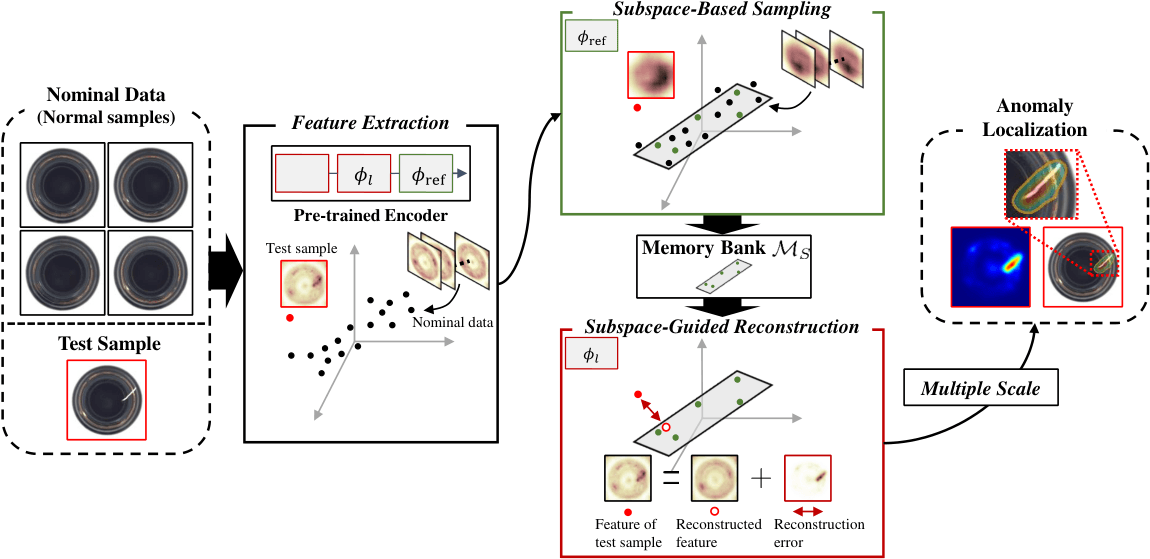
- New framework reconstructs target features from learned subspaces instead of matching against a fixed memory bank.
- Uses orthogonal matching pursuit and a self-expressive model over WideResNet50 features.
- Reaches 50.1 average AP across MTD, BTAD, and MVTec AD, topping PatchCore and DeSTSeg.
- Sparsity-based sampling keeps inference roughly N-independent, cutting per-image time near 40%.
- Stays within 1.5% of full-data performance using only 15% of training samples; beats rivals at 1%.
- Read the full paper on arXiv.
Spotting defects on a factory line sounds like a solved problem, but the hardest part is not detecting scratches you have seen a thousand times. It is flagging the ones you have never seen. A team from Iwate University, University of Toyama, and Okayama University proposes a framework that closes that gap by reconstructing target features from learned subspaces instead of matching them against a rigid memory bank.
The paper, Subspace-Guided Feature Reconstruction, published in IET Image Processing, pushes average precision on three industrial benchmarks past prior memory-bank and simulation-based methods without any dataset-specific training.
Why memory banks trip on unseen defects
Unsupervised anomaly localization tools like SPADE and PatchCore stash deep features from anomaly-free images into a memory bank, then flag pixels in test images whose features do not match anything stored. It is a clean idea, but nearest-neighbor matching on frozen embeddings is non-adaptive, and confidence collapses when a target patch resembles nothing in the finite bank.
Scaling the bank helps only up to a point. As it grows, localization becomes computationally expensive and latency climbs. The alternative, autoencoder-style reconstruction, has its own failure mode: the model gets so good at reconstructing anything you show it that anomalies come out clean too, hiding the defects you wanted to find.