
ItemizedCLIP Beats Medical Imaging AI by Finding Every Lesion at Once
A new contrastive learning framework tackles a blind spot in CLIP: images paired with lists of independent findings instead of overlapping captions.
 Pro
Takeaways
- ItemizedCLIP targets images paired with lists of independent findings, a setting CLIP variants handle poorly.
- Uses cross-attention plus four losses to enforce item independence and full coverage of all findings.
- Beats HLIP by 6.8 points mean AUC on 52-task brain MRI and 9.3 points on 83-task head CT benchmarks.
- Zero-shot performance exceeds linear-probing of specialized head CT foundation models on RSNA and CQ500.
- Enables query-driven attention maps and zero-shot tumor segmentation on BraTS2021 without mask supervision.
- Code and training recipes are available at github.com/MLNeurosurg/ItemizedCLIP.
Most vision-language models are trained under a comfortable assumption: each image is paired with captions that all describe roughly the same thing. That assumption collapses in medical imaging and satellite data, where a single scan or aerial photo is annotated with a list of independent findings that each point to a different part of the image. A new framework called ItemizedCLIP targets exactly this setting, and it beats prior state of the art by wide margins across brain MRI, head CT, chest CT, and remote sensing benchmarks.
The gap CLIP never closed
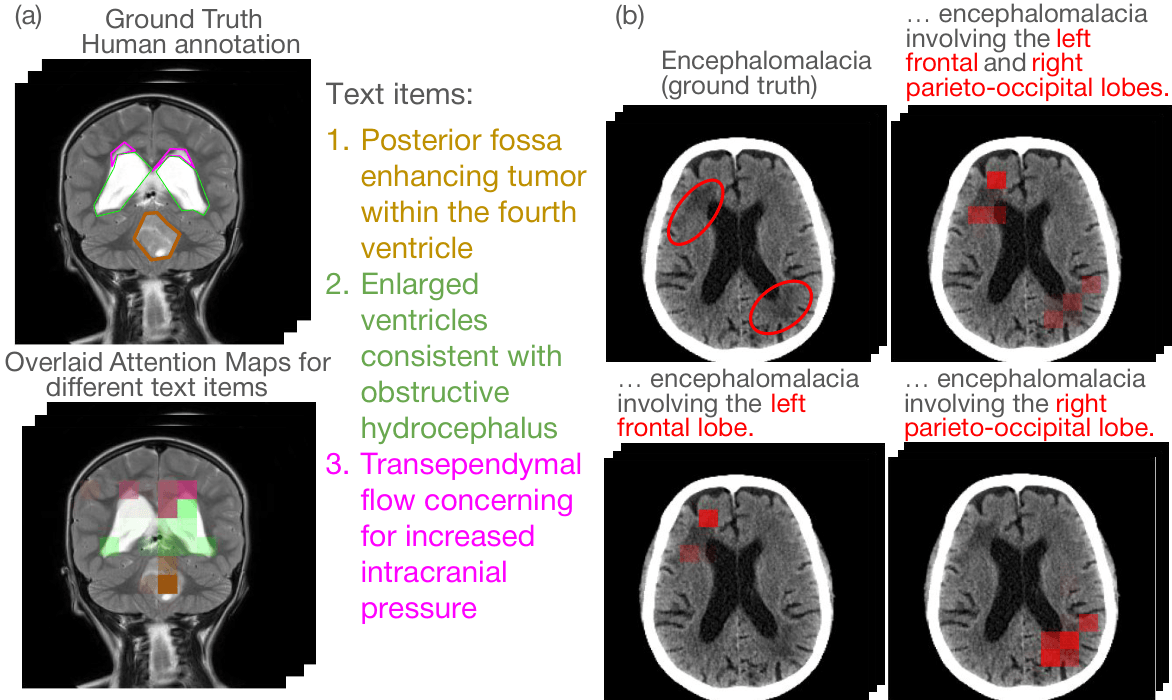
A brain MRI report may list separate findings such as "posterior fossa enhancing tumor," "ventricular enlargement," and "transependymal flow." Those items barely overlap semantically, and each refers to a different spatial region. Under multi-positive text supervision, a model is rewarded for matching an image with any one of its captions, since they all describe similar content. Under itemized supervision, a model must represent every text item simultaneously: omitting any one may correspond to missing a critical finding, such as a tumor or hemorrhage in a brain MRI, leading to a misdiagnosis.
Existing radiology CLIP variants sidestep the structure entirely. Prior models trained for radiology with CLIP-style objectives concatenate all text items into a single caption, discarding the compositional structure inherent in itemized supervision. Multi-positive methods like FLAIR and DreamLIP go the other way, pulling all captions closer together, which is precisely the wrong move when each caption points to a different lesion.

Two properties the authors demand
ItemizedCLIP formalizes what a good representation should look like when supervision is itemized:
- Item independence: different text items should attend to different image regions.
- Representation completeness: the visual embedding must cover every item, not just the easiest one.
Four objectives doing the work
The backbone is standard: a ViT visual encoder and a text encoder, plus a multi-headed cross-attention module with linear qkv projections that produces text-item-conditioned visual embeddings. The novelty is a stack of four objectives that jointly push the model toward the two properties above:
- Itemized Local Alignment (ILA): a SigLIP-style loss between each text item and the cross-attention output over image patches. It adds Upweighting Worst Positive, which increases the loss weight on whichever positive item the model is currently doing worst on, and masked attention that randomly hides visual tokens during training to prevent overfitting.
- Inter-Item Separation (IIS): treats two different items from the same image as negatives of each other, forcing the cross-attention to attend to distinct regions. FLAIR explored an IIS-like objective in its Appendix but abandoned it because it did not work well under multi-positive supervision. The authors found IIS very effective for itemized text supervision.
- Multi-Positive SigLIP (MPS): a lightly weighted global alignment loss between the CLS token and each text item, which the authors found helps downstream classification.
- Key Token Alignment (KTA): takes the top-K attention scores from ILA's cross-attention and runs another alignment loss using only those key tokens, sharpening localization.
Where it lands on benchmarks
The numbers are unusually clean. On the UM220K brain MRI prospective test set (52 diagnostic tasks), ItemizedCLIP hits 90.5 mean AUC versus 83.7 for HLIP, the previous SOTA. On HeadCT240K (83 tasks) it jumps from 75.8 to 85.1. On the public head CT benchmarks RSNA and CQ500, ItemizedCLIP again outperformed zero-shot baselines by a large margin: +9.3% in mean AUC across 83 tasks on the prospective test set and over 5% average gains across all RSNA/CQ500 tasks, compared to HLIP. Its zero-shot performance also beats the linear-probing results of dedicated head CT foundation models like FM-HeadCT, Google-CT, and Merlin.
On chest CT (CT-Rate and Rad-ChestCT), remote sensing (RSICD), and a synthetically itemized natural-image dataset built from CC3M captions, ItemizedCLIP tops every baseline including FLAIR, DreamLIP, and multi-positive SigLIP.
What actually changes for a user
Beyond raw accuracy, the model offers a piece of interpretability that vanilla CLIP-style radiology models cannot: query-driven attention maps. Feed in a text description of a specific pathology, and the cross-attention module returns a heatmap over the volume showing where the model thinks the finding is, without any segmentation supervision. On BraTS2021 the authors even use this to do zero-shot tumor segmentation by keeping the top 30 visual tokens ranked by attention.
The tradeoff is that ItemizedCLIP is genuinely tailored to itemized data. When text is redundant captioning rather than a list of independent findings, FLAIR or multi-positive SigLIP will do fine and the extra IIS and completeness machinery is unnecessary. The authors also flag that they did not test billion-scale pretraining or initialization from strong existing VLMs, so scaling behavior remains open.
Code is on GitHub under the MLNeurosurg org, with per-domain training recipes covering the brain MRI, head CT, chest CT, remote sensing, and natural-image experiments.