
Italian Universities' Dress-ED Benchmark Finally Lets AI Edit Clothes on Command
A new benchmark with 146,000 verified samples brings text-driven editing to virtual try-on and try-off, along with a unified diffusion baseline.
 Pro
Takeaways
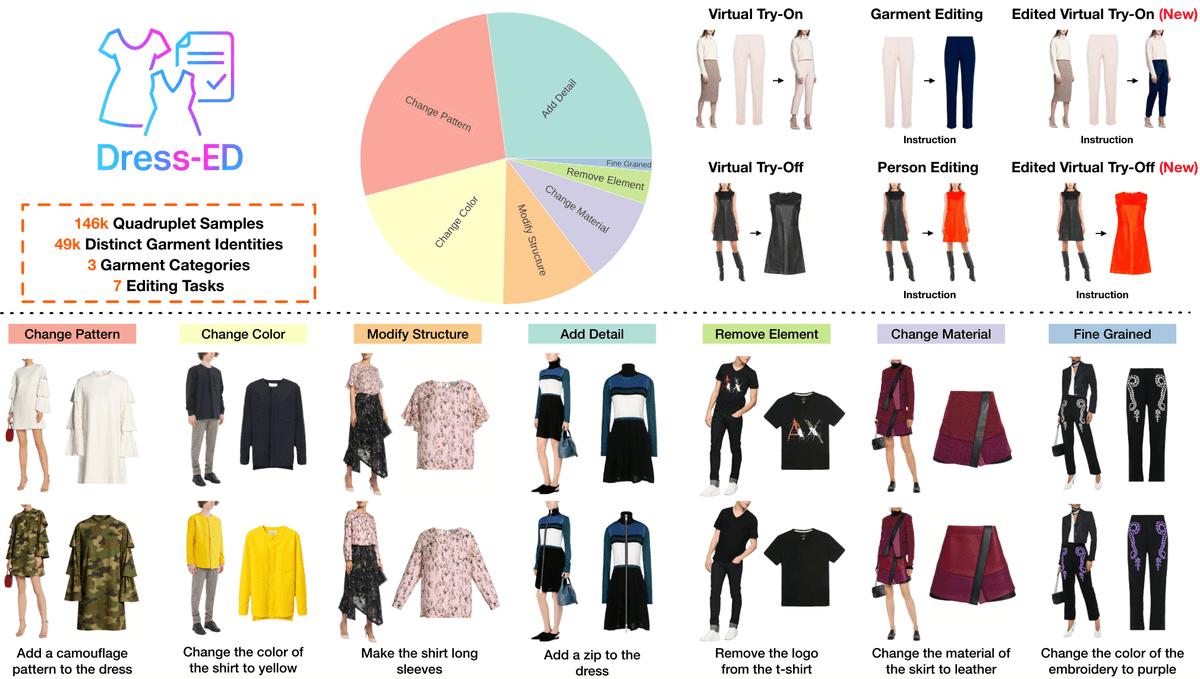
- Dress-ED introduces 146,460 verified quadruplets unifying VTON, VTOFF, and text-guided garment editing in one benchmark.
- Each sample contains garment, person, edited garment, edited person, plus a natural-language instruction.
- Automated pipeline chains Qwen3-VL, FLUX.2 Klein, FitDiT, and GPT-5 with fine-tuned InternVL-3.5 for verification.
- Seven edit types span appearance changes (color, pattern, material) and structural changes (sleeves, neckline, details).
- Dress-EM baseline combines InternVL-3.5, a lightweight connector, and Stable Diffusion 3 DiT.
- Beats CatVTON, Any2AnyTryon, FLUX.2 Klein, and Qwen-Image-Edit on FID, KID, LPIPS, DISTS, and DINO-I.
Virtual try-on has come a long way, but the datasets powering it remain stuck in a rigid mold: fixed pairs of a garment and a person wearing it, with no way to say "make the sleeves longer" or "change the pattern to floral." A team from the Universities of Modena, Trento, and Pisa is trying to fix that with Dress-ED, a large-scale benchmark that fuses virtual try-on (VTON), virtual try-off (VTOFF), and natural-language garment editing into a single dataset, along with a diffusion model called Dress-EM trained on top of it.
Why static datasets have held VTON back
The field splits into three fragmented buckets. VTON datasets focus on person-garment synthesis without editability, instruction-driven datasets support generic image editing but lack consistent garment-person correspondences, and fashion editing approaches tackle narrow sub-tasks without unified benchmarks. Nobody has been able to train or fairly evaluate a model that can, say, take a photo of someone in a striped shirt and render them wearing the same top with a different neckline.
Dress-ED's contribution is a new data structure. Each sample is a quadruplet: an in-shop garment, the person wearing it, an edited version of the garment, and the person wearing the edited version, all tied together by a natural-language instruction. The final dataset contains 146,460 verified quadruplets covering 49,664 distinct garment identities across 7 edit types and 3 garment categories, with a filter accuracy of 95.6% against human judgment.