
Italian Universities Build a Knowledge Graph to Find Drugs for Ultra-Rare AKU
A text-mining pipeline built on PubTator3 turns 165,000 PubMed articles into two knowledge graphs that surface new drug-repurposing hypotheses for an ultra-rare metabolic disease.
 Pro
Takeaways
- Researchers built two knowledge graphs for the ultra-rare disease Alkaptonuria using PubTator3 on 165,000+ PubMed articles.
- The extended network has 27,252 nodes and 261,649 edges; a high-confidence subset has 1,450 nodes and 3,307 edges.
- Validation against STRING, DGIdb and KEGG recovers all curated interactions, mostly via 3-4 hop metabolic paths.
- Analysis surfaces TNF-driven inflammation, SOST/DKK1 bone remodeling and NRF2/KEAP1 oxidative stress as key axes.
- Drug-repurposing candidates include Romosozumab, Denosumab, Metformin, Dimethyl fumarate and Vitamin E.
- Code and JSON graphs available on GitHub for adaptation to other rare diseases.
Rare diseases live in a data desert. When only a few thousand patients worldwide have a condition, the scientific literature is thin, curated databases skip over it, and knowledge graphs used for drug discovery treat it as a blank spot. A team from the universities of Pisa, Siena, Sassari and Bologna decided to fix that for one specific disease, and in the process laid out a reusable recipe for doing it with any other.
Their target is Alkaptonuria (AKU), an ultra-rare autosomal recessive disorder. PubTator3 is a web-based text-mining resource developed and maintained by the National Center for Biotechnology Information (NCBI) to facilitate large-scale information retrieval from biomedical literature. It provides automatic annotation of PubMed and PubMed Central articles with key biological concepts such as genes, diseases, chemicals, variants, species, and cell lines. These annotations are generated using state-of-the-art named entity recognition and normalization methods, and are linked to standardized identifiers from major biomedical databases. The authors chain PubTator3 to a graph-construction and validation pipeline to build a purpose-made knowledge graph (KG) for AKU.
Why rare diseases break standard KGs
AKU is caused by mutations in the HGD gene that block the breakdown of tyrosine, causing homogentisic acid (HGA) to accumulate. Over time this pigments cartilage and connective tissue, driving spondyloarthropathy, kidney stones and cardiovascular problems. The clinical cohort is tiny, so training or querying a large biomedical KG rarely surfaces useful associations. AKU is frequently underrepresented or entirely absent in existing biomedical KGs. Most publicly available KGs and benchmarks focus on common diseases with abundant literature. If you want to prioritize genes or repurpose drugs for a disease like this, you first have to build the graph yourself.
Seed, expand, filter
The construction pipeline is straightforward and reproducible:
- Seed PubMed with three query terms: Alkaptonuria, HGD, and homogentisic acid.
- Run PubTator3 on the retrieved abstracts to pull out entities (genes, diseases, chemicals, variants) and binary relations, each tagged with a confidence score.
- Take the entities most strongly linked to the seeds (average confidence > 0.7), and re-query PubMed with those 188 new terms, filtering out reviews and commentaries.
- Run PubTator3 again on the expanded corpus, discard low-confidence and generic relations, and glue variants to their parent genes.
- Weight each edge by
w = 1 - 2^-n, wherenis the number of supporting publications, so heavily-cited relations saturate toward 1.
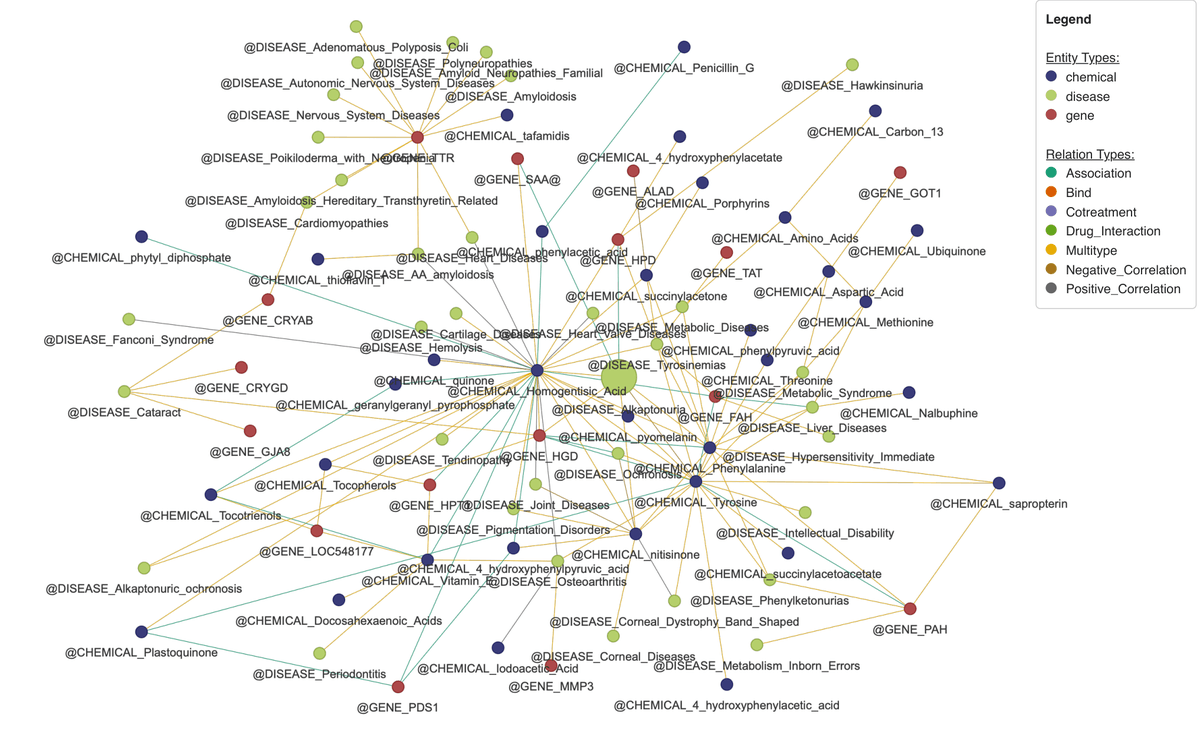
Alkaptonuria, HGD, and homogentisic acid were selected as the initial query terms for PubMed data retrieval. This process yielded 3,812 articles, from which PubTator3 extracted 4,435 unique named entities spanning categories such as diseases, chemicals, genes, and variants. 4,931 unique binary relations were also identified, each with a confidence score between 0.0 and 1.0. After the second expansion round, PubTator3 chewed through roughly 165,000 additional PubMed IDs. The result is two graphs: an extended network of 27,252 nodes and 261,649 edges, and a high-confidence network of 1,450 nodes and 3,307 edges, kept only when a relation appears in at least two independent papers.

Does it match what biology already knows?
The team validates the graphs against three curated resources: STRING (gene-gene), DGIdb (drug-gene) and the KEGG tyrosine metabolism pathway. Direct edge overlap looks low at first, but that turns out to be structural: in these KGs, genes usually connect through intermediate chemicals or diseases rather than directly. When the authors replace direct STRING edges with the shortest path in their graph, every STRING interaction is recovered, at an average path length of 4.1 in the extended network and 3.82 in the high-confidence one. Against KEGG, the fit is even tighter, with 25.9% of edges matching directly and an average path length of 2.56 for the rest. The reading is that AKU's pathology is mediated by metabolic flux more than direct protein binding, which is exactly what you'd expect for an enzyme-deficiency disease.
The hypotheses the graph coughs up
Once validated, the KG becomes a hypothesis generator. The authors use Personalized PageRank and Personalized Katz centrality with AKU as the source, then compute HeteSim scores along Chemical to Gene to Disease meta-paths, plus modularity-based community detection with the Leiden algorithm.
Several coherent themes surface:
- Inflammation axis around TNF, suggesting AKU joint degeneration shares mechanisms with rheumatoid arthritis.
- Bone remodeling via SOST, DKK1 and TNFSF11, which pulls in candidate drugs Romosozumab, Denosumab, Blosozumab and Teriparatide, currently used for osteoporosis.
- Oxidative stress through the NFE2L2/KEAP1 (NRF2) pathway, with Dimethyl fumarate (a multiple sclerosis drug) emerging as a repurposing candidate, alongside Vitamin C, Vitamin E and Thioctic acid.
- Chondrocyte autophagy via PI3K/AKT/mTOR, with Metformin and Sirolimus appearing as mechanistically plausible interventions.
- A TTR-AA amyloidosis cluster that supports the view that amyloid deposition is intrinsic to AKU rather than incidental.
What is actually novel here
The methodology itself is a fairly clean composition of existing pieces: PubMed retrieval, PubTator3 annotation, weighted graph construction, and standard network science. The real contribution is showing that this pipeline recovers essentially all curated knowledge about a rare disease while also generating specific, testable drug-repurposing leads that curated databases miss. The high-confidence network preserves the canonical metabolic core of the disease, while the extended network provides the noisier context needed to spot systemic comorbidities and off-label therapy candidates.
Availability
Both graphs are released as JSON supplementary data, and the analysis code, the two KG JSON files and full functional enrichment results are on GitHub. HTML views of the various subnetworks are linked from the paper's figures, which makes it much easier to poke at specific modules rather than staring at a static PNG. If you work on rare diseases, the pipeline is a reasonable template to adapt: swap the three seed terms for your own, keep the confidence thresholds, and let the second-round expansion do the heavy lifting.