
Italian Researchers Cut Robot Skill Forgetting by 65% on LIBERO
A new lifelong imitation learning method replays compressed latent features and enforces angular separation between tasks, cutting robot forgetting by up to 65 percent on LIBERO.
 Pro
Takeaways
- New lifelong imitation learning framework sets state of the art on LIBERO robot manipulation benchmarks.
- Multimodal Latent Replay stores compact vision, language, and state features instead of raw trajectories.
- Incremental Feature Adjustment uses angular margin loss to separate task embeddings and cut forgetting.
- Reports 10-17 point AUC gains and up to 65% less forgetting versus prior leading methods.
- Uses frozen CLIP encoders during lifelong stage, avoiding PEFT tuning of the vision backbone.
- Code is open source at github.com/yfqi/lifelong_mlr_ifa.
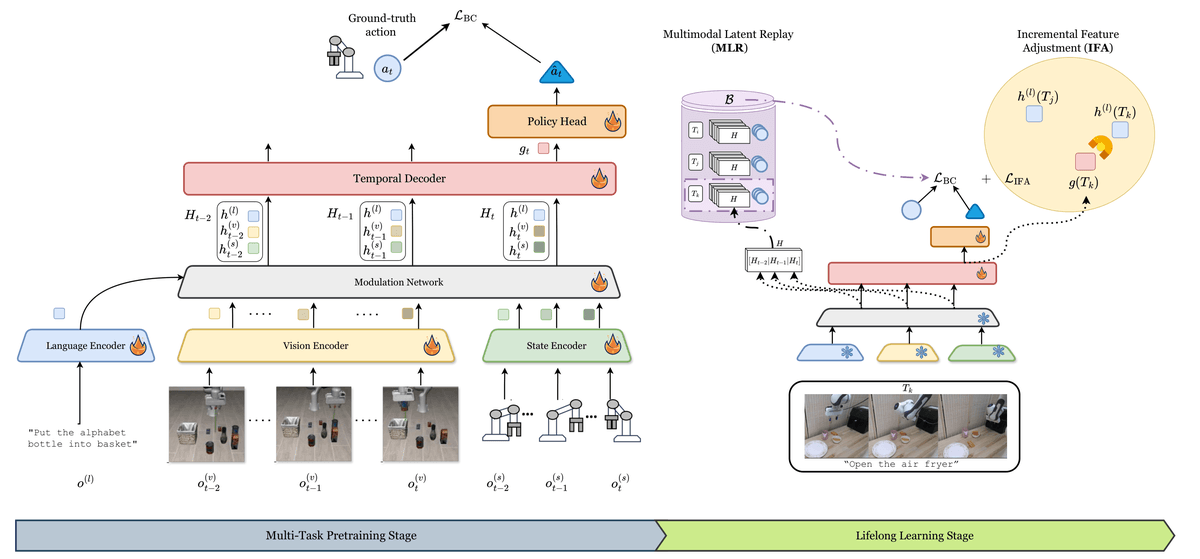
Teaching robots new skills without making them forget old ones is one of the messier problems in embodied AI. A team from Istituto Italiano di Tecnologia and the Universities of Genoa and Verona has proposed a lifelong imitation learning framework that pushes the state of the art on the LIBERO robot manipulation benchmark by combining two ideas: replay in a compact multimodal latent space, and an angular loss that keeps task representations from smearing into each other.
The forgetting problem in robot policies
Imitation learning lets a robot copy expert demonstrations, but standard setups assume a fixed catalog of tasks. Real environments keep serving up new objects and goals, and naive fine-tuning causes catastrophic forgetting, where new training overwrites what the network previously knew. The paper tackles the harder task-ID agnostic version of the problem: at test time the robot does not know which task it is being asked to do, so tricks like swapping in a task-specific adapter are off the table.
LIBERO is the standard testbed here. It ships tasks like "Open the top drawer of the cabinet and put the bowl in it" along with agent-view cameras, an eye-in-hand camera, proprioceptive state, and language instructions. The authors evaluate on three suites: LIBERO-OBJECT, LIBERO-GOAL, and the much larger LIBERO-50.
Replaying features, not pixels
Prior rehearsal methods store raw trajectories, which balloons memory and drags training. This work instead stores what it calls Multimodal Latent Replay, or MLR. Instead of storing past trajectories with the associated ground truth action, it maintains a compact buffer of multimodal latent representations produced by frozen encoders that fuse vision, language, and robot state.
The base policy stack is fairly conventional: CLIP image and text encoders as the vision and language backbones, a two-layer MLP as the state encoder, and a GPT-2 decoder as the temporal decoder, with FiLM layers modulating visual and state features using the language embedding. During the lifelong stage only the temporal decoder and the policy head are updated. Everything else stays frozen, which is a notable departure from methods that continue LoRA-tuning CLIP as new tasks arrive.

Angular margins for task separation
Replay alone still lets similar tasks collide in the shared embedding space, so the authors add Incremental Feature Adjustment (IFA). The idea is a triplet-style loss defined on angular distances: for each new task, its global latent should sit closer to its own reference embedding than to any previously learned task's reference, by at least some margin.
Two design choices matter. First, the reference for each task is its language embedding, which is fixed and does not drift during training. Second, the margin is not a fixed hyperparameter; it scales with the arccos distance between task references, so semantically distant tasks get pushed apart harder than near-duplicates. IFA is only applied to task pairs that simultaneously fall within the top 50% of most similar pairs in both modalities (agent view and language), targeting the collisions that actually cause interference.
The numbers
Across all three LIBERO suites, MLR + IFA sets new bests on forward transfer (FWT), area under the curve (AUC), and negative backward transfer (NBT, which measures forgetting). A few concrete comparisons:
- LIBERO-GOAL: AUC jumps from 60.5 (ISCIL) to 77.2, while NBT drops from 19.4 to 6.9, a roughly 65% reduction in forgetting.
- LIBERO-OBJECT: AUC of 79.4 vs 69.0 for M2Distill, with FWT reaching 84.6.
- LIBERO-50: AUC of 56.1 vs 45.0 for LOTUS on the hardest 50-task split, where M2Distill does not report numbers.
Ablations back up each design choice. Replacing the language-based reference with the mean of global latents hurts performance, using cosine distance instead of angular distance produces higher variance, and dropping FiLM conditioning tanks forward transfer. LoRA-only fine-tuning of the temporal decoder also underperforms full fine-tuning by a wide margin, which is a useful counterpoint to the current PEFT-everywhere trend.
What is useful and what is not
The framework is well-suited for continual robot learning setups where you have a fixed pretrained multimodal backbone, limited memory for a replay buffer, and no task-ID at inference time. The authors report that at a 0.5 store probability the buffer for LIBERO-OBJECT takes 188MB, dropping to under 40MB at a 0.1 probability with only modest performance loss.
Limitations are worth flagging. The evaluation is entirely in LIBERO's simulated kitchen; there is no real-robot deployment, no long-horizon composition beyond what LIBERO-50 tests, and no cross-embodiment work. IFA also does not help when two tasks are genuinely almost identical, since the adaptive margin shrinks with them. The code is on GitHub for anyone who wants to plug MLR and IFA into their own lifelong learning pipeline.