
ISTA Proves Two AI Models Trained Separately Share the Same Hidden Space
A new theory shows that adding independent components analysis to any standard autoencoder yields state-of-the-art disentanglement, no exotic training required.
 Pro
Takeaways
- New theory splits representation identifiability into statistical (consistent across runs) and structural (matches true latents), with ε-near-identifiability definitions.
- Proves intermediate-layer representations of MAEs, GPTs, and supervised nets are identifiable up to rigid motion when decoders are bi-Lipschitz.
- Applying FastICA to latents reduces the ambiguity to a signed permutation and recovers true factors when factors are independent.
- Vanilla autoencoder + ICA matches or beats β-VAE, β-TCVAE, and BioAE on Shapes3D, MPI3D, Falcor3D, and Isaac3D disentanglement.
- Applied to OpenPhenom cell microscopy embeddings, ICA improves out-of-distribution perturbation classification and disentangles batch effects from biology.
- Full paper on arXiv; theorems cover masked autoencoders, GPTs, supervised learners, and encoder-decoder architectures.
Anyone who has trained a self-supervised model twice from different seeds knows the strange result: the loss curves look identical, the downstream benchmarks match, but the latent vectors look nothing alike. A new paper from researchers at the Institute of Science and Technology Austria and the Chan Zuckerberg Initiative pins down exactly why that happens, and turns it into a practical recipe. Statistical and structural identifiability in representation learning proves that a broad class of models produces representations that are the same up to a rotation, and shows that a decades-old algorithm, linear independent components analysis (ICA), can strip that rotation away.
Two ideas people kept confusing
The word "identifiability" gets used to mean two different things in the representation-learning literature, and the paper's first contribution is to separate them cleanly. Statistical identifiability is the condition that optimizing a given representation learning model will yield the same representations up to some simple transformation, while structural identifiability is the condition that optimizing yields a particular representation every time, corresponding to some latent component of the data-generating process.
The other move is to relax exact equality. Real networks never converge to identical points, so the authors introduce an error tolerance ε and define near-identifiability. Two representations count as ε-near-identifiable if they agree up to a simple group of transformations (rotations, linear maps, or signed permutations) plus a small distortion of size at most ε in the L∞ sense.
The main theorem, in plain terms
Prior work by Roeder and colleagues had shown that the penultimate layer of exponential-family models like GPTs is identifiable up to a linear transformation. That covers the very last layer of language models and supervised classifiers, but nothing else. This paper extends the result to intermediate layers of a much wider class of models, including masked autoencoders, vanilla autoencoders, and supervised networks.
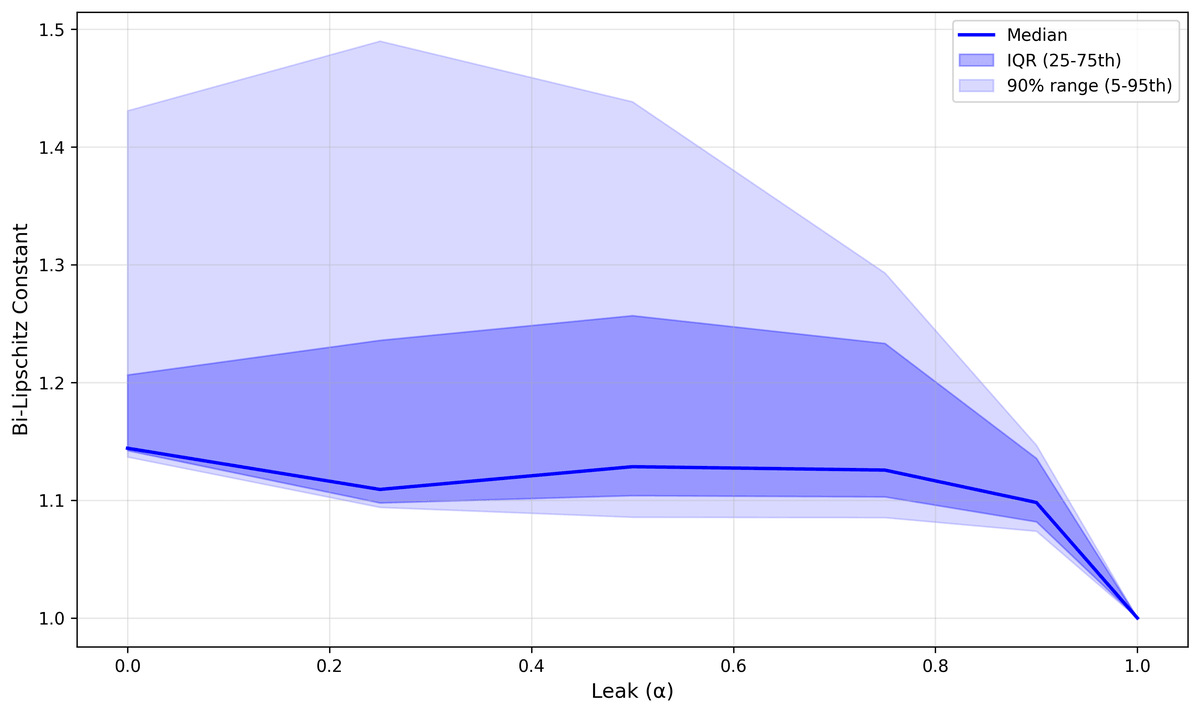
The trick is a smoothness condition on the decoder. If the mapping from an internal representation to the final output is locally bi-Lipschitz, meaning small changes in the latents produce proportionally small changes in the outputs (with a constant of roughly 1+L), then two independently trained networks will produce internal representations that agree up to a rigid motion, with the error scaling as roughly √(2L + L²). A bound on the local bi-Lipschitz constant is small when small changes in the latent variables result in small changes in the outputs of the network. The good news is that many standard regularizers, including weight decay, spectral normalization, and residual connections, push networks toward this "dynamical isometry" regime.

To validate this on real networks, the authors trained pairs of MNIST autoencoders with LeakyReLU activations, sweeping the leak parameter α to control the decoder's bi-Lipschitz constant. As α approaches 1 and L approaches 0, the alignment error between the two latent spaces shrinks in exactly the shape the theorem predicts, and this happens even when reconstruction is imperfect.
ICA cleans up the rotation
A rigid rotation is still an annoying indeterminacy, because it means individual latent dimensions have no consistent meaning across runs. The paper's second theorem shows that applying whitening followed by contrast-function ICA, such as FastICA, to the latent space reduces the remaining ambiguity to a signed permutation. Under an additional assumption on the data-generating process, namely that the true latent factors are independent, non-Gaussian, and generated by a bi-Lipschitz mapping, this same procedure recovers the true factors themselves, which is the classical goal of disentanglement.
The practical recipe is small enough to write down:
from sklearn.decomposition import FastICA
# z: (N, D) latent vectors from any trained encoder
ica = FastICA(whiten="unit-variance")
z_disentangled = ica.fit_transform(z)
Measuring alignment in off-the-shelf models
The authors then tested the theory on pretrained models pulled from the wild. They compared pairs of independently trained Pythia-160M language models, MAE image encoders, CheXpert medical imaging models, and ResNet-18 classifiers, measuring how much the average L2 error shrinks as they allow richer alignment transformations.
| Model pair | Permutation | Rigid | Linear | ICA (% efficiency) |
|---|---|---|---|---|
| Pythia-160M | 0.219 | 0.150 | 0.131 | 0.202 (25%) |
| MAE-timm → MAE-original | 0.197 | 0.109 | 0.036 | 0.145 (59%) |
| CheXpert | 0.218 | 0.104 | 0.048 | 0.175 (38%) |
| ResNet-18 | 0.382 | 0.206 | 0.175 | 0.312 (40%) |
For MAE pairs, ICA recovers about 59% of the alignment quality of a fully supervised rigid fit, without ever seeing paired examples.
State-of-the-art disentanglement from a plain autoencoder
The disentanglement experiments are where the theory pays off. The authors trained vanilla autoencoders on Shapes3D, MPI3D, Falcor3D, and Isaac3D, varying only weight decay, and then applied FastICA to the latent space. On the InfoMEC benchmark suite, this simple pipeline matches or beats specialized architectures like β-VAE, β-TCVAE, and BioAE across the four datasets. The aggregated modularity score reaches 0.65 for AE+ICA versus 0.59 for β-VAE.
A real payoff in cell microscopy
The most compelling demonstration is on RxRx3-core, a cell-painting dataset where images of perturbed cells are corrupted by "batch effects", technical variation from microscopes, plates, and experimental conditions that has nothing to do with biology. The authors took OpenPhenom, a foundation-scale masked autoencoder for microscopy, and applied whitening plus ICA to its patch embeddings.
On an out-of-distribution perturbation classification task, held out at the plate level, ICA consistently improved AUROC across six gene perturbations. For CYP11B1, base embeddings scored 0.663, PCA whitening bumped it to 0.692, and PCA+ICA reached 0.709. A random rotation applied after whitening barely helped, confirming that ICA finds a meaningful axis alignment rather than just any orthogonal frame. The information relevant to biology was also more concentrated: the top 25% of ICA features carried 38.6% more predictive signal than the bottom 75%, versus 16.3% for the raw embeddings.
What it does not solve
Two caveats matter. First, the bi-Lipschitz assumption is difficult to verify empirically on large networks; the paper relies on the plausible but indirect claim that common regularizers induce it. Second, structural identifiability, meaning recovery of the actual data-generating factors, still requires perfect reconstruction from the encoder-decoder model and independence of the true factors. Statistical identifiability, which is the weaker "two runs give the same representation" property, needs neither.
The bigger implication is that a lot of the architectural machinery invented specifically for disentanglement, quantized latents, total-correlation penalties, biological constraints, may be doing work that a standard autoencoder plus a post-hoc linear method can already do. And for foundation models being pretrained today at enormous cost, this suggests that meaningful, aligned latent axes might be waiting inside them, one FastICA call away.