
IQuest-Coder-V1 Matches Claude on Coding Tasks as an Open Model
A new open-weight code model family trains on repository commit histories and ships full checkpoint chains, matching frontier proprietary systems on agentic coding benchmarks.
 Pro
Takeaways
- IQuest-Coder-V1 releases 7B, 14B, 40B, and 40B-Loop code models with full checkpoint chain open-sourced.
- Code-Flow training uses repository commit triplets (R_old, patch, R_new) instead of static file snapshots.
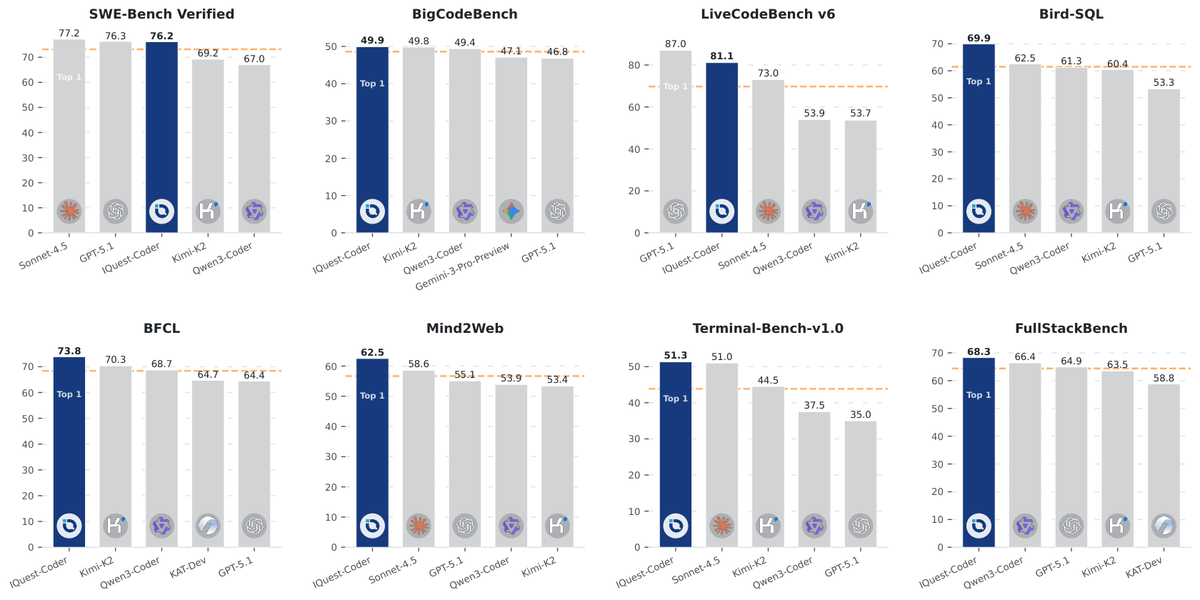
- 40B-Loop-Instruct hits 76.2 on SWE-bench Verified, matching Claude Sonnet 4.5 and GPT-5.1 tier.
- LoopCoder architecture reuses transformer blocks in two iterations with gated global-plus-local attention for extra depth.
- Bifurcated post-training produces Thinking models via reasoning RL and Instruct models via SFT-plus-RL.
- All variants natively handle 128k context; weights on Hugging Face, vLLM-ready.
A new family of open-weight code models has landed with a training recipe that treats software less like a pile of text files and more like a moving system that evolves through commits. The IQuest-Coder-V1 release spans four variants and pushes into scores that until recently were the exclusive territory of closed frontier models.
The series ships in 7B, 14B, 40B, and 40B-Loop sizes, each available in both an Instruct build for general assistance and a Thinking build tuned with reasoning-driven reinforcement learning. Weights, intermediate checkpoints, and evaluation code are on Hugging Face and GitHub, with the authors explicitly framing this as a white-box release for research on how coding agents actually learn.
Why static code data hits a wall
Most code LLMs learn from snapshots: a file scraped at a moment in time, stripped of the history that produced it. That works for autocomplete and short function generation, but a wide gap remains between open-weight models and proprietary leaders like Claude 4.5 Sonnet, most visible in long-horizon reasoning and navigating complex, multi-file codebases. Fixing a real bug rarely looks like producing one file from scratch. It looks like reading three files, running a test, editing a fourth, and iterating.
The core idea in this report is to train on the flow of software rather than only its state. During pre-training the team constructs triplets of the form (R_old, patch, R_new), where R_old is the codebase at a stable development phase, the patch captures the diff, and R_new is the state after the changes. To avoid noise from early prototypes or late-stage churn, starting points are drawn from the 40 to 80 percent range of a project's lifecycle, when the codebase is relatively stable. The team's first finding is that this commit-flow signal beats training on static snapshots for task planning.
A four-stage evolutionary pipeline
The training recipe, which the authors call Code-Flow, is a sequence of specialized phases rather than a single mixed corpus. The pillars are: