
InternLM's JanusCoder Beats GPT-4o at Turning Screenshots Into Working Code
InternLM's new open model suite unifies chart-to-code, web UI generation, and Manim animation into one visual-programmatic interface
Takeaways
- InternLM released JanusCoder and JanusCoderV, open 7B-14B models unifying chart, web UI, and animation code generation: GitHub
- Trained on JanusCode-800K, the largest multimodal code corpus assembled to date, spanning 11 task categories
- Data toolkit uses Guided Evolution, Re-Contextualization, Reverse Instruction, and Bidirectional Translation with VLM-based reward filtering
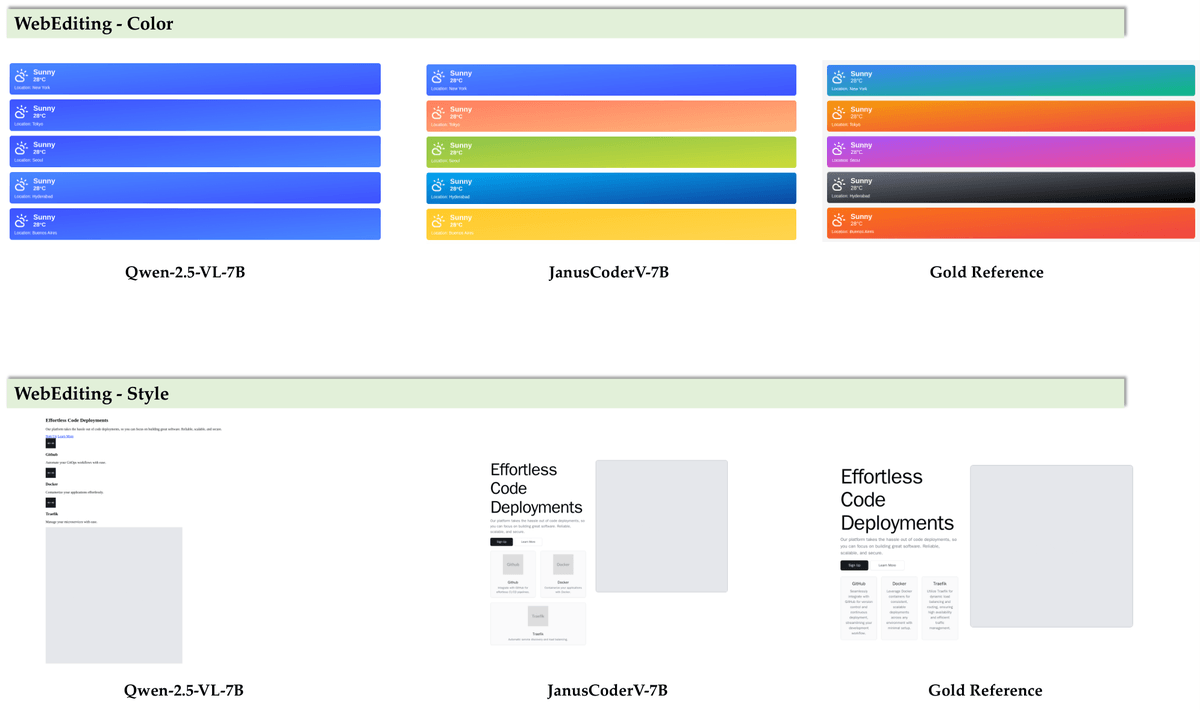
- Matches or beats GPT-4o on PandasPlotBench, ArtifactsBench, ChartMimic, and DesignBench at 7B-14B scale
- Introduces DTVBench, a new benchmark for dynamic theorem visualizations using Manim and Wolfram Mathematica
- Checkpoints available on Hugging Face; requires transformers 4.55.0 or later
Code generation models have gotten very good at producing text output, but they still stumble when the target is something a human actually looks at: a chart, a rendered web page, a math animation. A team from InternLM, Shanghai AI Laboratory, HKU, and CMU is trying to close that gap with a new open-source model family called JanusCoder, along with what they claim is the largest multimodal code corpus assembled so far.
JanusCoder is a suite of open models that establish a unified visual-programmatic interface for multimodal code intelligence, handling text-centric and vision-centric tasks in a single framework spanning chart-to-code, web UI generation and editing, and dynamic theorem visualizations, with results approaching or surpassing proprietary systems. The release includes 7B, 8B, and 14B checkpoints, an 800K-example training corpus, a data synthesis toolkit, and a new benchmark for animated theorem visualization.

The bottleneck nobody wanted to solve
Most existing work in this space builds one specialized model per task: a chart-to-code model here, a WebUI-to-code model there, a Manim animator somewhere else. The authors argue these siloed systems represent a departure from what a unified model can offer, and that they can neither generalize across scenarios nor scale.
The deeper problem is data. High-quality pairs of (instruction, code, rendered visual) are scarce because you need three things that rarely come together: diverse natural language prompts, executable code across many languages, and matching validation environments (Python, Playwright, Wolfram Engine, Manim). The team's response is a synthesis toolkit that leverages reciprocal synergies between data modalities to produce a large-scale corpus spanning standard charts, complex interactive web UIs, and code-driven animations. The result is JanusCode-800K.