
InterEdit Rewrites Two-Person Motion AI With 75.5% Human Preference
A new diffusion framework and dataset tackle the messy problem of editing two-person 3D motion with text instructions while preserving interaction dynamics.
 Pro
Takeaways
- InterEdit introduces the first benchmark for text-guided editing of two-person 3D motion, called TMME.
- InterEdit3D provides 5,161 source-target-text triplets built via retrieval on InterHuman and manual annotation.
- The diffusion model uses learnable plan tokens aligned to a motion teacher via InfoNCE contrastive loss.
- DCT band-energy pooling on average and difference signals captures synchrony, rhythm, and contact timing.
- Beats TIMotion by 16.7% on FID and wins 75.5% of human preference votes on interaction realism.
- Fails on subtle gesture disambiguation and long-horizon spatial consistency in complex dances.
Text-guided motion editing has worked well when there is only one person moving. Ask a model to make a character throw a ball higher, and diffusion-based editors handle it. Ask it to change how two people interact, and things fall apart. A new paper called InterEdit tackles that gap with a dedicated dataset, a benchmark, and a diffusion model designed around the fact that two bodies moving together are more than the sum of their trajectories.
Why two-person editing breaks single-person tools
Text-guided 3D motion editing has seen success in single-person scenarios, but its extension to multi-person settings is less explored due to limited paired data and the complexity of inter-person interactions. The core difficulty is coupling: a small change to one dancer disrupts synchronization with the other; shifting one fighter's timing turns a block into a miss. Editing must stay anchored to the source motion and apply only instruction-relevant changes, and this "change what is requested, preserve the rest" constraint is harder in interactive settings where small temporal deviations can alter semantics.
Existing interaction datasets like InterHuman and Inter-X focus on generating two-person motion from scratch, not editing paired source-target sequences. Existing edit datasets like MotionFix are single-person only.
InterEdit3D: 5,161 triplets built from retrieval
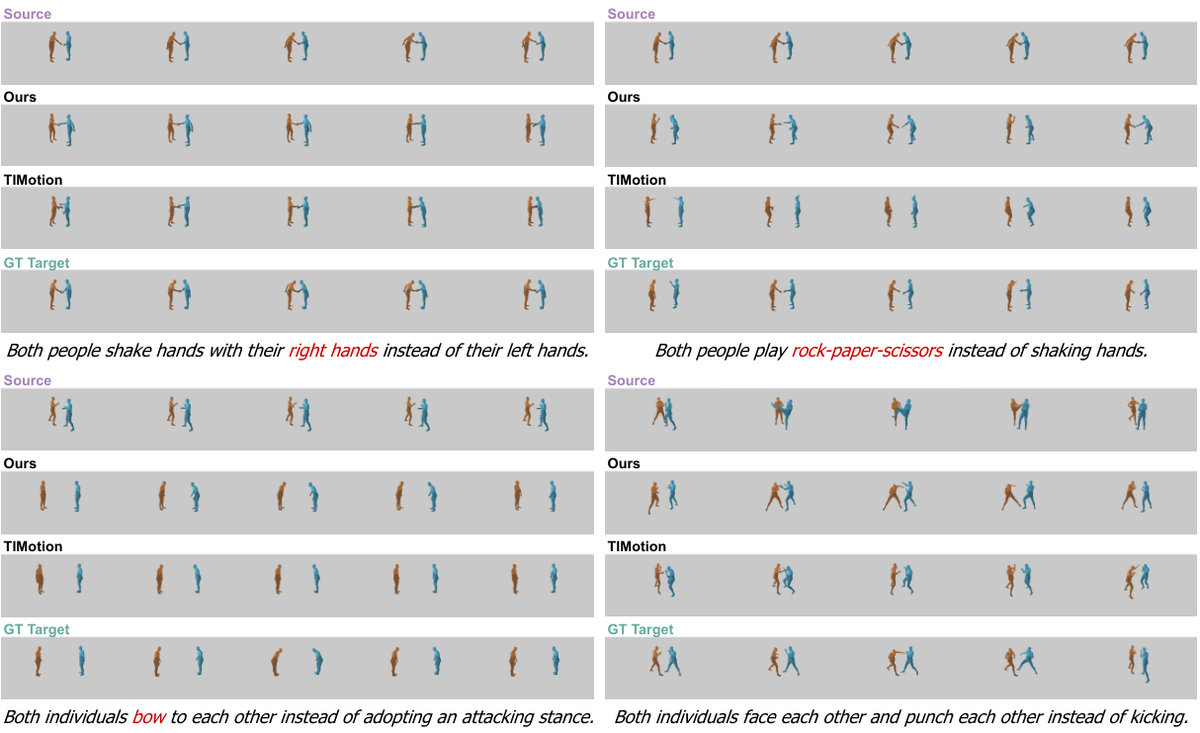
To create paired training data, the team built InterEdit3D on top of InterHuman using a semi-automatic pipeline. Motions are encoded with a frozen TMR encoder, then sliced into overlapping windows and matched by cosine similarity to find pairs that share a base motion for one person but differ in interaction semantics. Eight annotators wrote free-form edit instructions describing how to transform source into target, with cross-checking to remove ambiguous pairs. The result: 5,161 source-target-text triplets covering spatial changes (approach vs. back away), temporal edits (order and repetition), action swaps (shaking hands to rock-paper-scissors), and body-part-specific adjustments.

Two ideas that make the diffusion model interaction-aware
InterEdit is a classifier-free conditional diffusion model that predicts the clean target motion (START_X parameterization) from a noisy input, a source motion embedding, and a CLIP-encoded instruction. It borrows TIMotion's symmetric interleaved token stream so the transformer sees the two people in an alternating order that respects role switching. On top of that base, the paper adds two novel alignment mechanisms:
- Semantic-Aware Plan Token Alignment. Sixteen learnable "plan tokens" are appended to the token sequence. At an intermediate transformer block, they are aligned via InfoNCE contrastive loss to a frozen motion-teacher embedding of the ground-truth target. This teaches the model a high-level plan of what should change without leaking the target at inference time.
- Interaction-Aware Frequency Token Alignment. The two-person motion is decomposed into an average signal (shared, synchronized motion) and a difference signal (relative, oppositional motion). A Discrete Cosine Transform along the time axis converts each into frequency coefficients, which are pooled into low, mid, and high band-energy descriptors. Six frequency tokens are trained to regress these descriptors, so the model learns to respect rhythm, synchrony, and contact timing rather than just per-frame poses.

Numbers against the strongest baselines
The team adapted four baselines to the task: single-person editors MotionFix and MotionLab (features concatenated along the channel dimension), and two-person generators InterGen and TIMotion (source motion injected via AdaLN). InterEdit beats all of them on the TMME benchmark:
- FID of 0.3707 versus 0.4451 for TIMotion, a 16.7% reduction.
- Generated-to-target Recall@1 of 30.82% versus 24.97% for TIMotion, meaning edits better match the intended target.
- Generated-to-source Recall@1 of 17.08% versus 12.54%, meaning source content is better preserved.
- Human preference study: InterEdit wins 75.5% overall, 78.5% on instruction adherence, 71.0% on source preservation, 81.0% on interaction realism.
The model has 85M trainable parameters (close to TIMotion's 81M, much smaller than InterGen's 251M) and runs at 2.84 samples per second at inference. Training took about 4.5 hours on 8 RTX Pro 6000 GPUs. It also generalizes: on the standard InterHuman text-to-motion generation benchmark, it edges out TIMotion on R-Precision at all ranks.
Where it still struggles
The failure analysis is honest. The model confuses subtle gesture variations, for example clapping both hands with the other person versus clapping to oneself. It also drifts on long-horizon dance sequences where strict inter-person spatial relations need to hold over many seconds of high-motion dynamics. Both failures point at open problems for anyone building character animation or embodied-AI training pipelines on top of this work.
Code and dataset are promised at the project repo, with the download layout already documented. For animation tools, social robotics simulators, and virtual agent behavior editing, this is the first serious benchmark to test against, and the plan-token plus frequency-token recipe is a clean template that transfers to other coupled-signal generation problems.