
INTARG Breaks AI Forecasters 2.42x by Attacking Only When They're Most Confident
A new attack framework fools streaming time-series forecasters by perturbing under 10% of inputs, boosting prediction error up to 2.42x while evading detectors.
 Pro
Takeaways
- INTARG proposes a selective adversarial attack framework for online, bounded-buffer time-series forecasting.
- Uses conformalized quantile regression intervals as a confidence signal to decide when to perturb.
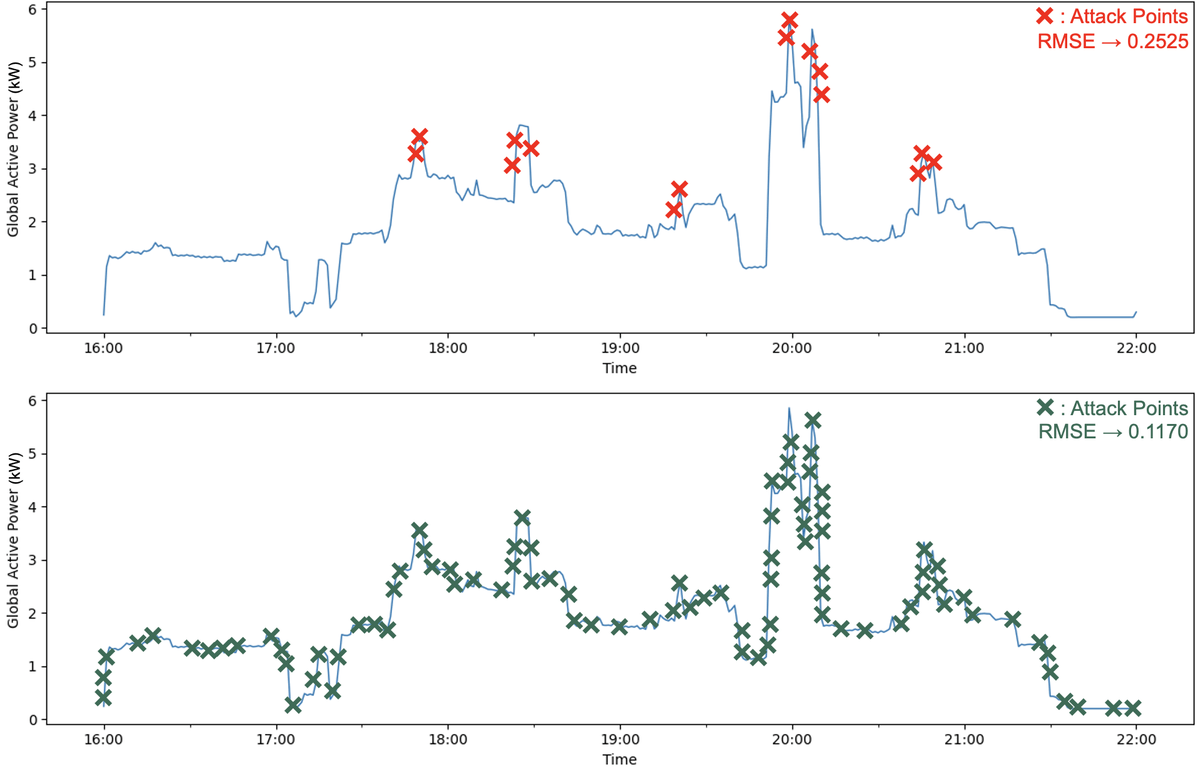
- Increases forecast RMSE up to 2.42x while attacking under 10% of timesteps.
- Wraps standard gradient attacks (FGSM, BIM, NI-FGSM) with an adaptive quantile threshold scheduler.
- Also degrades LID-based adversarial detectors, dropping F1 from 0.58 to 0.018 in one setting.
- Evaluated on Pecan Street Dataport and UCI Household Power datasets with a 1D-CNN forecaster.
Adversarial attacks on image classifiers are well-charted territory, but the same threat model rarely survives contact with a real streaming system. A new paper from researchers at San Diego State University and UC San Diego, INTARG, argues that most published attacks on time-series forecasters cheat by assuming the adversary can see all history and perturb every incoming sample. Drop those assumptions, and a smarter strategy emerges: attack rarely, but attack when the model is most confident.
The resulting framework selectively targets time steps where the forecaster shows high confidence and expected prediction error is maximal, and it damages performance far more than spraying perturbations across every sample.
Where attack papers diverge from streaming reality
Deep learning forecasters now underpin power grids, load balancing, healthcare monitoring, and network traffic prediction. They are also known to be fragile. The awkward part is that most published attacks assume the adversary holds the full historical series and can perturb every timestep, which the authors point out is unrealistic because historical data typically sits in secure storage and forecasts are produced in real time from a sliding window.
INTARG rewrites the threat model around what an online attacker actually has: a bounded rolling buffer of recent samples, a tight compute budget, and a cap on how many timesteps can be tampered with (the paper limits this to 10%).