
Instituto Superior Técnico Fixes Multi-Robot Tracking by Weighting Uncertain Agents Less
A distributed Kalman-Consensus tracker gains uncertainty-aware weighting to shield drifting robots from bad neighbor data, lifting MOTA by 0.09.
 Pro
Takeaways
- Extends the MOTLEE distributed multi-robot tracker with inverse-variance consensus weighting based on neighbor covariance.
- Weights let drifting robots anchor to well-localized neighbors while suppressing unreliable estimates during fusion.
- Delivers +0.093 MOTA for the high-uncertainty agent in Gazebo simulation with two lidar-equipped ground robots.
- Well-localized agents lose about 0.10 MOTA due to overly conservative rejection of noisy but valid data.
- Uses DBSCAN clustering, constant-velocity Kalman filtering, and Global Nearest Neighbor association with the Hungarian algorithm.
- Limitations: motion reversals, communication latency, and reliance on dense dynamic objects for frame alignment.
Teams of mobile robots that share what they see can track pedestrians and vehicles far better than any single robot alone. But there is a catch: if one robot thinks it is standing two meters east of where it actually is, every track it broadcasts arrives in its teammates' maps shifted by two meters. The result is duplicated tracks, ghost objects, and consensus filters that confidently converge to the wrong answer. A new paper from Instituto Superior Técnico tackles this with a simple but effective fix: weight each neighbor's contribution by how certain that neighbor is about its own position.
Where consensus filters break down
The work builds directly on MOTLEE from MIT's Aerospace Controls Lab, which established the distributed Kalman-Consensus Filter (KCF) approach for multi-robot tracking. MOTLEE performs distributed tracking in the ground plane using the Kalman-Consensus filter and corrects frame misalignment by using both static landmarks and dynamic objects that are co-visible between vehicles. The insight is that consistently tracked moving objects can act as transient landmarks, letting robots refine their estimate of each other's relative pose without a central server.
MOTLEE already acknowledged that object measurement noise must properly reflect both a vehicle's own localization uncertainty and the uncertainty of frame alignment when measurements are sent to neighboring vehicles, so that vehicles with more localization uncertainty can have their measurements appropriately down-weighted relative to other vehicles' information. The new paper pushes this idea into the consensus term itself, which in standard formulations assigns equal or fixed weights to every neighbor regardless of who is drifting and who is well-localized.
The adaptive weighting trick
Local perception on each robot is deliberately classical: a 2D lidar feeds DBSCAN clustering to find candidate moving objects, centroids are tracked with a Kalman Filter under a constant-velocity model, and detections are matched to tracks using Mahalanobis distance with the Hungarian algorithm for globally optimal assignment. This is standard tracking-by-detection.
The novelty sits in the fusion step. For each robot i and neighbor j, the authors compute a weight inversely proportional to the neighbor's position standard deviation:
w_j(k) = (1 / sigma_j(k)) / sum_over_neighbors(1 / sigma(k))These weights then scale the consensus term in the DKCF update, so a neighbor with a tight covariance pulls harder on the local estimate, while a neighbor whose covariance has blown up is largely ignored. Crucially, the mechanism is dynamic: as a robot drifts through a poorly mapped region, its influence on teammates automatically fades.
What the numbers say
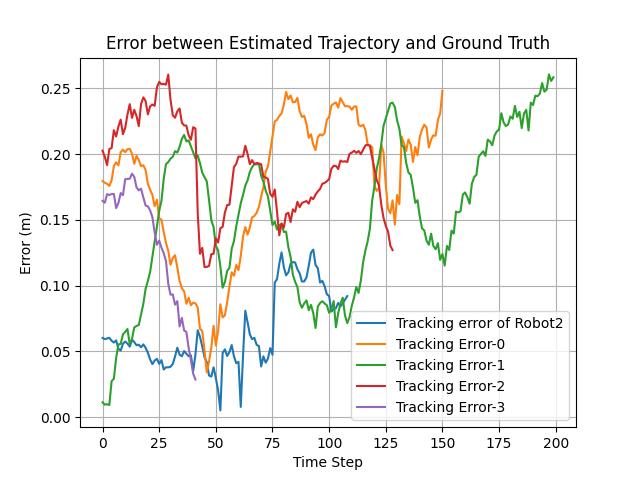
The system was implemented in ROS and evaluated in Gazebo with two differential-drive robots tracking four cylindrical objects moving on predefined paths. The results reveal a clean asymmetry.

- Robot 1 (high uncertainty): local MOTA improved by +0.085, global fused estimate by +0.093
- Robot 2 (low uncertainty): mean MOTA dropped by about -0.10
The struggling agent effectively anchors itself to the more reliable neighbor's frame, while the well-localized agent becomes overly conservative and rejects noisy but still useful information from its drifting partner. As the authors put it, uncertainty-aware weighting acts as a quality filter that stabilizes worst-case performers at the cost of some cooperative gain for best-case ones.
Honest limitations
The paper is refreshingly direct about where the pipeline breaks. The constant-velocity model fails on abrupt maneuvers, and target reversals cause innovation spikes that temporarily decouple consensus fusion until linear motion resumes. Frame alignment depends on a minimum density of observable dynamic objects, so sparse scenes leave the relative transform optimization ill-conditioned. And while adaptive weighting attenuates stale data, it does not correct the underlying temporal error, so significant communication delays still cause information loss.
When it is worth using
This is not a new SOTA tracker. It is a targeted patch for a real problem in multi-robot deployments where some agents have better sensors, better maps, or fresher localization than others. If you are running a fleet where localization quality is homogeneous, standard consensus works fine. If you are dealing with heterogeneous teams, mixed sensor payloads, or agents that drift into badly mapped regions, the inverse-variance weighting is a cheap addition that measurably protects the weakest link.
The underlying MOTLEE code and hardware dataset from the MIT ACL group are open source. The extension in this paper is described mathematically but no accompanying repository is announced. Future work targets Interacting Multiple-Model filters to handle abrupt maneuvers, tighter SLAM-tracking coupling, and asymmetric consensus strategies that stop over-penalizing well-localized agents.