
InSpatio-WorldFM Runs Open-Source World Generation at 10 FPS on One GPU
A new open-source world model ditches video-style sequential generation to render each frame independently, hitting interactive frame rates on a single RTX 4090.
 Pro
Takeaways
- InSpatio-WorldFM is an open-source real-time frame model for spatial intelligence, released under Apache-2.0.
- Generates each frame independently instead of processing video windows, eliminating window-level latency.
- Combines explicit point-cloud 3D anchors with implicit reference-frame memory for multi-view consistency.
- Runs at 10 FPS on an A100 and 7 FPS on a consumer RTX 4090 at 512x512 resolution.
- Three-stage pipeline: PixArt-Σ pretraining, controllable frame training, two-step DMD distillation.
- Limitations include weak dynamic content, motion boundaries from offline anchors, and frame jitter.
Most so-called world models today are really video generators in disguise. They produce sequences of frames inside a rolling window, which looks great in demos but tanks the moment you try to steer the camera in real time. A new open-source project called InSpatio-WorldFM takes a different route: it treats world generation as a per-frame problem, and manages to keep the geometry stable across viewpoints while running on a consumer GPU.
The technical report from the InSpatio team frames this as a direct response to the limitations of video-based approaches. Unlike video-based world models that rely on sequential frame generation and incur substantial latency due to window-level processing, InSpatio-WorldFM adopts a frame-based paradigm that generates each frame independently, enabling low-latency real-time spatial inference. The code is on GitHub, and the model is released under Apache-2.0.
Why video-style world models keep hitting a wall
To understand why this matters, it helps to know what breaks in video-based world models. They rely on bidirectional attention over a window of frames, which means every generation step has to process the full window at once. Even with aggressive distillation, that window-level dependency puts a hard floor on interactive latency.
The second problem is drift. Video models optimize for short-term temporal continuity, not long-term spatial consistency, so small geometric errors accumulate the longer you explore. Walk around a scene for a while and walls warp, objects move, and the layout you saw a minute ago no longer matches what you see now. Such spatial hallucinations remain prevalent even in the most advanced video generation models today. The InSpatio team argues that purely 2D learning is insufficient to achieve spatial intelligence, and that the most fundamental property of spatial intelligence is 3D multi-view consistency.
World Labs recently explored a similar direction with their RTFM real-time frame model, but that work is closed source with minimal published detail. InSpatio-WorldFM is essentially the first public attempt to build and open-source this architecture.
The trick: explicit anchors plus implicit memory
The core idea is that each frame is generated independently, but conditioned on two forms of scene memory that keep the geometry pinned in place:
- Explicit 3D anchors: a point cloud rendered at the target viewpoint, which acts as a coarse geometric prior telling the model where things should be.
- Implicit spatial memory: a reference frame plus its camera pose, which the transformer attends to via self-attention to pull in fine-grained appearance details.
The pipeline splits into an offline and online stage. Given a single input image, a multi-view consistent model generates plausible observations that provide reference appearances, while the 3D anchors are obtained using a reconstruction model like VGGT, DUSt3R, or MoGe. Then, during interactive exploration, the online frame model synthesizes each new viewpoint on demand.

How the frame model is put together
Inside the DiT, the noisy target latent, the point cloud rendering, and the reference image are concatenated along the width dimension and passed through a shared patch embedding. The whole thing is a self-attention-only transformer. The authors found that injecting conditions through self-attention produced better generation quality than the more common cross-attention route.
Camera pose is where a lot of frame models struggle, and this one uses Projected Relative Positional Encoding (PRoPE). Rather than adding ray-direction embeddings to tokens, PRoPE bakes camera projection matrices directly into the query, key, and value transformations of the attention layer. In practice this let the attention mechanism reason about cross-view geometric correspondences natively, and the team reports it converged faster and was more stable than Plücker ray embeddings or plain parametric injection.

Three stages, ending in two-step denoising
The training pipeline is where the report gets interesting. It progressively transforms a general-purpose image diffusion model into a real-time world simulator:
- Stage I: Pre-training. Start with PixArt-Σ, an efficient text-to-image DiT chosen for its balance of quality and inference throughput.
- Stage II: Middle-training. Convert it into a controllable frame model. Training data is pulled from public video datasets like DL3DV and RealEstate10K, in-house captures, and synthetic Unreal Engine rollouts with perfect ground-truth poses and depth. The team uses noise-schedule biasing to prioritize geometry over texture, progressive condition injection so the model does not overfit to the point cloud anchor, and random anchor masking to keep the implicit memory pathway alive.
- Stage III: Post-training. Distill the multi-step diffusion model into a few-step generator using Distribution Matching Distillation (DMD).
The distillation finding worth highlighting: one-step DMD blurs fine detail because a single forward pass from pure noise can only recover coarse structure. Switching to two-step denoising with an intermediate timestep of t=200 on a 1000-step schedule gave a dedicated refinement phase that preserved textures without giving up much speed.
What it actually delivers
The distilled model runs at roughly 10 FPS at 512×512 on a single NVIDIA A100 with 50 to 70 ms of interaction latency. On a consumer RTX 4090 it hits 7 FPS with single-step inference, and the authors note that KV-cache management and VAE latent caching should push this further. The company page also mentions a related 4D video-conditioned model running at 24 FPS.
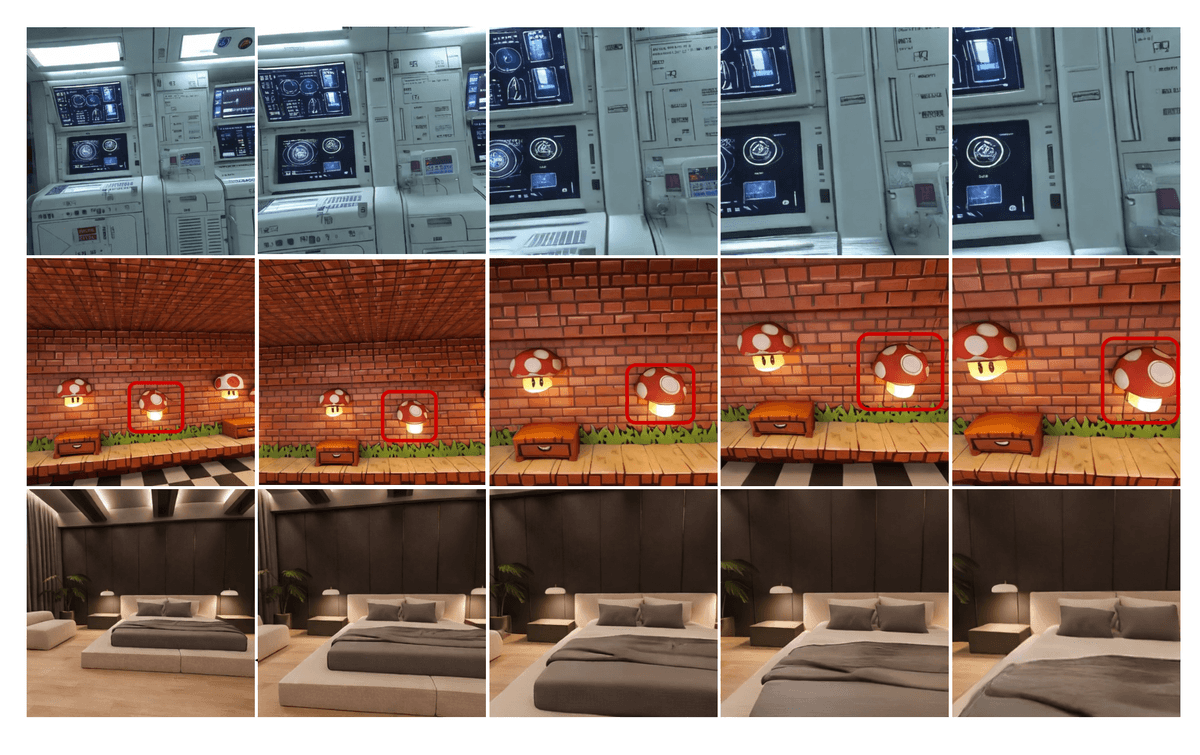
Qualitative results across photorealistic, science-fiction, game-like, and artistic environments show the model holding geometry across substantial viewpoint changes and preserving details when you move closer to or farther from an object. That kind of scale-invariant consistency is exactly what breaks in video-based world models over long trajectories.
Where it still falls short
The authors are upfront about the rough edges:
- Dynamic content is weak. The training data leans heavily on multi-view-consistent static scenes, so animated elements and moving objects are hard to generate stably.
- Motion boundaries exist. The offline stage that produces reference observations and anchors is expensive, which caps how far you can wander before the online model runs out of memory context.
- Frame jitter. Because each frame is generated independently with no temporal constraint between consecutive frames, the output can flicker during interaction.
Those last two points are the honest cost of choosing a per-frame architecture. You get real-time latency and stronger long-term geometric coherence, and you pay for it in temporal smoothness. For robotics simulation, embodied AI environments, and interactive scene exploration on hardware that already sits under people’s desks, that trade seems very much worth making, and having the code available under Apache-2.0 means the community can now attack the remaining problems in the open.