
Inria's Robot Controller Discovers Gallops, Jumps and Handstands With Just 30 Samples
A CPU-only MPC framework discovers trotting, galloping, jumping, and handstands on a real quadruped without any predefined gait patterns or offline training.
 Pro
Takeaways
- Inria team's reference-free MPPI variant discovers gaits, jumps, and handstands with no gait priors.
- Cubic Hermite splines carrying both position and velocity targets replace position-only sampling for richer exploration.
- Runs in real time at 50 Hz on a CPU with only 30 sampled trajectories for a quadruped.
- Validated on the real Unitree Go2, reaching 0.55 m jumps and robust disturbance rejection.
- Same algorithm transfers to the G1 humanoid in simulation, discovering bipedal walking unchanged.
- Accepted to ICRA 2026; useful as a motion discovery engine feeding downstream optimizers.
A team from Inria and Sorbonne Université has built a legged-robot controller that figures out how to walk, trot, gallop, jump, and even balance on its front legs, all in real time, on a laptop-class CPU, and without any pre-baked gait patterns telling it when each foot should touch the ground. The paper, accepted to ICRA 2026, shows that a carefully redesigned sampling-based Model Predictive Controller can discover locomotion from scratch, at every control step, using as few as 30 sampled trajectories.
The method discovers diverse motion patterns, from trotting to galloping, robust standing, jumping, and handstand balancing, purely through the optimization of high-level objectives, and it does so by building on Model Predictive Path Integral (MPPI) control with a cubic Hermite spline parameterization that operates on position and velocity control points. The whole thing runs on a Mac Studio driving a Unitree Go2 quadruped over the network.

The problem with today's legged controllers
There are basically two families of controllers for legged robots, and both have painful trade-offs. Reinforcement learning produces spectacular acrobatics but requires extensive offline training and may fail to generalize or adapt well to new environments or tasks that were not seen during training. RL controllers also lean heavily on hand-engineered reward terms such as phase clocks, air-time penalties, and foot-clearance objectives to nudge the policy toward structured contact behavior.
Trajectory optimization is the other camp. It produces high-quality solutions but is computationally intensive, needs reliable gradients (which contact discontinuities murder), and in practice usually requires you to hand-specify which foot lifts when. Sampling-based MPC dodges the gradient problem by just simulating many candidate trajectories and averaging the good ones, but recent state-of-the-art variants still cheat in one of two ways: they either need thousands of GPU-parallel rollouts, or they rely on gait heuristics like the Raibert stepping law.
Splines that carry velocity, not just position
The core technical move is how the control sequence is parameterized. Prior joint-space samplers place spline knots that only specify target positions, which forces the PD controller downstream to assume zero target velocity at every knot. That kills a lot of the dynamic behaviors you would want to explore.
The authors switch to cubic Hermite splines, where each knot carries both a target position and a target velocity. Sampling perturbs both, so the optimizer explores dynamically consistent trajectories from the start. There is also a nice safety trick: because Hermite splines let you constrain the derivative at each knot, they clamp per-node velocities based on how close the position knot is to a joint limit, which prevents mid-interval overshoot without any expensive constraint solving.

How a single control step actually runs
At each 50 Hz control tick, the controller runs three internal optimization iterations. Within each iteration:
- Sample 30 (quadruped) or 70 (humanoid) perturbed spline sets around the current nominal, with noise scaled by an annealing schedule.
- Interpolate each set to get candidate joint-position and joint-velocity trajectories over a 0.9 s horizon.
- Roll every candidate out in the Simple physics simulator and score it with the cost function.
- Compute softmax weights over the costs and take an importance-weighted average to update the nominal trajectory.
- Send the first control point of the best rollout, not the averaged mixture, to a low-level PD controller.
That last step is worth highlighting. The nominal trajectory evolves through weighted averaging as in standard MPPI, but the robot only ever executes actions from a fully-simulated best trajectory. This safeguards against the untested mixtures that MPPI averaging can produce, and the ablation shows the optimizer fails to improve on the previous best 27.9%, 29.7%, and 27.1% of the time on walking, jumping, and handstand tasks respectively, so tracking the verified best actually matters.
The annealing schedule borrows from diffusion models: variance is high for spline knots far in the future and early in the optimization, then shrinks as knots get closer to execution and iterations progress. Both effects are combined into a single precomputed covariance schedule, so the noise structure costs almost nothing at runtime.
What actually emerges
With no gait references, only a target base velocity in the cost, the Go2 spontaneously produces different gaits at different commanded speeds:
- At 0 m/s: a stable four-foot stance that rejects pushes and pulled legs.
- At 0.5 m/s: a diagonal trot.
- At 2.0 m/s: an extended-flight gallop, with a smooth transition between the two as the velocity command ramps.
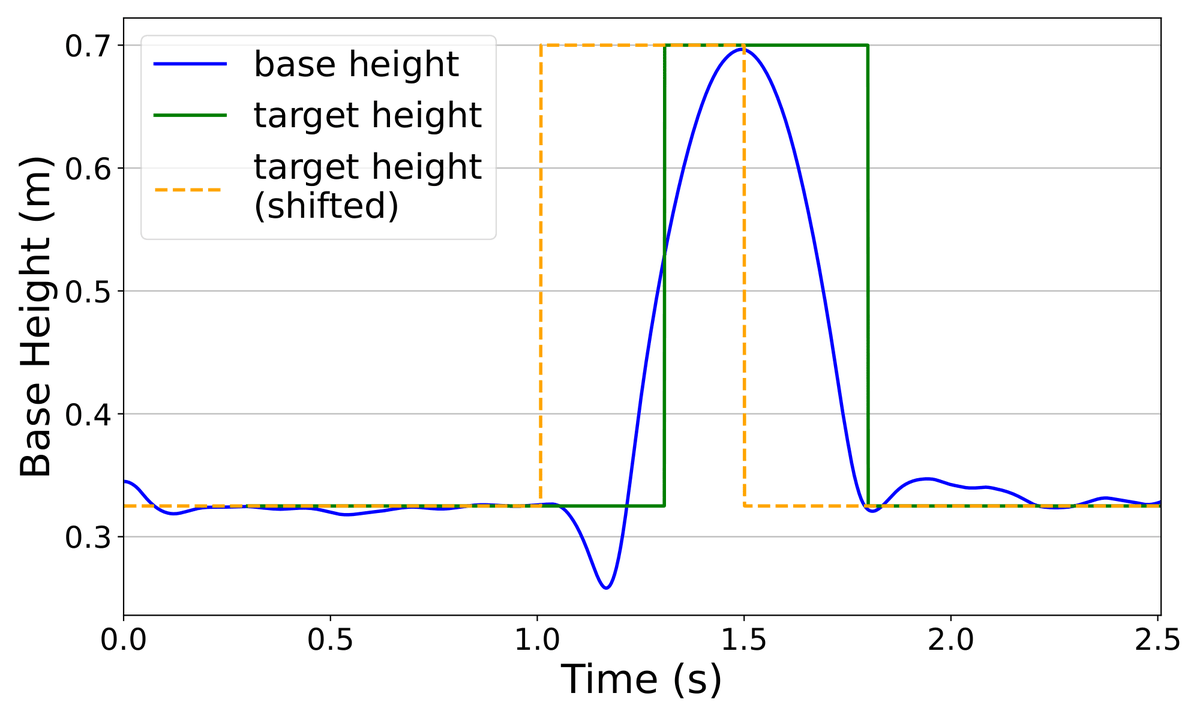
For jumping, the cost only specifies a target base height. The robot discovers on its own that it needs to crouch, extend explosively, control body orientation mid-air, and absorb landing. It reaches 0.55 m of vertical clearance on real hardware and 0.7 m in simulation. Add a target pitch of 180 degrees at the apex and it invents a backflip. Add a 45-degree base pitch target and it swings up into a handstand and holds it for around a second by constantly repositioning its front legs.

The same algorithm, cost function, and spline parameterization transfer to the Unitree G1 humanoid in simulation (37 degrees of freedom instead of 12) and discover a bipedal walk without modification, though the humanoid needs 60 to 70 samples and drops out of real-time.
Where it lands versus the competition
The ablation numbers are the clearest way to see what the Hermite parameterization buys. On the walking task, the Hermite variant hits 10/10 successes with a mean cost of 913.9, while a cubic-position-only spline gets 6/10 and 1124.1, and quadratic splines fail 0/10 times. On jumping, Hermite reaches 68.4 cm mean height versus 47.7 cm for quadratic. Compared to DIAL-MPC, which needs 2048 to 4096 samples on a GPU and swing-foot references, this approach uses 30 to 70 samples on a CPU with zero references.
What it is good for, and what it is not
The honest limitation, which the authors call out, is that motions are not always smooth or energy-efficient. Because sampling happens in joint space and torques come from a fixed PD controller, you lose the fine torque-level polish that a full-order optimizer or a well-trained RL policy would give you. The framework's real value is as a motion discovery engine: it can generate contact sequences and candidate strategies for new tasks or morphologies within minutes of cost tuning, which can then serve as warm starts for gradient-based trajectory optimizers or as data for learning-based refinement.
If you have a new robot, a new task, and no time to train a policy or hand-design a gait schedule, this is exactly the kind of tool worth reaching for. The paper does not link a public code release, but the authors point to their Simple simulator and integrate with a standard PD stack, so a reimplementation of Algorithm 1 is well within reach for anyone comfortable with MPPI.