
Inria and MIT's SOAR Teaches Small Open Models to Beat o3-mini on ARC-AGI
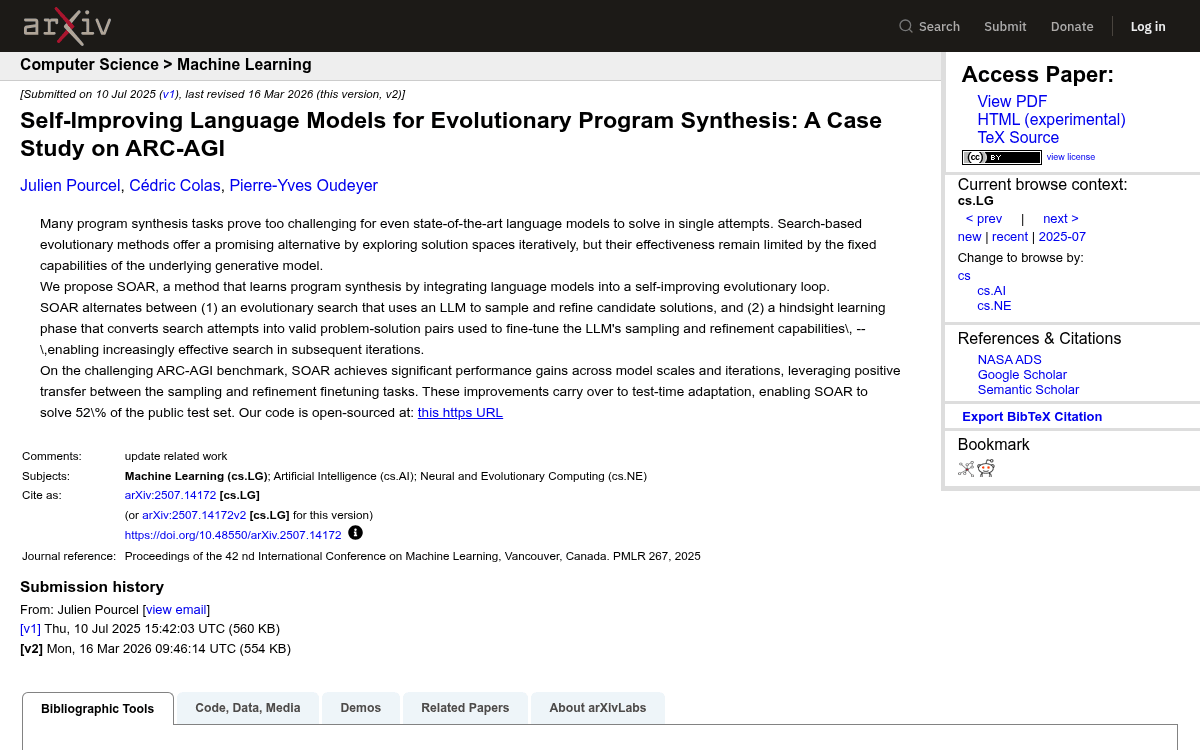
SOAR pairs evolutionary program search with hindsight fine-tuning, letting open-source coders climb from single-digit accuracy to 52% on ARC-AGI.
 Pro
Takeaways
- SOAR reaches 52% on ARC-AGI public test set using open-source Qwen and Mistral models.
- Alternates evolutionary search (sample plus refine) with LoRA fine-tuning on relabeled search traces.
- Hindsight relabeling turns every failed program into a valid task-solution pair for training data.
- Qwen-2.5-Coder-7B jumps from 14.25% to 36.25%, outperforming o3-mini and Claude-4-Sonnet.
- Joint training on sampling and refinement outperforms specialist models due to positive transfer.
- Full code released at github.com/flowersteam/SOAR, no human-engineered DSLs or datasets required.
A team from Inria and MIT has released SOAR (Self-improving Operators for Automated Refinements), a program synthesis system that repeatedly rewrites its own weights based on what it discovers during search. Running on open Qwen and Mistral checkpoints, it solves 52% of the ARC-AGI public test set, beating prior open-source inductive methods and even edging out closed reasoning models like o3-mini on the same benchmark.
The core question the paper tackles is one that anyone who has bolted an LLM onto an evolutionary loop has run into: the search gets smarter, but the model doesn't. Large language models have marked a new turn in program synthesis by acting as powerful program generators and as intelligent operators for evolutionary search, proposing targeted modifications to existing solutions. The catch is that sampling and mutating with a frozen model hits a ceiling fast. SOAR's contribution is a training loop that turns every search attempt, successful or not, into fine-tuning data for the next round.
Why ARC breaks single-shot LLMs
ARC-AGI tasks show a model a handful of colored grid input/output pairs and ask it to infer the transformation, then apply it to a held-out input. The transformations touch on object permanence, counting, symmetry, and simple physics, and each task uses a fresh rule, which is what makes pattern matching insufficient.
The baseline numbers make the difficulty concrete. Even state-of-the-art models like Claude-4-Sonnet and GPT-4.1 solve only 20.75% and 8.00% of test tasks respectively in a one-shot setting, while Qwen-2.5-Coder models achieve 1.00 to 2.25% across model sizes. Wrapping those small open models in a 6,000-attempt sample-and-refine search pushes Qwen-2.5-Coder-7B up to 14.25% and the 32B version to 25.25%, but the curve flattens as you keep spending compute.
The self-improvement loop
SOAR alternates two phases. First, a Sample&Refine search: the LLM independently samples 3,000 candidate Python programs per task, then spends another 3,000 calls refining the most promising ones using execution feedback. Refinement is framed as a bandit problem solved with REx, a Thompson-sampling variant that balances exploiting programs that already pass many training examples against exploring new branches.
Then comes the learning phase, which is where the trick lives. Most search attempts fail, so training only on successes leaves almost no signal. Instead, SOAR uses hindsight relabeling, an idea borrowed from goal-conditioned RL. Any program the LLM sampled is, by construction, the correct solution for the task of mapping its inputs to the outputs it actually produced. Running each failed program on the training grids yields a synthetic (task, solution) pair that is guaranteed to be valid, even if it solves a different problem than the one intended.
That turns 2.4 million junk attempts into supervised training data. The team subsamples down to roughly 50 pairs per task using a greedy-diverse strategy: 25 top-scoring programs plus 25 low-scoring ones to preserve variety. The base model is then fine-tuned with LoRA (rank 256) for both sampling and refinement jointly, and the improved model powers the next search iteration.

Positive transfer between sampling and refining
One of the more useful empirical findings is that these two skills reinforce each other. Training a single model to both propose fresh programs and repair broken ones outperforms training two specialists. In the ablation, a jointly fine-tuned Qwen-2.5-Coder-14B hits 39.79% sampling accuracy and 44.42% after full search, versus 36.46% and 43.88% when the tasks are split across separate models. Learning to refine also improves cold-start generation, which suggests the model is picking up shared representations of grid transformations rather than two disconnected skills.
Breaking the scaling plateau
The headline result is what happens across iterations. After four training rounds plus two test-time training rounds, every model size jumps sharply:
- Qwen-2.5-Coder-7B: 14.25% to 36.25% (a 2.5x increase)
- Qwen-2.5-Coder-14B: 19.87% to 42.75%
- Qwen-2.5-Coder-32B: 25.25% to 44.37%
- Qwen-2.5-72B: 25.62% to 44.87%
- Mistral-Large-2: 26.25% to 45.50%
- Ensembling all five via majority vote: 52.00% (oracle: 57.25%)
The 7B model post-SOAR outperforms o3-mini and Claude-4-Sonnet on this benchmark. And critically, without the learning phase, scaling from 32B to 123B parameters barely moves the needle. Each SOAR iteration lifts the entire scaling curve upward instead of pushing further along a flattening one.
Test-time training on unseen tasks
Because hindsight relabeling doesn't need ground truth, SOAR can keep improving on the actual test set. Starting from a model already fine-tuned on all training-set traces, two extra iterations of test-time training on ARC-test tasks add roughly 5% accuracy across model sizes. The system uses training-example accuracy plus majority voting to pick likely-correct programs, then relabels the rest.
Where it falls short
The obvious cost is compute: 6,000 synthesis attempts per task per iteration, though the authors point out that fine-tuning itself is only about 5% of total FLOPs. Gains also diminish over iterations, and diversity collapses on tasks the model has already solved. Solution diversity on unsolved tasks stays roughly flat after the first iteration, which the authors credit to hindsight relabeling but flag as insufficient for open-ended progress. Explicit quality-diversity methods or generated auxiliary problems are floated as future directions.
What to take away
SOAR is a drop-in template for anyone running LLM-based evolutionary search, whether that's AlphaEvolve-style algorithm discovery, code repair loops, or theorem proving. The recipe is small: run search, relabel every failed attempt as a new valid task, fine-tune with LoRA, repeat. The full training and inference stack, including the REx modifications and majority-voting logic, is available in the flowersteam/SOAR repository, and all base models are open-weight Qwen and Mistral checkpoints. For teams that have been paying for repeated calls to a frozen frontier model, this is a concrete argument that a much smaller model plus a learning loop can go further.