
INR-DMD Beats Neural PDE Surrogates While Staying Physically Interpretable
A physics-coded Koopman framework factorizes space and time into neural fields, delivering interpretable spectra and orders-of-magnitude gains on parametric PDEs.
 Pro
Takeaways
- INR-DMD parameterizes Koopman eigenfunctions and eigenvalues as neural fields conditioned on physics code, factorizing space from time.
- Long rollouts reduce to a matrix exponential, enabling near-free inference and CPU deployment after training.
- Achieves lowest error across Burgers, double shear, Kármán vortex street, and 6D airfoil benchmarks versus FNO, KNO, KAE, P-DMD, PDE-T, RKN.
- Three key tricks: complex conjugate-pair modes, stage-wise deflation for orthogonality, mixed short and long horizon loss.
- Exposes interpretable growth/decay rates and frequencies, unlike black-box neural operators or autoregressive transformers.
- Uses under 400K parameters where baselines need millions; some baselines OOM or diverge on 2D problems.
A team from the University of British Columbia and the University of Toronto has released Factorized Neural Implicit DMD for Parametric Dynamics, a method for learning the temporal evolution of physical systems that keeps the interpretability of classical spectral analysis while matching or beating modern neural PDE surrogates. The paper introduces INR-DMD, a neural Koopman framework that decouples spatial modes from temporal evolution and conditions both on the physical parameters of the problem.
The pitch is direct: instead of learning a black-box mapping from initial condition to future state, learn the eigenvalues and eigenfunctions of the underlying dynamics as continuous neural fields. That structural choice turns long-horizon rollout into a matrix exponential, exposes growth and decay rates directly, and generalizes to unseen viscosities, boundary positions, and airfoil shapes without retraining.
Why neural PDE surrogates keep breaking
Simulating parametric PDEs (Burgers, Navier-Stokes, lattice Boltzmann flows) with traditional solvers is expensive, and real-time analysis or control is essentially out of reach on high-dimensional state spaces. Machine learning surrogates have taken over, but each family has a distinct failure mode. The authors argue that physics-constrained neural fields fit a single solution surface, and neural operators directly approximate the solution operator at fixed time horizons, both of which limit generalization and interpretability.
Autoregressive transformers and Fourier Neural Operators can approximate solutions well over short windows, but they treat time as a black-box map. Errors compound over long rollouts, and there is no explicit handle on the spectrum of the underlying operator. Koopman-based approaches promise linear evolution in a lifted space, but existing Koopman Neural Operators rely on a high-dimensional latent operator that is implicitly defined and lacks explicit physical or spectral structure, limiting generalization across varying parameter settings and geometric configurations.
Factoring the flow into modes and eigenvalues
The core idea is a Koopman spectral decomposition where the two ingredients are parameterized separately as neural fields conditioned on a physics code vector (viscosity, obstacle position, airfoil shape, etc.):
- A network
Φ_θ(x; ξ)outputs the spatial basis functions (Koopman modes) at any continuous coordinatex. - A second network
Λ_η(ξ)outputs the complex eigenvalues that dictate how each mode evolves over time.
Once trained, prediction is a three-step recipe: project the initial state onto the learned basis via least squares, propagate the modal coefficients with the matrix exponential of Λ, and reconstruct the field. The paper writes this compactly as evaluating Φ_θ(x; ξ) · exp[Λ_η(ξ)(t_j - t_i)] · z(t_i; ξ). Long-horizon simulation becomes a cheap matrix multiplication, not a repeated forward pass.

The three tricks that make it stable
Getting a neural spectral decomposition to actually converge without collapsing modes into each other requires more than a straightforward MLP fit. The authors introduce three interlocking design choices:
- Conjugate-pair parameterization. Each mode is learned as a complex-conjugate pair, where the real part of the eigenvalue is the growth or decay rate and the imaginary part is the oscillatory frequency. This preserves the spectral symmetry of real-valued physical fields.
- Stage-wise deflation. Rather than train all modes jointly (which tends to make them collapse into the same low-frequency band), modes are learned sequentially. At each stage, previously learned modes are frozen and the new candidate mode is projected orthogonally to them before optimization.
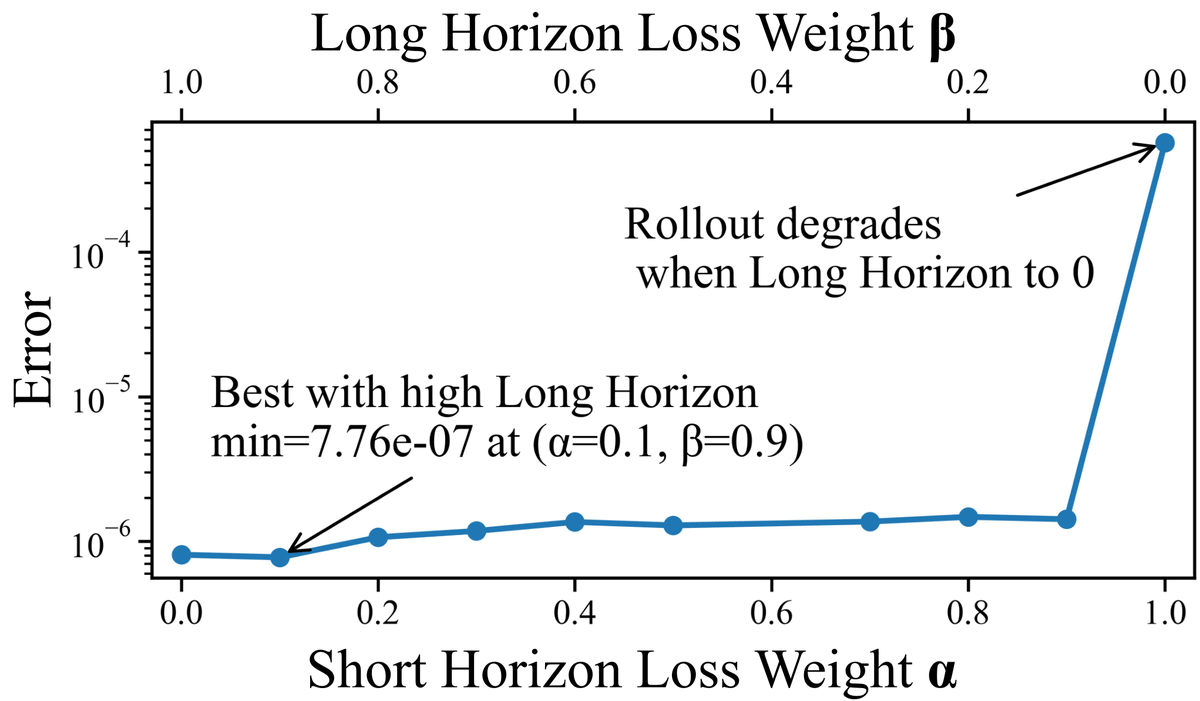
- Mixed short and long horizon loss. A one-step DMD-style loss keeps local accuracy sharp while a multi-step OptDMD-style loss prevents error accumulation over long rollouts.
The ablation numbers make the case. On the Kármán vortex street benchmark, removing the long-horizon loss balloons rollout error from roughly 8e-7 to 5.7e-4, and removing deflation drives it to 1.8e-4. Both are more than two orders of magnitude worse than the full model.
Benchmarks: four PDE families, one method
INR-DMD is evaluated against six baselines including Fourier Neural Operator (FNO), Koopman Neural Operator (KNO), Consistent Koopman Autoencoder (KAE), Parametric DMD, PDE-Transformer, and ResKoopNet. The four testbeds cover progressively harder generalization axes:
- Burgers’ equation with viscosity sweeps in [0.001, 0.01].
- 2D Navier-Stokes double shear layer parameterized by shear separation, exhibiting Kelvin-Helmholtz roll-up.
- Kármán vortex street generated with the lattice Boltzmann method, varying cylinder position (fluid-solid coupling with moving boundary).
- Airfoil flow over a 6-dimensional CST shape space including rotation and trailing-edge thickness.

On Burgers, INR-DMD reports 1.35e-4 relative MSE, roughly an order of magnitude below Parametric DMD (1.35e-3) and two orders below FNO and KAE, while running at 0.006 ms per frame. On the Kármán benchmark it uses 316K parameters versus 2.4M for P-DMD and hits the lowest error with the fastest inference. Several baselines fail outright: RKN runs out of memory on the 2D benchmarks, FNO diverges on the shear layer, and KNO cannot handle spatial dimensions greater than one so it is not applicable to Kármán or airfoil at all.
What you actually get
The practical value shows up in three places. First, the learned modes are physically interpretable: each conjugate pair corresponds to a coherent flow structure with a specific frequency and stability, which you can inspect directly. Second, once trained, evaluation is essentially free because rollouts are a matrix exponential, making the method deployable on CPU-only systems. Third, generalization across the parameter space works without retraining, whether that parameter is a scalar viscosity or a six-dimensional airfoil shape.
The trade-offs are also clear. The method assumes the dynamics can be well approximated by a low-rank Koopman decomposition with a modest number of modes (2 to 6 in the experiments). Systems with genuinely broadband turbulence or strong nonlinear intermittency may need many more modes than the low-rank truncation supports. Training also requires trajectories at multiple parameter values, so it is a surrogate-learning setting, not a one-shot solver replacement. The paper does not indicate a public code release at this stage; the arXiv listing shows the PDF, HTML, and TeX source but no linked repository.
For anyone building reduced-order models, real-time controllers, or design-space explorers over PDE families, the appeal is straightforward: you get a linear, spectral surrogate that behaves like classical DMD but scales to parametric families and continuous domains through neural fields, and comes with an ablation-verified recipe for making the spectral learning actually converge.