
InfoMRI Cuts MRI Scan Data by 32x Without Losing Diagnostic Accuracy
A new framework treats MRI acquisition as an information problem, jointly learning what to sample and what to infer with calibrated uncertainty.
Takeaways
- InfoMRI jointly optimizes MRI sampling, reconstruction, and diagnosis by maximizing mutual information between k-space and task.
- A single amortized model handles arbitrary sampling ratios via a Pattern Generation Network conditioned on the ratio.
- One knob β switches between joint reconstruction+task, pure compressed learning, and privacy-preserving acquisition.
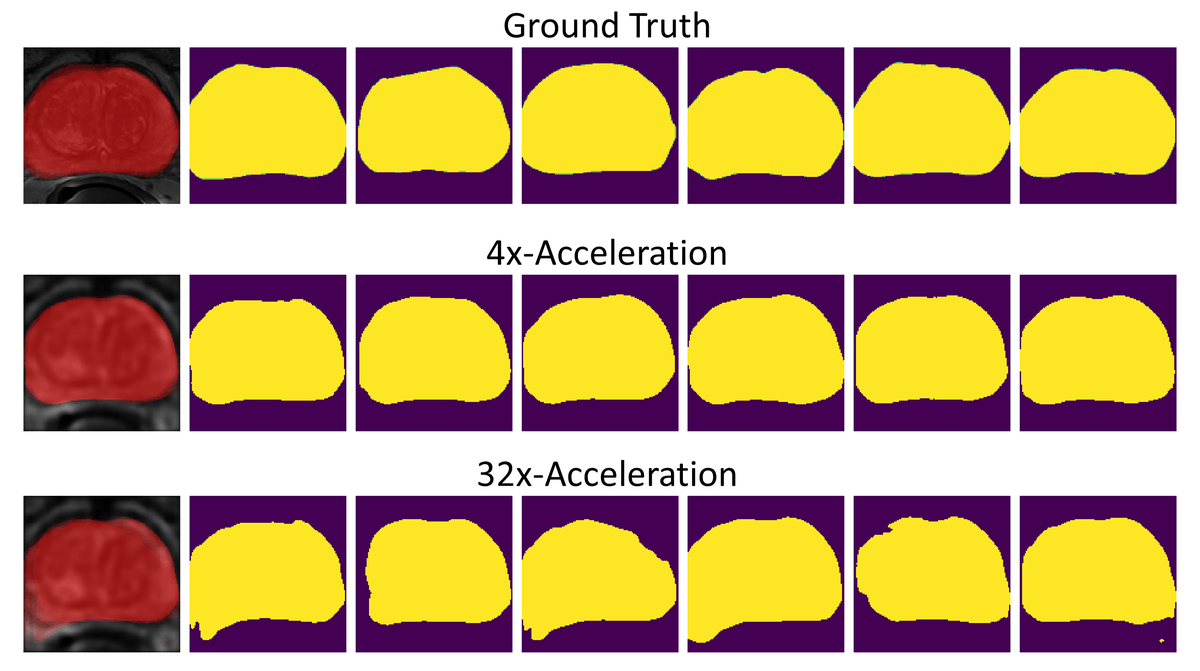
- Beats LOUPE, SeqMRI, and Tackle on QUBIQ 2021 GED at 8x-32x acceleration, degrading much more gracefully at high acceleration.
- Produces calibrated uncertainty by sampling latent variables, giving multiple plausible segmentations for radiologist review. Paper.
- Currently limited to single-coil simulated data and 2D slices; multi-coil and 3D extensions remain future work.
MRI scans are slow because physics forces you to collect a lot of raw frequency data (k-space) to get a clean image. Compressed sensing MRI (CS-MRI) speeds things up by sampling only a fraction of that data and reconstructing the image with a learned model. A new paper accepted at IEEE TPAMI reframes the entire pipeline around a single question: how do you sample the fewest measurements that still contain the information a doctor actually needs?
The framework, called InfoMRI, jointly learns the k-space sampling pattern, the reconstruction network, and the downstream task model (segmentation or classification) by maximizing the mutual information between the undersampled measurements and the clinical task. According to the authors, it is the first task-adapted CS-MRI method that simultaneously delivers probabilistic uncertainty, arbitrary sampling ratios in a single trained model, and support for two very different clinical use cases.
Undersampling breaks certainty
Existing task-adapted CS-MRI pipelines have two chronic issues: they ignore diagnostic uncertainty, and they cannot adapt their sampling patterns end-to-end alongside reconstruction or the clinical task. The uncertainty issue is not academic. When you throw away most of k-space, the mapping from measurement to diagnosis is genuinely one-to-many, especially at low sampling ratios where several different tumors or organ boundaries would produce nearly identical partial data.
Prior end-to-end methods like LOUPE lock in one sampling ratio at training time. Active-acquisition methods can vary the ratio but lean on a frozen reconstruction network, so the two components drift out of alignment. Deterministic segmentation heads simply pick one answer, giving no signal when the answer is ambiguous.