
Indo-Korea Researchers Fix Quantum PCA's Silent Failure With FSPA
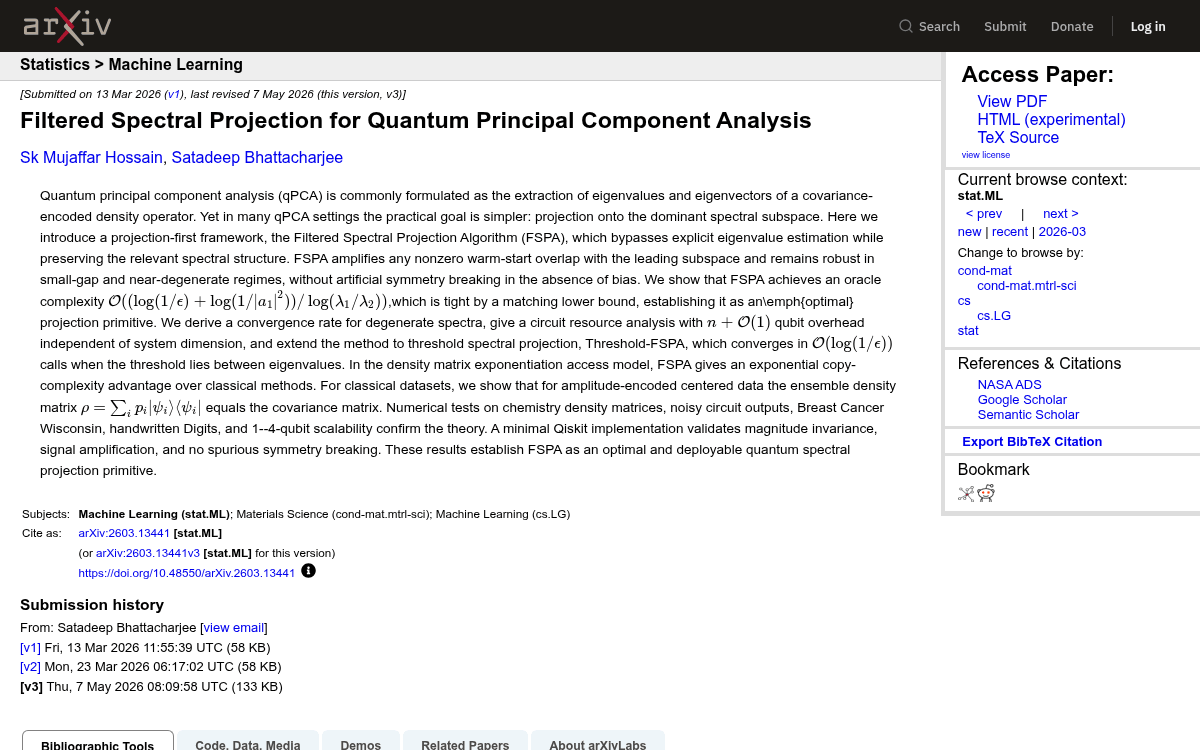
A new quantum PCA method skips eigenvalue estimation entirely, targeting spectral projection directly with provable optimality and robustness to small eigenvalues.
 Pro
Takeaways
- New algorithm FSPA does quantum PCA by projecting onto top eigenspace, skipping eigenvalue estimation entirely. Paper
- Invariant to uniform spectral rescaling, fixing a known failure mode of Lloyd-style qPCA on small eigenvalues.
- Provably optimal: oracle complexity matches a tight lower bound in the spectral-ratio model.
- Uses only n+1 qubits total; gate count independent of system dimension via block-encoding.
- On LiH 1-RDM with gap 0.023: subspace fidelity hits 1.000 while eigenvector fidelity stalls at 0.83.
- Threshold-FSPA variant achieves log(1/epsilon) convergence independent of spectral ratio when threshold sits between eigenvalues.
Quantum principal component analysis has been a poster child for quantum machine learning since Lloyd, Mohseni, and Rebentrost proposed it, but it has a stubborn practical problem: the algorithm can silently fail when eigenvalues are small in absolute magnitude, even if their ratios are perfectly fine. A new paper on arXiv from researchers at the Indo-Korea Science and Technology Center proposes a fix by rethinking what qPCA is actually trying to do.
Their argument is that in most applications, you do not really need the eigenvalues. You need to project data onto the top few directions. So they built an algorithm, called the Filtered Spectral Projection Algorithm (FSPA), that does exactly that and nothing more.
Two failure modes hiding inside qPCA
Standard qPCA relies on quantum phase estimation to pull eigenvalues out of a density matrix. Resolving nearby eigenvalues requires phase estimation time proportional to one over the spectral gap, which is the well-known gap-dependence issue. The subtler problem is magnitude dependence: even when the spectral gap is fixed, algorithms based on phase encoding fail when the absolute scale of eigenvalues is small, because the phase signal becomes indistinguishable from the identity as the eigenvalue approaches zero at finite evolution time.
That is a real problem for noisy density matrices, where every eigenvalue gets shrunk by decoherence. Ordering is preserved, but the whole spectrum gets squished toward zero and phase estimation stops working.
Projection first, eigenvalues never
FSPA sidesteps the whole issue by not computing eigenvalues at all. At the state-update level, FSPA is equivalent to normalized power iteration with an adaptive schedule, wrapped in a form that fits inside quantum circuits via block-encoding.
The algorithm is short enough to sketch in a few lines:
normalize |phi>
beta = 1
for t in range(T):
    for k in range(beta):
        |phi> = rho |phi>
        normalize |phi>
    beta = 2 * beta
return |phi>
Each application of rho is a block-encoded quantum oracle followed by post-selection on an ancilla. The doubling schedule for beta means later rounds apply progressively stronger spectral filtering, and the normalization step is what buys magnitude invariance. The normalized iterates produced by FSPA applied to rho and c times rho are identical at every step, so uniform rescaling of the entire spectrum has no effect whatsoever.
Optimal, with a matching lower bound
The theoretical core is a pair of bounds. FSPA achieves oracle complexity of order log(1/epsilon) plus log(1/|a_1|^2), divided by log(lambda_1/lambda_2), and this bound is tight: a matching lower bound proves FSPA is an optimal projection primitive. In plain terms: convergence speed is set entirely by the ratio of the top two eigenvalues and how much overlap your starting state already has with the target subspace.
Circuit cost is also modest. A circuit resource analysis establishes n plus a constant qubit overhead independent of dimension, meaning you pay one extra ancilla for the renormalization post-selection, plus whatever the block-encoding of rho already needs.
Handling degeneracy without symmetry breaking
Near-degenerate spectra are where standard qPCA gets weird. If the top two eigenvalues are basically equal, individual eigenvectors are not well-defined and tiny perturbations rotate them arbitrarily. FSPA converges to the invariant subspace instead of a specific eigenvector, and initialising in the second eigenstate with zero overlap with the top eigenvector, FSPA converges to that second eigenstate and the overlap with the top eigenvector remains at machine zero, confirming that FSPA amplifies existing spectral bias without creating a spurious preferred direction.
The LiH experiment tells the whole story
The authors ran FSPA on one-body reduced density matrices from full configuration interaction calculations of H2, LiH, and BeH2. The lithium hydride result is the clearest demonstration of the paper's thesis: LiH near-degenerate case with a gap of 0.023: eigenvector fidelity reaches 0.83 while subspace fidelity converges to 1.000.
Same algorithm, same run. If you insist on measuring how well you recovered a specific eigenvector, you get 83 percent. If you measure how well you projected onto the correct two-dimensional subspace, you get essentially perfect. The projection was always the thing you actually wanted.
Additional benchmarks cover:
- Breast Cancer Wisconsin covariance matrices showing that individual eigenvectors rotate under small perturbations while subspace fidelity holds steady
- Depolarizing-noise density matrices from 2-qubit random circuits, where FSPA achieves at least 99% fidelity for noise rates up to 0.10 while Lloyd-style qPCA collapses
- A 1-to-4 qubit scalability study showing oracle counts stay flat with dimension at fixed spectral gap
- A minimal Qiskit AerSimulator implementation that matches the classical reference exactly
Threshold-FSPA: the surprise result
A variant called Threshold-FSPA replaces rho with a shifted, thresholded version that zeroes out any eigenvalue below a chosen tau. When the threshold falls strictly between eigenvalues, projection onto the subspace above the threshold requires only order log(1/epsilon) oracle calls, independent of the spectral ratio. That is a qualitative jump from standard FSPA, which is bounded by the gap ratio. If you know roughly where to cut, you get logarithmic convergence regardless of how close the surviving eigenvalues sit to each other.
Where it fits and where it does not
FSPA is not a claimed speedup over classical power iteration in asymptotic terms. Its role is to serve as a stable quantum spectral primitive within circuits that already operate on quantum-encoded states, for instance as a subroutine in a larger quantum algorithm where rho is accessed via block-encoding rather than as an explicit classical matrix. In the density matrix exponentiation model, the authors argue for exponential copy-complexity advantage over full state tomography, though Tang's dequantization applies to the quantum-inspired sampling model and does not affect this separation.
The paper does not release a standalone repository, but the PDF includes enough algorithmic detail and a described Qiskit implementation for anyone comfortable with block-encoded operators to reproduce the experiments. Data is available on request from the corresponding author.