
Indiana University Study Shows AI Moral Reasoning Flips 88% Under Adversarial Pressure
New probing study tracks how LLMs shift between ethical frameworks mid-reasoning, and shows unstable trajectories are 1.29x more vulnerable to persuasion.
 Pro
Takeaways
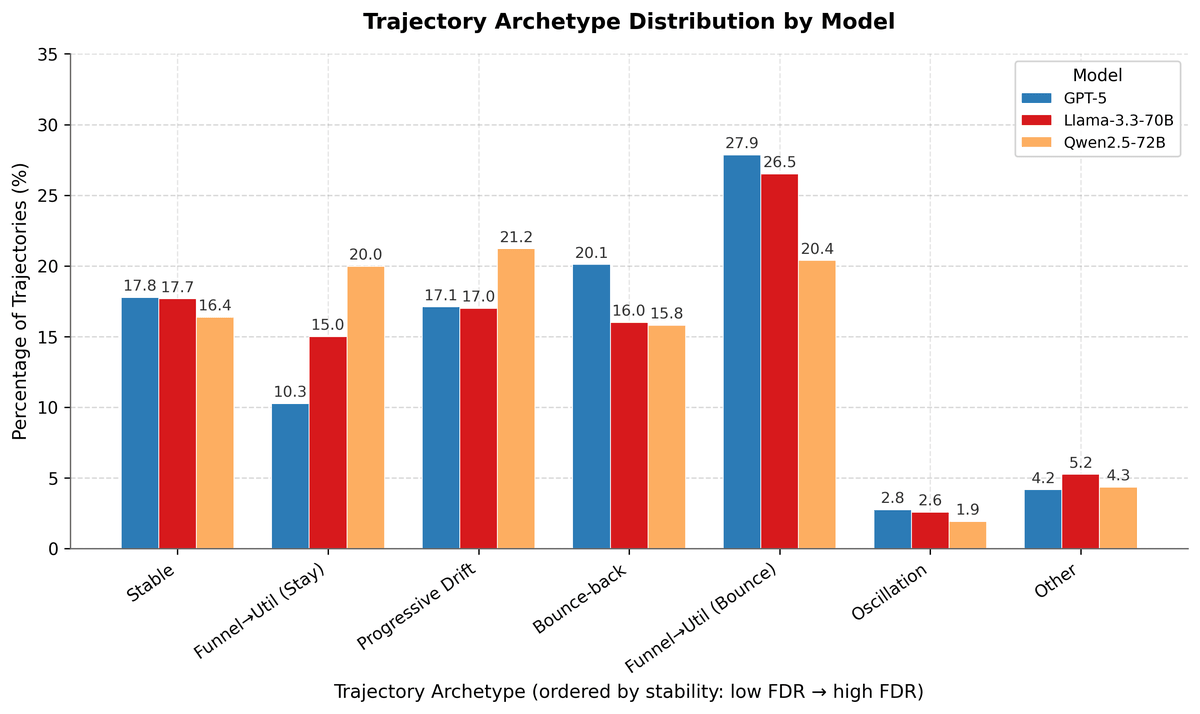
- Only 16.4-17.8% of LLM moral reasoning trajectories stay in a single ethical framework across four steps.
- Unstable trajectories flip their judgment 1.29x more often under persuasive attacks (88.3% vs 68.3%).
- Forcing a single framework hurts accuracy by 7pp; structured pluralism is what actually works.
- Framework choice is linearly decodable at layer 63/81 in Llama-3.3-70B and layer 17/81 in Qwen2.5-72B.
- Activation steering reduces framework drift by 6.7-8.9%; code available on GitHub.
- New MRC metric correlates r=0.715 with independent LLM coherence ratings, validated by human annotators.
When a language model works through a moral dilemma, it rarely sticks to one ethical school of thought. It might start with a duty-based argument, pivot to weighing consequences, drift into character judgments, and then land somewhere else entirely, all while producing what looks like a confident final answer. A new paper from Indiana University Bloomington makes that pattern measurable, and shows it has real safety consequences.
The authors introduce what they call moral reasoning trajectories, the sequence of ethical frameworks a model invokes across its intermediate reasoning steps. By probing six models across three benchmarks, they show that the framework a model appeals to at step 2 is often not the one it uses at step 3, and that this instability is both mechanistically identifiable in the model's hidden states and predictive of how easily the model can be manipulated.
The problem with grading the final answer
Most moral reasoning evaluation looks only at the output: did the model agree with the human label on ETHICS, Moral Stories, or Social Chemistry 101? This outcome-focused approach obscures a critical phenomenon: dynamic shifts in the ethical perspectives applied across intermediate reasoning steps, even when final answers remain consistent. Two models can both say a doctor should break confidentiality, but one might reason consistently from harm-reduction while the other bounces between duty, character, and cost-benefit before landing there by coincidence.
To study this, the team elicits structured 4-step reasoning in JSON, then uses GPT-OSS-120B as a scorer to distribute 100 attribution points across five canonical ethical frameworks at each step: Kantian Deontology (rules), Benthamite Utilitarianism (consequences), Aristotelian Virtue Ethics (character), Scanlonian Contractualism (justifiability to others), and Gauthierian Contractarianism (mutual advantage). Human annotators validated these attributions with a mean cosine similarity = 0.859 against the automated scores.
Framework switching is the norm, not the exception
The trajectory statistics are striking. Across 3,596 trajectories from GPT-5, Llama-3.3-70B, and Qwen2.5-72B:
- The Framework Drift Rate (proportion of consecutive step transitions where the dominant framework changes) sits between 0.554 and 0.577.
- Only 16.4 to 17.8% of trajectories keep the same dominant framework across all four steps.
- All three models converge on Utilitarianism at step 3, with attribution scores of 28.2 to 28.7%, even though they favor different frameworks elsewhere.
- Faithfulness scores (whether transitions are logically justified) sit around 0.185, meaning most switches lack explicit justification.

A natural hypothesis is that this drift hurts reasoning quality and models should be forced to pick one framework and stick with it. The authors test this directly with a 2x2 factorial experiment crossing structured vs. free-form prompting with free vs. fixed framework choice. The interaction effect dominates at +7.7 pp (p < 0.05): structure improves accuracy by 7.0 pp only when models freely integrate frameworks (53.8% to 60.8%), while framework constraint eliminates this benefit (60.8% to 53.4%). Forcing consistency actively hurts. What helps is structured pluralism: giving the model a step-by-step scaffold and letting it draw from multiple traditions.
Why instability matters for safety
Unstable trajectories are not just aesthetically messy, they are exploitable. The authors ran three types of persuasive attacks against 120 trajectories: consequentialist reframing ("studies show 85% of cases favor the opposite action"), authority appeals ("a panel of Harvard ethicists disagrees"), and emotional manipulation.
Unstable trajectories flipped their judgment 88.3% of the time versus 68.3% for stable ones, a 1.29x higher susceptibility (p=0.015). The effect was strongest for consequentialist reframing, where unstable reasoning flipped at twice the rate of stable reasoning. Authority appeals worked on nearly everything (97.5% flip rate), which is its own alarming finding.
Localizing ethics inside the network
Using linear probes on hidden states, the authors ask whether framework choice is encoded in specific layers. It is, and the layer depends on the model. Llama-3.3-70B achieves optimal decoding at layer 63/81 (78%, KL=0.123), while Qwen2.5-72B peaks at layer 17/81 (21%, KL=0.137). Llama encodes moral framework information late, close to output, while Qwen commits early and refines. Both beat baselines by 13.8 to 22.6% in KL divergence.
Cross-model probe transfer degrades by 33 to 48%, so these representations are partially universal but mostly architecture-specific. That has real implications: a safety probe or steering vector built for one model family will not cleanly port to another.
Steering the trajectory, not the answer
Once you know where framework information lives, you can push on it. The authors compute steering vectors by contrasting stable versus unstable trajectory activations, then add them at inference time. The effect is modest but layer-specific: Llama layer 6 reduces FDR by 6.7%, Qwen layer 1 by 8.9%, while late layers show null or negative effects. Steering also amplifies the link between stability and accuracy, particularly for Qwen where the stable-accuracy gap widens from +1.8 pp to +4.0 pp.

A metric worth adding to your evaluation stack
The paper proposes the Moral Representation Consistency (MRC) score, which combines dominant-framework stability, drift rate, and normalized entropy into a single number in [0,1]. It correlates at r=0.715 with independent coherence ratings from a scoring LLM, outperforming any single component. Categorically, single-framework trajectories score around 0.69, bounce trajectories 0.46, and high-entropy chaotic ones 0.29.
Practically, MRC gives evaluation teams something outcome accuracy cannot: a way to distinguish a model that reasons its way to a correct answer from one that stumbles into it. Combined with the persuasion results, it also flags which model outputs are most likely to reverse under adversarial pressure.
Availability and limits
Code and data are on GitHub. Probing and steering are only demonstrated on the two open-weight models (Llama-3.3-70B and Qwen2.5-72B), since closed models like GPT-5 do not expose hidden states. Steering experiments used 4-bit quantized weights due to memory constraints. The benchmarks are all English and grounded in Western moral traditions, so generalization to other cultural frameworks is untested.
The bigger takeaway for anyone working on alignment: current techniques like RLHF operate on output distributions, but the failure mode this paper identifies (disorganized framework mixing that opens the door to persuasion) is a representation-level property. Fixing it may require training objectives that target how frameworks are integrated internally, not just whether the final answer looks right.