
Impermanent Catches Time-Series AI Models Winning on Broken Benchmarks
Impermanent is a live benchmark that scores time-series forecasting models daily on GitHub data, exposing contamination flaws in static evaluations
 Pro
Takeaways
- Impermanent is the first live benchmark for time-series forecasting, scoring models sequentially on continuously updated GitHub data to prevent test-set contamination.
- Static benchmarks are broken for foundation models: pretraining data often overlaps with evaluation sets, inflating reported zero-shot performance.
- The benchmark tracks 400 top GitHub repos across 4 signals (issues, PRs, pushes, stars) at hourly, daily, weekly, and monthly frequencies.
- Early results show TimesFM 2.5 leads overall, but SeasonalNaive's collapse on probabilistic metrics reveals what single-metric static benchmarks miss.
- The evaluation loop is fully automated and contamination-proof: models forecast before ground truth exists, scores update only after outcomes arrive.
- Code and live leaderboard are available at GitHub and impermanent.timecopilot.dev.
Time-series foundation models have been on a winning streak. Models like Chronos, TimesFM, and Moirai routinely top leaderboards, claiming broad generalization across domains. But a new paper asks a pointed question: are those wins real, or are they a product of benchmarks that are fundamentally broken?
The answer, according to researchers from TimeCopilot, Mila, ELLIS Tübingen, and AWS, is that existing evaluation protocols provide surprisingly little evidence of true generalization. Their response is Impermanent, the first live benchmark designed specifically to test whether time-series foundation models (TSFMs) can sustain their performance as the world keeps changing around them.
The Benchmark Problem Nobody Talks About
The standard way to evaluate a forecasting model is simple: freeze a dataset, carve out a test split, train on the rest, and measure accuracy on the held-out portion. This works fine for traditional models. For foundation models, it is a trap.
Many modern benchmarks are assembled by reusing public datasets, meaning evaluation data may overlap with, or remain implicitly connected to, pretraining corpora, leading to hidden information leakage and overly optimistic estimates of zero-shot generalization. The problem is compounded by opacity: in time series, fragmented naming and versioning, weak semantic transparency, and strong temporal dependence make contamination harder to detect than in other modalities.
There is also a subtler issue. Even without direct data leakage, static benchmarks let researchers pick the best-performing model by peeking at test scores during development. That is model selection on the test set, which inflates reported numbers. While current TSFM benchmarking studies rely on historical data for evaluation, they typically evaluate models using many series but with only a single time-based split per series , which means the test window is fixed and can be gamed.
A Benchmark That Never Stops Moving
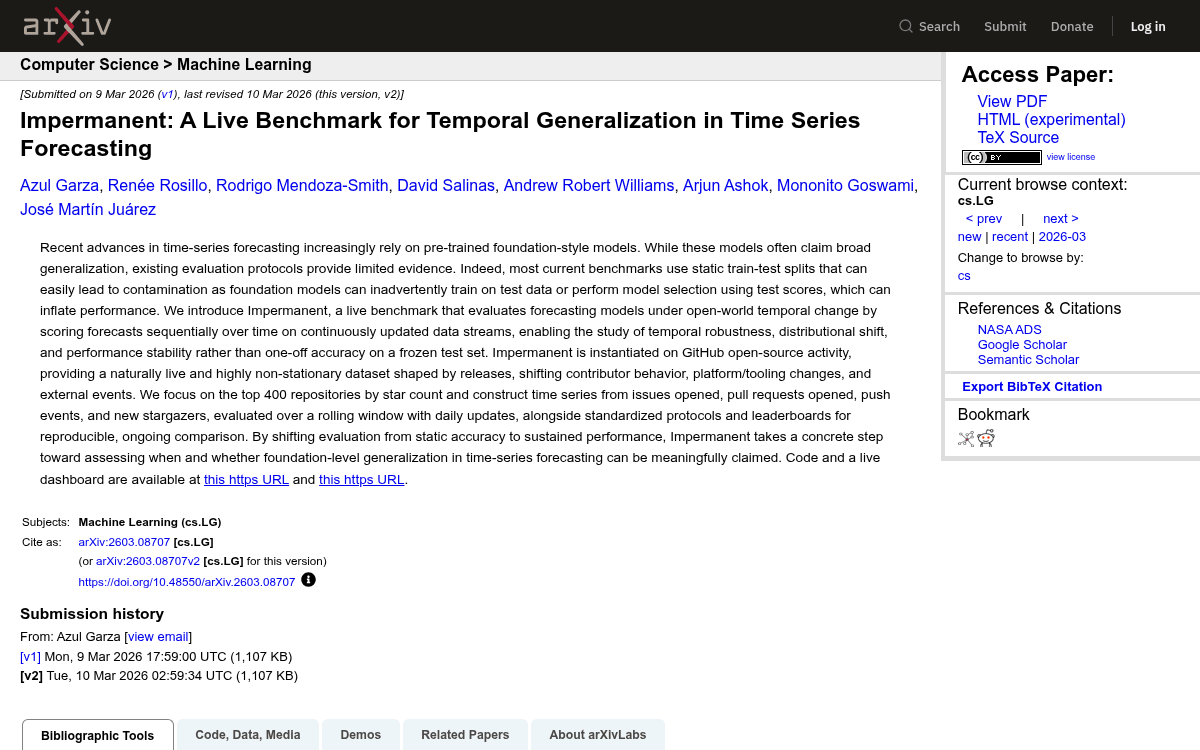
Impermanent sidesteps all of this by making the test set a moving target. It evaluates forecasting models under open-world temporal change by scoring forecasts sequentially over time on continuously updated data streams, enabling the study of temporal robustness, distributional shift, and performance stability rather than one-off accuracy on a frozen test set.
The data source is GitHub. Specifically, Impermanent is instantiated on GitHub open-source activity, providing a naturally live and highly non-stationary dataset shaped by releases, shifting contributor behavior, platform and tooling changes, and external events. The benchmark tracks four signals across the top 400 repositories by star count:
- Issues opened
- Pull requests opened
- Push events
- New stargazers
These signals have properties that make them genuinely hard to forecast. They mix slow, trend-like growth with sudden spikes driven by viral moments, new releases, or community events. A model that memorized historical GitHub data would still struggle because the future behavior of any given repository is shaped by events that have not happened yet.

How the Evaluation Loop Works
The core design principle is prequential evaluation: models must commit to a forecast before the ground truth exists. There is no peeking. Here is the flow:
- At each cutoff date, every model receives a context window of historical observations.
- Models produce point forecasts and probabilistic forecasts (nine quantile levels: 0.1 through 0.9) for the next horizon period.
- Forecasts are stored. Ground truth arrives later.
- Once ground truth is available, scores are computed and the leaderboard updates.
The benchmark runs at four frequencies simultaneously: hourly (24-step horizon), daily (7-step), weekly (4-step), and monthly (1-step). Cutoffs advance one full horizon at a time, so there is no overlap between evaluation windows. The entire pipeline is automated and runs weekly on serverless infrastructure, with results published to a live dashboard.
Two metrics are used. MASE (Mean Absolute Scaled Error) measures point forecast accuracy relative to a seasonal naive baseline. Scaled CRPS (Continuous Ranked Probability Score) measures the quality of the full predictive distribution, not just the point estimate. Both are scaled by a zero-model baseline to make scores comparable across very different series.
What the First Results Reveal
The early leaderboard snapshot, covering data through mid-February 2026, already tells an interesting story. Foundation models dominate the top four spots, but the details are more nuanced than a simple ranking suggests.
Pre-trained foundation models occupy the top four positions, with TimesFM leading on three of four columns. However, the picture is nuanced: SeasonalNaive achieves a competitive MASE rank while showing poor probabilistic calibration, and AutoETS and AutoARIMA attain CRPS ranks comparable to DynOptTheta despite weaker point accuracy.
Here is the full leaderboard from that early snapshot:
| Model | MASE (median) | CRPS (median) | MASE rank | CRPS rank |
|---|---|---|---|---|
| TimesFM 2.5 | 0.609 | 1.055 | 2.98 | 2.04 |
| TiRex | 0.757 | 2.270 | 2.94 | 4.22 |
| Moirai 2.0 | 0.786 | 2.153 | 3.03 | 4.17 |
| Chronos-2 | 0.789 | 2.341 | 3.34 | 4.35 |
| DynOptTheta | 1.522 | 2.494 | 5.84 | 6.09 |
| SeasonalNaive | 1.272 | 2.950 | 5.39 | 9.50 |
| AutoETS | 2.802 | 2.232 | 7.12 | 5.86 |
| AutoARIMA | 3.157 | 2.258 | 7.84 | 5.84 |
| AutoCES | 2.272 | 2.385 | 7.29 | 6.43 |
| Prophet | 4.264 | 6.713 | 9.79 | 8.64 |
| HistoricAverage | 4.740 | 3.669 | 9.94 | 8.40 |
The SeasonalNaive result is worth pausing on. It ranks 5th on point accuracy but 9th on probabilistic calibration. That gap reveals something important: a model can look competitive on a single metric while being genuinely bad at quantifying its own uncertainty. Static benchmarks that report only MASE would miss this entirely.

Why This Matters Beyond GitHub
The GitHub data is a means to an end. What Impermanent is really testing is whether a model's learned representations hold up when the world keeps changing. Because Impermanent scores models sequentially over an evolving stream, these rankings will shift as new cutoffs accumulate, making it possible to track whether early advantages persist under continued distributional shift rather than taking any one leaderboard snapshot as definitive.
This is a fundamentally different question from what existing benchmarks ask. GIFT-Eval, the Monash Forecasting Repository, and similar suites measure cross-sectional generalization: can a model trained on some data forecast different data? Impermanent measures temporal generalization: can a model keep forecasting accurately as the underlying distribution evolves month after month?
The distinction matters for anyone deploying forecasting models in production. Real systems face concept drift, structural breaks, and regime changes. A model that aced a static benchmark in 2024 may quietly degrade through 2025 with no one noticing until it causes a real problem.
Limitations and What Comes Next
The current version of Impermanent has real constraints worth knowing:
- Single domain: Only GitHub activity data is included in this first release. The framework is designed to expand, but the current leaderboard reflects one slice of the world.
- Univariate only: Each repository-event pair is forecast independently. Cross-repository correlations and external covariates are not yet used.
- Foundation model advantage may be real or residual: It is too early to tell whether TSFMs lead because of genuine generalization or because GitHub-like data appeared in their pretraining corpora. The live evaluation will help answer this over time.
- GPU required for foundation models: All four TSFMs run on NVIDIA A10G GPUs, while statistical baselines run on CPU, so infrastructure costs differ significantly.
The authors plan to expand to additional live data streams, add auxiliary contextual information as covariates, and extend evaluation horizons. All pipeline code, evaluation logic, and leaderboard infrastructure are open source and fully automated, meaning new models can be added without reprocessing historical data.
The deeper ambition is to build a shared resource that answers a question the field has been avoiding: does strong benchmark performance in a static setting actually predict reliable performance after deployment? Impermanent is designed to find out.