
Imperial College's Touch G.O.G. Folds Laundry With One Arm and No Cameras
A single-arm robot handles cloth like it has two hands, using a nested gripper design and tactile sensors to slide along fabric edges without any cameras watching.
 Pro
Takeaways
- Touch G.O.G. enables bimanual cloth manipulation with a single arm via a nested gripper-on-gripper design
- Perception stack uses SAM-backboned ViT for classification (PC-Net) and edge pose regression (PE-Net)
- SD-Net generates 30,000 synthetic tactile images from just 100 manual annotations to train PE-Net
- Achieves 96% contact-region classification, 0.59mm edge localization, and 4.52 degree orientation error
- Real-world unfolding succeeds 24/35 times on flat and 20/35 on crumpled cloth without any cameras
- Paper and supplementary at arXiv and project page
Folding laundry sounds trivial until you try to make a robot do it. Fabric is floppy, high-dimensional, and constantly hides itself from any camera you point at it. The standard workaround has been to bolt two robot arms together and let them coordinate, which balloons cost and control complexity. A team from the Robot Intelligence Lab at Imperial College London has taken a different route with Touch G.O.G., a single-arm system that fakes bimanual dexterity through a gripper-inside-a-gripper design and closed-loop tactile perception.
The headline numbers: 96% accuracy in distinguishing edges, corners, interior regions, and grasp failures, sub-millimeter edge localization, and 4.5 degrees of orientation error. Real-world results demonstrate reliable cloth unfolding, even for crumpled fabrics, using only a single robotic arm. All of that runs from tactile images alone. No external cameras.
Why cloth breaks conventional robotics
Rigid-body control assumes an object has a predictable shape you can plan around. Fabric does not. Wrinkles, folds, and self-occlusion mean that global cameras lose sight of the features (corners, hems, edges) that matter most for manipulation. Prior work leaned heavily on dual-arm systems to stretch cloth taut and expose those features, but that means coordinating collisions between two expensive arms.
An earlier project from the same lab, G.O.G. (Gripper-on-Gripper), replaced the second arm with a nested mechanical design. The first gripper independently regulates the span, up to 500mm, between its fingers which are in turn also grippers. Touch G.O.G. is the sensorized, learning-enabled successor to that hardware.
The hardware: two grippers, one arm, tactile skin

The end-effector splits into two modules. The Decoupled Width Control Gripper (D-WCG) is the outer frame: a dual-rail linear stage where each finger carriage is driven by its own stepper motor via a timing belt. Independent actuation lets the fingers assume asymmetric positions to match irregular cloth geometries, and the belt-driven transmission was chosen for stiffness so the finger separation actually tracks the commanded position when fabric pulls back.
Each of those outer fingers ends in a Tactile Variable Friction Gripper (T-VFG), the inner active interface. Each T-VFG carries a DIGIT vision-based tactile sensor (an internal camera pressed against an elastomer pad) and adds an abduction degree of freedom driven by a compact DC motor. That extra rotational axis is the trick that lets the gripper re-orient contact against a fabric edge without moving the whole arm.
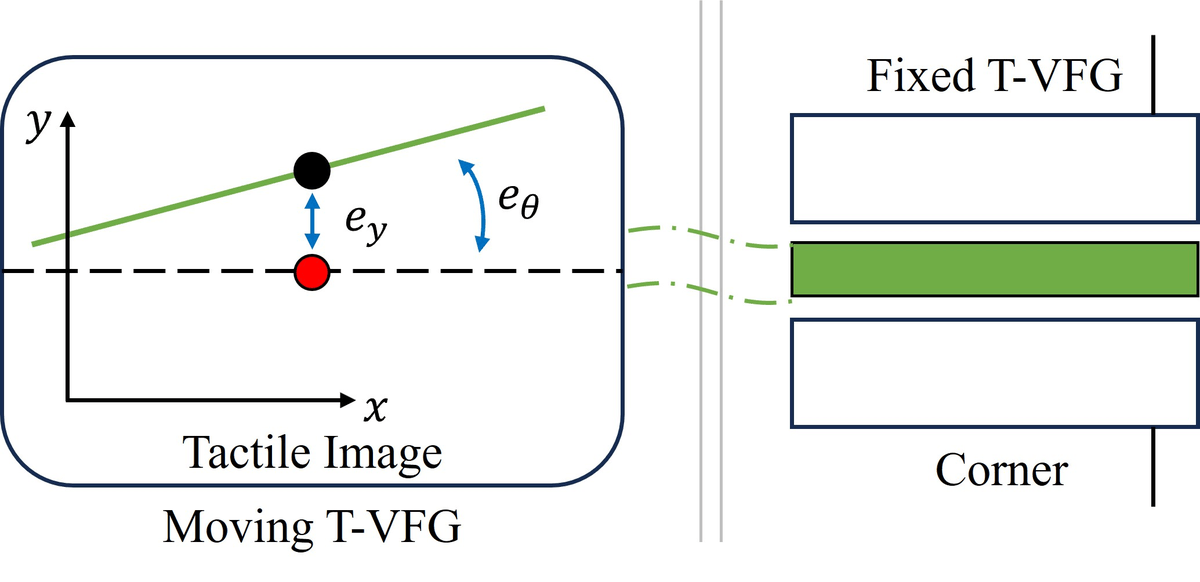
A PID loop with derivative filtering via exponential smoothing regulates both the grasping width and abduction angle. During sliding, two PD controllers coordinate the UR5 arm's yaw and the T-VFG abduction to keep the detected edge centered in the tactile image, with a feed-forward term that compensates for the coupling between end-effector rotation and perceived edge tilt.
Perception without cameras

The perception stack has three networks, all built on the Segment Anything Model (SAM) as a Vision Transformer backbone. The choice matters: SAM was trained on billions of segmentation masks, so its features transfer well to novel textures without task-specific pretraining.
- PC-Net classifies each contact into edge, corner, in-fabric, or grasp failure. It stacks the last five tactile frames along a temporal dimension, then uses SAM patch embeddings feeding a convolutional head. Temporal aggregation is a simple average across frames.
- SD-Net is the data engine. It is a SAM-backboned encoder-decoder that turns crude edge annotations into synthetic tactile images. Training uses a weighted combination of MSE and SSIM loss to preserve both pixel accuracy and structural similarity.
- PE-Net regresses the edge center position (x, y) and orientation theta. It swaps PC-Net's classification head for a regression head and is trained with MSE for position plus a cosine similarity angular loss that respects the periodicity of angles.
The synthetic pipeline is the practical breakthrough. From only 100 manually annotated tactile edge images, SD-Net generates 30,000 diverse synthetic samples. A t-SNE analysis shows the synthetic points span a broader region of latent space than the real dataset, filling in edge orientations and contact patterns that would rarely be captured by hand.
How the numbers stack up
On edge pose estimation, PE-Net trained with synthetic data delivers 0.59 mm mean distance error and 4.52 degrees angular error. That beats a ViT baseline (0.83 mm, 5.35 degrees), a DenseNet (1.04 mm, 7.03 degrees), and classical Harris-style edge detection (3.38 mm, 50.22 degrees) by wide margins. Ablating the synthetic data pushes error up to 0.78 mm and 5.52 degrees, confirming SD-Net earns its keep.
For the real-world sliding task, the robot starts with one T-VFG grasping a corner and the other tasked with sliding along the edge until it reaches the opposite corner. Success is measured only by tactile classification; no vision is allowed for corner detection or pose correction.
| Configuration | Flattened | Crumpled |
|---|---|---|
| Template fabrics (TF1-TF4) | 14/20 | 11/20 |
| Unseen fabrics (PT1, LB1, PT2) | 10/15 | 9/15 |
| Overall | 24/35 | 20/35 |
Roughly 69% success on flat cloth and 57% on crumpled cloth, across patterned towels, a linen blanket, and unseen fabrics. Not perfect, but this is entirely tactile control, no camera assistance, on fabrics with wrinkles and non-uniform thickness.
What it is good and bad at
Touch G.O.G. is compelling when self-occlusion is unavoidable: hand-over-hand edge tracing, unfolding crumpled fabric, or any manipulation that buries the contact point under folds. It also swaps a second arm's cost for a more elaborate end-effector, which is a favorable trade for domestic and healthcare robotics where space and budget matter.
The limits are visible in the results and the paper's own conclusions. Crumpled trials still fail 43% of the time. The controller starts each experiment with one corner already correctly grasped, so upstream corner-finding is assumed rather than solved. The authors flag scaling to larger garments and multi-step tasks like folding or dressing as future work, likely requiring force-torque sensing or a return of global vision in a coordinated role.
Availability
The paper does not release code or trained weights in the arXiv version. Supplementary videos and hardware details are hosted at the project site, sites.google.com/view/touchgog. The predecessor G.O.G. gripper design has its own supplementary page covering CAD and mechanism details, which is useful context for anyone considering building the platform.