
Imperial College's Pore-Scale GNS Simulates Underground Fluid Flow 10,000x Faster
A graph network simulator plus 3D U-Net learns pore-scale multiphase flow from synchrotron velocimetry, replacing day-long simulations with seconds of inference.
 Pro
Takeaways
- Pore-Scale GNS learns multiphase flow in porous rocks directly from 4D synchrotron micro-velocimetry data.
- Couples a graph network for tracer particles with a 3D U-Net for the fluid-fluid interface, tied together by pore geometry.
- Delivers 10^3 to 10^4x speedup: 5 seconds of inference replaces hours to days of direct numerical simulation.
- Achieves R-squared of 0.9999 on 30-step particle trajectory rollouts and Dice scores above 0.98 for interfaces.
- Zero-shot transfer to Ketton limestone works partially, with NRMSE rising from 12.5% to 16.4%.
- Code and experimental datasets are publicly released for reproduction and extension.
Simulating how two immiscible fluids fight through the microscopic maze of a rock, one droplet at a time, is one of the ugliest problems in computational physics. It underpins everything from geological CO2 storage to underground hydrogen reservoirs, and yet the standard tools either idealize the geometry into a cartoon network of tubes or spend days on a supercomputer resolving one small sample. A team from Imperial College London, Ghent, Stanford, Yale, and NVIDIA has now trained a hybrid neural surrogate that learns this physics directly from 4D X-ray experiments and rolls it forward in seconds.
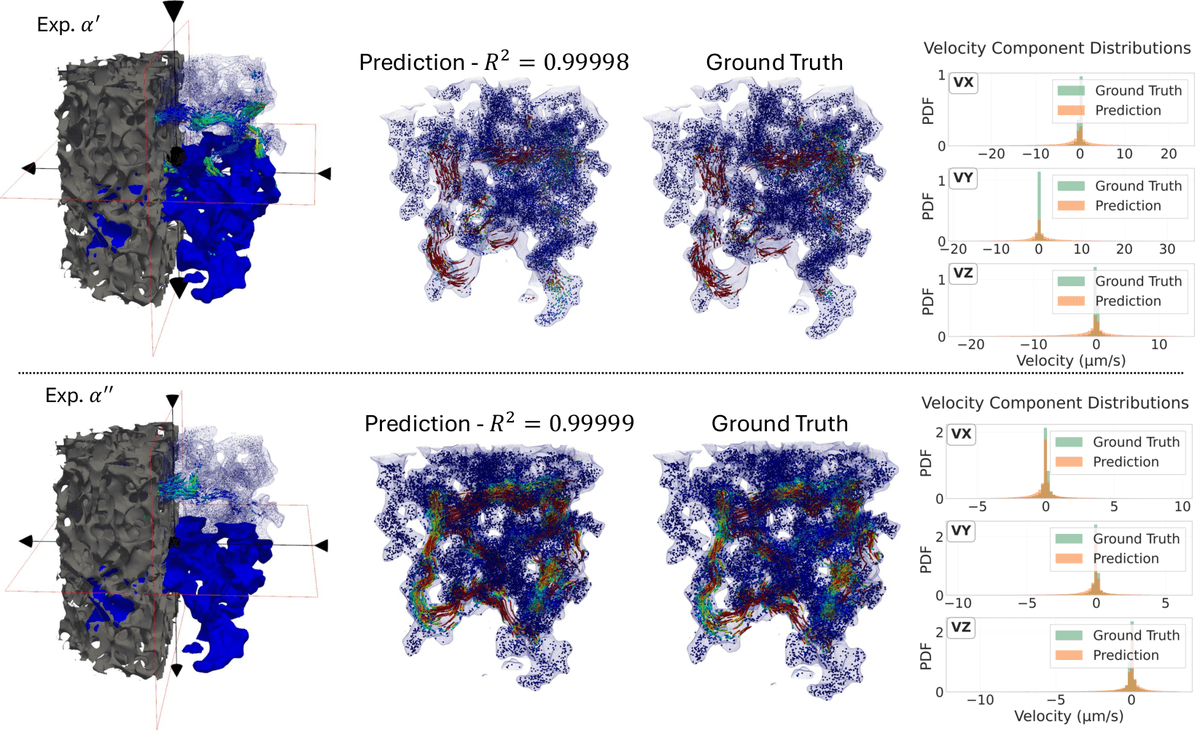
The system, called Pore-Scale GNS, is the first ML architecture to learn multiphase pore-scale flow directly from time-resolved experimental measurements rather than from simplified simulations. Trained on synchrotron micro-velocimetry data, it predicts both the velocity of tracer particles in the fluid and the evolving fluid-fluid interface, and it achieves a 10^3 to 10^4-fold speedup over direct numerical simulation.
Why pore-scale flow breaks conventional solvers
At the scales relevant to carbon storage, capillary forces dominate viscous ones. The relevant capillary number sits near 10^-6, which means interface tension is orders of magnitude stronger than the pressure gradient pushing the fluid. In that regime the flow is punctuated by sudden reconfigurations called Haines jumps, where a meniscus snaps forward through a pore throat and radiates a nonlocal velocity perturbation across the sample.
Pore-network models efficiently explore topology-controlled displacement but rely on quasi-static invasion rules and idealized throat geometries, and lattice Boltzmann methods directly resolve interfacial hydrodynamics but are constrained by diffuse-interface assumptions and limited density ratios. Both hit a scale wall: faithfully representing sub-pore effects requires boundary conditions at nanometer resolution over millimeter-centimeter domains, a constraint that remains computationally intractable.
Experiments do not have this problem. Synchrotron-based facilities now achieve micrometer-scale spatial resolution and sub-second temporal resolution, and when combined with tracer particles, 4D micro-velocimetry simultaneously resolves pore-scale velocity fields and fluid-fluid interface evolution. That is what the authors feed to their model.
Two networks, tightly coupled
The architecture treats the flow with two complementary representations that talk to each other every step.

- Graph Network Simulator (GNS). Each tracer particle is a node in a graph, connected to neighbors within a physical correlation radius. Iterative message passing propagates local flow information across the network, encoding the long-range velocity correlations characteristic of capillary-dominated displacement, a feature that isotropic grid-based methods cannot readily replicate.
- 3D U-Net. The evolving fluid-fluid interface is represented as a binary voxel occupancy field. An encoder-decoder with skip connections predicts the next frame conditioned on the past two interface states, the interpolated velocity field from the GNS, and the static dry-rock geometry.
The imaged pore geometry acts as a hard boundary constraint for both networks, and the two are coupled autoregressively: velocities from the GNS get max-pooled onto a voxel grid and fed to the U-Net; the U-Net's predicted interface is fed back to the GNS so particle motion respects the evolving phase boundary. That coupling matters. In ablations, removing interface and structure inputs from the GNS produced strongly unphysical behavior, with particles predicted to escape the nonwetting phase region. Going the other direction, adding the velocity field to the U-Net improved the interface Dice score from 0.84 to 0.94 and eliminated disconnected-fluid artifacts.
Training data straight from a beamline
The training set came from an earlier experiment by Bultreys and colleagues at the Swiss Light Source. Silicone oil was injected into brine-saturated sintered glass filters with a mean pore size of 122 microns and porosity of 27 percent, tracked using 10-micron silver-coated hollow tracer spheres at a capillary number of roughly 5.5 x 10^-6. Imaging was performed at 2.75 micron voxel resolution and 0.25 seconds per frame, yielding full 3D reconstructions of both the interface and Lagrangian particle trajectories over a 50-second window.
Training uses the first 150 frames of one experiment. Rollout robustness comes from injecting Gaussian noise into particle positions during training, and from a Kalman smoother with constant-acceleration dynamics that denoises the raw tracked trajectories before the model ever sees them.
What the numbers look like
On the held-out extrapolation window, the model predicts particle positions with an R-squared of 0.9999 across 30 rollout steps (roughly 7.5 seconds of physical time). Interface reconstruction stays sharp: Dice scores exceed 0.98 in both training and test settings, with volume error below 0.4 percent and comparably low surface area error over the 30-frame rollout.

Generalization is tested at three levels. Within the same sintered glass sample but a different meniscus configuration and flow rate, the model transfers cleanly. The harder test is zero-shot transfer to Ketton limestone, a totally different rock with mean pore size 122 microns and 27 percent porosity for the sintered glass filter versus 52 microns and 14 percent for Ketton. Here performance degrades: NRMSE relative to the 99th-percentile velocity rises from 12.5 percent on the in-distribution case to 16.4 percent on Ketton, indicating partial but non-trivial statistical agreement under cross-rock domain shift.

The speedup that changes what is doable
Wall-clock is where this becomes interesting. Even with substantial computational resources such as 80 parallel NVIDIA V100 GPUs, numerical simulations for cases comparable to this one require between 2 and 20 hours of wall-clock time, depending on capillary number and initialization quality. The learned surrogate needs roughly 200 autoregressive steps to reproduce a 50-second experiment, and inference runs at a constant rate of roughly 0.027 seconds per step on a single NVIDIA A100 (80 GB), regardless of capillary number or boundary-condition complexity. Total inference: about 5 seconds.
What it is good for, and where it breaks
The obvious use cases are the ones the authors call out: rapidly exploring injection scenarios and pore-geometry effects for subsurface CO2 and hydrogen storage. Because the model reproduces both velocity and interface evolution, it also opens the door to studying capillary trapping, dissolution efficiency, and interfacial stability without launching a full lattice-Boltzmann campaign for every configuration.
The honest caveats:
- Autoregressive drift. The failure-mode analysis shows agreement is strong through the first 45 or so frames, but visible deviations emerge by frame 70 as errors accumulate.
- Cross-rock transfer is only partial. Ketton results are physically plausible in aggregate but show localized degradation in specific pore regions.
- Training data is scarce. Synchrotron 4D velocimetry requires dedicated beamtime and specialized sample preparation. The current model is trained on essentially one sample geometry.
Code, training scripts, and benchmarks are available in the pore_gns GitHub repository, and the experimental datasets are hosted at the PSI Public Data Repository. For anyone working on porous-media simulation, reactive transport, or subsurface storage modeling, this is a concrete demonstration that experimental 4D data can substitute for scarce simulation ground truth when the coupling between representations is designed carefully.