
Imperial College's MaDiS Converts Text to Sign Language 40% Faster
A new masked diffusion approach for text-to-sign generation delivers bidirectional context, parallel decoding, 40% higher throughput, and state-of-the-art quality.
 Pro
Takeaways
- MaDiS replaces autoregressive sign language generation with a masked diffusion language model based on Qwen3-0.6B-Base.
- Bidirectional attention and parallel decoding deliver 132 tokens per second, a 40% throughput gain over SOKE.
- Tri-level pretraining across token, latent VQ-VAE, and 3D physical spaces injects grounded sign knowledge.
- Unmasking with Temporal Checkpoints imposes coarse-to-fine order, cutting unmasking permutations by over 10^41 times.
- New metrics SiBLEU and SiCLIP correlate with human ratings better than the standard DTW error.
- Sets state-of-the-art on CSL-Daily, Phoenix-2014T, and How2Sign; code and models to be released.
Translating written text into fluid sign language motion has quietly become one of the hardest generation problems in multimodal AI. It combines the linguistic structure of language with the fine-grained kinematics of two hands and a body, and until now the leading approaches have leaned on autoregressive language models that generate one token at a time, left to right. A new method called MaDiS from Imperial College London rethinks that pipeline using masked diffusion language models, and the numbers suggest the switch is worth paying attention to.
Why left-to-right hits a wall
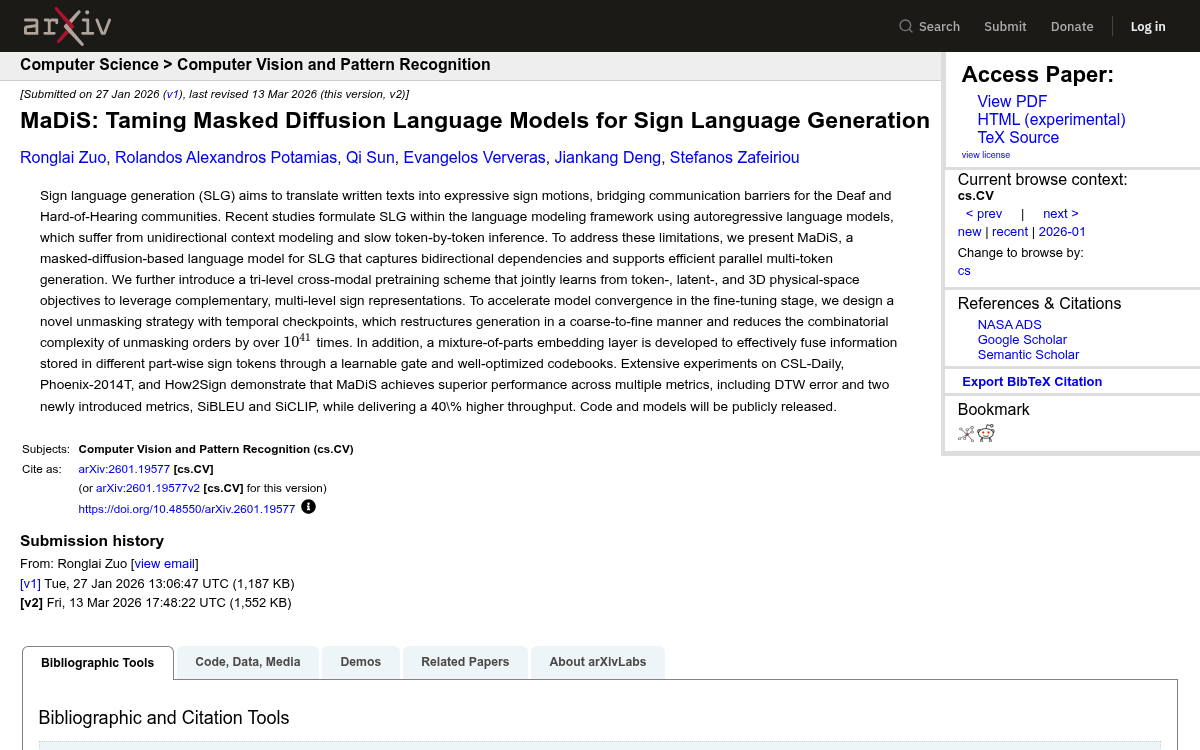
Sign language generation (SLG) aims to turn written text into expressive sign motions that bridge the gap between hearing and Deaf and Hard-of-Hearing communities. Recent studies formulate SLG within a language modeling framework by tokenizing sign motion and predicting tokens autoregressively, but these autoregressive language models have two main limitations: their left-to-right generation order restricts the use of bidirectional contexts and their one-token-at-a-time decoding introduces an inference bottleneck.
That matters because signs are not a linear string of phonemes. A single sign often depends on what comes after it, mouth shape modifies handshape, and the two hands can carry independent information. Generating token 5 without seeing tokens 6 through 100 leaves a lot of context on the table.
Swapping autoregression for masked diffusion
MaDiS is built on masked diffusion language models (MDLMs), the same family behind LLaDA. Instead of predicting the next token, an MDLM starts from a fully masked sequence and iteratively unmasks tokens in parallel, with full bidirectional attention over the whole sequence. This mechanism enables MDLMs to construct model distributions with bidirectional dependencies, allowing them to capture richer contextual information, and during the reverse process multiple tokens can be sampled simultaneously, thereby improving inference efficiency.
Concretely, the authors instantiate the MDLM with Qwen3-0.6B-Base and replace the causal attention mask in each transformer layer with a non-causal one. Sign motions themselves are discretized using a decoupled tokenizer consisting of three parallel VQ-VAEs responsible for different body parts: the upper body, left hand, and right hand.

Pretraining across three representation spaces
The biggest conceptual bet in the paper is that a sign generation model should learn from multiple views of what a sign actually is. MaDiS is pretrained simultaneously in three spaces:
- Token space: standard mask-then-predict cross-entropy on both text and sign tokens.
- Latent space: a JEPA-style objective that predicts the VQ-VAE code embeddings of the masked tokens using a smoothed L1 loss.
- 3D physical space: the hidden states are pushed through the frozen VAE decoder and matched against the ground-truth SMPL-X sign motion.
Unlike existing works that mask and reconstruct sign poses, MaDiS masks tokens but reconstructs poses, which is more challenging and encourages the model to learn more grounded sign representations. The ablation table shows each level adds real value: turning on all three levels drops DTW-JPE on CSL-Daily from 6.93 to 5.99 and boosts sentence-level retrieval (R@1) from 31.49 to 38.61.
Taming the exploding order of unmasking
Masked diffusion has one nasty property during fine-tuning: the model can unmask tokens in an absurd number of possible orders, which slows convergence. When generating 100 tokens with 4 tokens per step, the number of possible unmasking orders reaches roughly 2.9 times 10 to the 123.
MaDiS constrains this with Unmasking with Temporal Checkpoints (UTC). Inspired by VAR, which adopts a coarse-to-fine generation scheme with progressively enhanced resolution, the reverse process is divided into three stages at t=0.75 and t=0.5, where 1/4 and 1/2 of the tokens have been unmasked respectively. Both pivot states are enforced to contain uniformly distributed tokens, while a standard confidence-based unmasking strategy is applied within each stage.
The effect is a coarse-to-fine timeline of generation (first sketch every fourth frame, then every second, then fill in the rest) that reduces the number of orders by 10 to the 41 times compared to the vanilla unmasking strategy. Training loss drops faster and validation quality improves at the same epoch.

A gated embedding for body-part tokens
Because sign tokens are split across body, left hand, and right hand, MaDiS uses a Mixture-of-Parts (MoP) embedding layer. It is a dense mixture-of-experts fusion where a learnable gate weights the three part-wise code embeddings before feeding them into the transformer. The visualized gate weights are interpretable: for single-handed signs the layer assigns higher weight to the active hand, and for two-handed signs the weights become roughly balanced.
New metrics: SiBLEU and SiCLIP
The authors argue that the standard DTW error is too generous because it aligns sequences before measuring distance, and back-translation adds its own errors. They introduce two alternatives:
- SiBLEU: BLEU computed directly over generated sign tokens against ground-truth tokens, giving a fast, token-level precision signal.
- SiCLIP: a CLIP model trained on ground-truth sign-text pairs, used for sign-to-text retrieval evaluation in a joint embedding space.
In a user study with five professional CSL signers, SiBLEU and SiCLIP exhibit strong correlation with human ratings, whereas DTW, based on minimum-distance alignment, shows weaker correlation.
Benchmarks and speed
MaDiS is evaluated on CSL-Daily, Phoenix-2014T, and How2Sign, which contain 20K/8K/35K video-text pairs for Chinese, German, and American sign languages respectively. It sets a new state of the art on every dataset and every metric reported. On CSL-Daily, body DTW-JPE drops from SOKE's 7.29 to 5.99, SiBLEU-Body rises from 2.71 to 4.87, and retrieval R@1 jumps from 25.05 to 38.61.
Speed is arguably the more practical story. Across all test samples of the three datasets, MaDiS achieves a throughput of 132 tokens per second, a 40% improvement over SOKE with KV caching, enabling the generation of a 400-frame (100-token) video in only 0.76 seconds. The user study rated MaDiS at 6.9 out of 10 versus SOKE's 4.6, with ground-truth motion capped at 8.4.

What it is good for, and what it is not
MaDiS generates 3D SMPL-X sign motion, not photorealistic video, so it is best positioned as the middle stage in a pipeline that later renders those motions into avatars or synthesized video. If your work touches accessibility tooling, avatar-based sign interpretation, or motion generation research, the combination of bidirectional context, 100-token parallel decoding, and interpretable part-wise gates is directly useful. It is less suited for gloss-based or end-to-end video-generation setups, and the released model is 0.6B parameters, so expressiveness on completely open-domain prompts will still be limited by dataset scale.
The authors state that code and models will be publicly released, and the paper is available on arXiv alongside the PDF version. For anyone tracking the broader shift from autoregressive to diffusion-based language models, MaDiS is a clean case study in what that shift buys you outside of pure text.