
Imperial College's Lite Any Stereo Beats Giant Models at 1% of the Cost
A compact stereo depth model from Imperial College London matches heavyweight networks at under 1 percent of the compute, topping four zero-shot benchmarks.
 Pro
Takeaways
- Lite Any Stereo achieves state-of-the-art zero-shot stereo depth at under 1% of the compute of accurate methods.
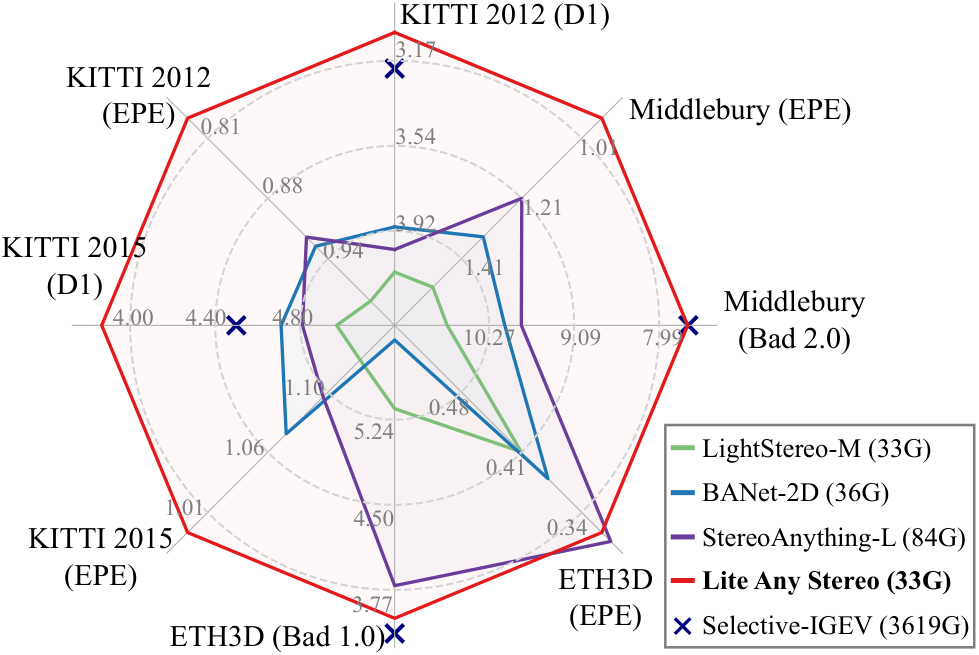
- Ranks 1st on KITTI 2012, KITTI 2015, ETH3D and Middlebury zero-shot benchmarks among efficient models.
- Uses a hybrid 3D-then-2D cost aggregation with only ~5% of compute allocated to 3D blocks.
- Three-stage training: synthetic supervision, self-distillation, then pseudo-label distillation on 0.5M real pairs.
- Beats teacher model FoundationStereo on DrivingStereo weather despite training only via distillation.
- Accepted at CVPR 2026, code available at github.com/TomTomTommi/LiteAnyStereo.
Stereo matching has followed the same script as most of computer vision: bigger backbones, more parameters, better numbers. Foundation-model-based stereo networks now dominate zero-shot leaderboards, but they consume the kind of compute that rules out embedded deployment. A team from Imperial College London is pushing back with Lite Any Stereo, a lightweight model that ranks first across four widely used real-world benchmarks while requiring less than 1% of the computational cost of state-of-the-art accurate methods.
The paper, accepted at CVPR 2026, argues that efficient stereo networks were never fundamentally incapable of zero-shot generalization. They were trained wrong and structured wrong. Fix both, and a 33 GMAC model can trade blows with a 12,824 GMAC one.
Why efficient stereo kept losing
Stereo matching estimates per-pixel disparity between a rectified left and right image, which maps directly to depth. The dominant architectures build a cost volume, a tensor that scores how well each pixel in the left image matches candidate positions along the corresponding row in the right image, then aggregate that volume with 3D or 4D convolutions.
Accurate networks like FoundationStereo and MonSter get zero-shot generalization by piping in features from monocular depth foundation models such as DepthAnything V2. That works, but it inflates the compute budget by an order of magnitude or more. Efficient networks avoid the foundation-model tax by using 2D cost aggregation, which collapses the disparity axis into channels. The result is fast inference but weaker cross-domain performance, because this strategy does not explicitly model structured continuity along the disparity dimension.
The authors' insight is that you can keep most of the 2D efficiency while sprinkling in just enough 3D reasoning to recover disparity awareness.
A hybrid cost aggregator that stays cheap

The backbone is deliberately conventional. Features come from a MobileNetV2 pretrained on ImageNet without external priors, extracted at 1/4, 1/8, 1/16 and 1/32 resolution and fused back to 1/4. A standard dot-product correlation builds the cost volume.
The interesting part is the aggregation module. Rather than the bilateral 2D-plus-3D sum used in prior work, the team tried four hybrid designs and settled on a serial 3D-then-2D configuration where a small 3D block first aggregates over disparity and space, followed by ConvNeXt-style 2D layers for spatial refinement. The 3D component is kept intentionally tiny. Ablations show that increasing the proportion of 3D blocks degrades performance, particularly on Middlebury under limited MACs. Around 5% of compute in 3D is the sweet spot.
Unlike FoundationStereo, which benefits from large 3D kernels, Lite Any Stereo works best with plain (3,3,3) kernels. Bigger is not always better once the model gets small.
Three stages to close the sim-to-real gap

Architecture alone does not deliver zero-shot performance. The training recipe does most of the work, running in three stages:
- Supervised pretraining on 1.8M synthetic pairs. The mix combines SceneFlow, FallingThings, FSD, CREStereo, VKITTI2, TartanAir and Dynamic Replica. The team deliberately excludes IRS, Sintel, Spring and InfinigenSV due to annotation quality issues or domain mismatch.
- Self-distillation for robustness. A teacher and student share the Stage 1 weights. The teacher receives clean inputs, while the student is fed perturbed inputs to encourage learning of domain-invariant representations via feature alignment, using cosine similarity between feature maps. Surprisingly, freezing the teacher outperforms EMA and hard-copy updates.
- Pseudo-label distillation on real data. 0.5M unlabeled real-world stereo pairs from Flickr1024, InStereo2K, Holopix50K, DrivingStereo, SouthKenSV and UASOL, with pseudo disparities produced by FoundationStereo. Even for datasets with ground truth, dense pseudo labels are preferred over sparse LiDAR annotations.
Data quality beats data scale here. Adding the 18M-pair Stereo4D dataset actually hurts, because its 512x512 resolution is too limited, and HRWSI's rectification quality is poor.
The numbers
Trained on million-scale data and evaluated zero-shot on KITTI 2012, KITTI 2015, ETH3D and Middlebury, Lite Any Stereo posts the best score in every column against other efficient methods, and matches or beats non-prior accurate networks. On KITTI 2015 D1 it hits 3.87 versus Selective-IGEV's 4.50, while on Middlebury Bad 2.0 it scores 7.51 against Selective-IGEV's 7.50. The compute gap: 33 GMACs versus 3619 for Selective-IGEV and 12824 for FoundationStereo.
An unusual result appears on the DrivingStereo weather subset. Although the model is only trained via knowledge distillation on general datasets, it surpasses the teacher FoundationStereo by a significant margin, dropping overall D1 error from 10.71 to 8.74. The student beat the teacher on this benchmark.
Inference times measured locally with torch.compile and CUDA sync land at 4ms on a 4090 and 7ms on an A100 at KITTI resolution, on par with LightStereo-M and BANet-2D.

Where it fits, and where it still trails
The obvious win is real-time depth on resource-constrained hardware: robotics, drones, AR headsets, automotive vision stacks, and any embedded system where a 12 TMAC foundation network is not landing. Because the model works zero-shot, it removes the usual domain-specific fine-tuning step that made efficient stereo networks a research artifact rather than an off-the-shelf tool.
The authors are candid about limits. Prior-based methods still win on absolute accuracy, particularly for transparent surfaces and reflections. Middlebury performance actually drops slightly in Stage 3, which they attribute to the limited scale of indoor real-world data. The training strategy also generalizes: applied to LightStereo-M and BANet-2D, the three-stage recipe improved both, suggesting the recipe itself may be as valuable as the specific architecture.
Code and weights are available on GitHub, and the paper is on arXiv. For anyone building depth-aware systems outside the datacenter, this is worth a serious look.