
Imperial College's HINT-14B Beats GPT-5 at Understanding Where You're Pointing
A new benchmark and method teach multimodal models to interpret pointing gestures in first-person video, closing a gap where even GPT-5 struggles.
 Pro
Takeaways
- Imperial College team releases EgoPointVQA, first benchmark for pointing-gesture egocentric video QA.
- HINT-14B hits 68.1% average accuracy, beating InternVL3-14B by 5.4 points and GPT-5's 62.6%.
- Method injects 3D hand keypoints from WiLoR as tokens interleaved with visual tokens in the LLM input.
- Dataset contains 4,000 synthetic AI2-THOR videos plus 400 real Ray-Ban smart-glasses clips across six task types.
- Overhead is under 1% of input tokens; inference time rises only from 2.58s to 2.84s per 32-frame video.
- Humans reach 95.9% on the benchmark, showing large remaining headroom; code and data to be released.
Ask a smart-glasses assistant "what is this?" while pointing at a jar on a shelf, and today's best multimodal models will likely guess wrong. That failure mode is the target of new work from Imperial College London, which introduces both a benchmark to expose the problem and a lightweight technique to fix it. The team's HINT-14B model hits 68.1% accuracy on gesture-grounded questions, beating InternVL3-14B by 5.4 points and outperforming GPT-5 on the same benchmark.
The pointing problem
Wearable AI assistants on devices like Apple Vision Pro, Meta Orion, and Ray-Ban smart glasses need to resolve what researchers call deictic expressions: pronouns like this, that, or these whose meaning depends entirely on where the user is pointing. Current multimodal LLMs fail here for two structural reasons: the datasets they train on contain limited gesture-rich video, and their architectures integrate visual and textual inputs globally without any mechanism to interpret hand positions or pointing directions.
The result is that even frontier models trip on basic queries. In one example from the paper, both GPT-4o and Qwen3-VL-32B incorrectly claim two pots have different colors despite both being black, because they cannot connect the deictic reference to the pointed objects.
Building a gesture-first benchmark
To make the problem measurable, the authors built EgoPointVQA, the first dataset explicitly designed for pointing-based egocentric QA. It combines two data sources:
- 4,000 synthetic videos generated using AI2-THOR, a photorealistic 3D simulator with 184 indoor scenes, with pointing gestures created by adapting MIXAMO animations using inverse kinematics so the index finger aligns with the selected object.
- 400 real egocentric videos collected using Meta Ray-Ban smart glasses from 20 participants pointing at objects in indoor and outdoor settings, ranging from 3 to 8 seconds at 30 FPS.
Questions fall into six categories that stress different reasoning skills, from simple identification to tracking the order of multiple gestures over time.

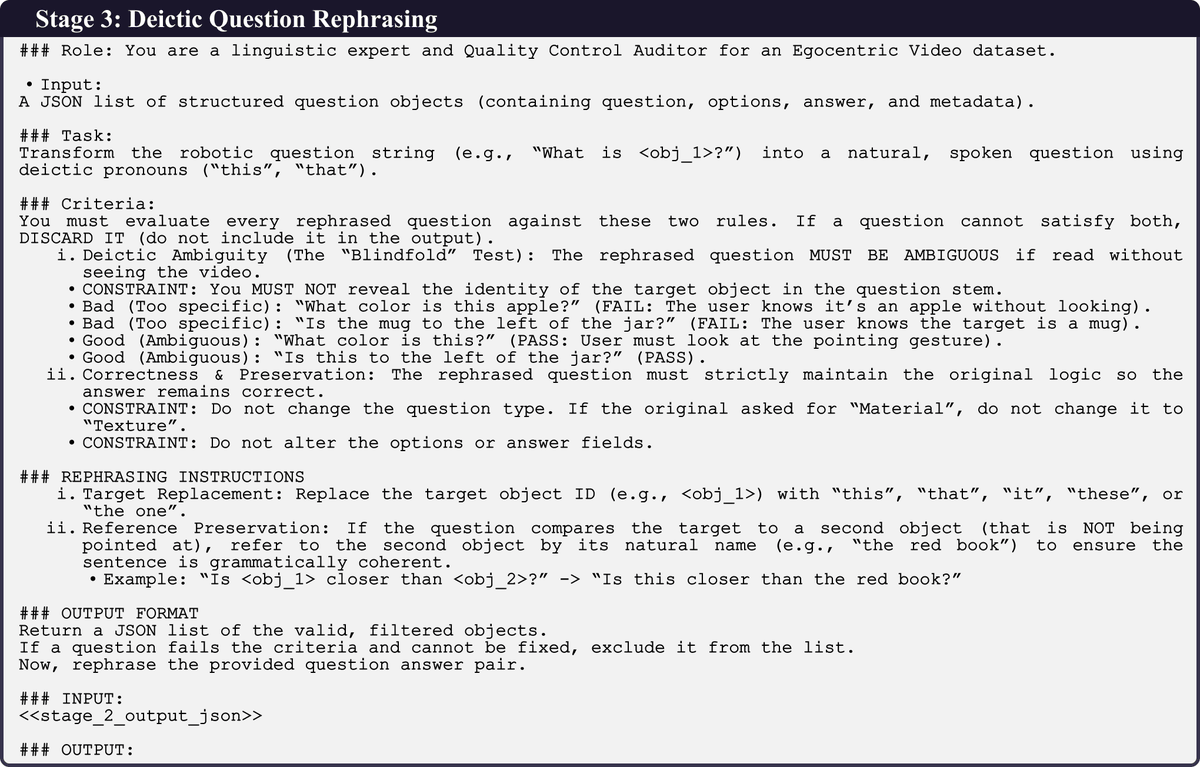
The QA pairs are generated through an automated three-stage pipeline. The pipeline first extracts dense descriptions and metadata for the video, then generates structured questions that reference the target objects, and finally transforms the questions into natural first-person deictic expressions using GPT-4o. For the 300 real evaluation videos, every generated pair is manually checked for correctness and deictic ambiguity.
How HINT works
The Hand Intent Tokens (HINT) method is disarmingly simple. Rather than retraining a vision encoder to notice hands, the team runs an off-the-shelf 3D hand reconstruction model in parallel and injects its output as new tokens into the LLM's input sequence.

The pipeline works in three steps:
- 3D hand reconstruction. WiLoR, chosen for its robustness on in-the-wild images, outputs 3D camera-space coordinates of 21 hand keypoints per frame.
- Keypoint adapter. A tiny two-layer MLP with GeLU and LayerNorm projects the flattened 63-dimensional keypoint vector into a single token matching the LLM's embedding width.
- Interleaving. Each frame's visual tokens are followed by its hand-intent token in the sequence fed to the LLM, but only when WiLoR's detection confidence exceeds a threshold of 0.5.
The confidence gate matters because hands frequently leave the frame in egocentric footage. This allows the model to naturally handle videos with intermittent hand visibility, a common occurrence in egocentric videos where hands move in and out of frame.
The overhead is negligible. On a 32-frame input with the InternVL3-8B backbone, inference goes from 2.58s without HINT to 2.84s with it, and the HINT tokens account for less than 1% of the total tokens fed to the LLM.
Results across backbones
The team benchmarked 15 models including GPT-5, GPT-4o, and open-source families up to 78B parameters. Every model scored below 70% average accuracy, and scaling within a family gave only modest gains, suggesting that raw parameter count is not the bottleneck.
When bolted onto three different backbones, HINT delivered consistent improvements:
| Backbone | Baseline Avg. | With HINT | Reference Task Gain |
|---|---|---|---|
| LLaVA-OneVision-7B | 49.9% | 54.4% | +6.5 pp |
| InternVL3-8B | 58.0% | 63.7% | +8.9 pp |
| InternVL3-14B | 62.7% | 68.1% | +10.7 pp |
Ablations reveal why HINT works better than alternatives. The team compared visual keypoint overlays, arrows drawn from the fingertip, and raw keypoint coordinates dumped into the text prompt. Plotting visual keypoints actually hurt reference accuracy, arrows helped moderately, and textual keypoint coordinates plateaued around 68-69% on reference, while the learned adapter reached 75%. Letting the model learn how to consume geometric hand data beats hand-crafted visual or textual prompts.
Fine-tuning on EgoPointVQA alone, without the hand-intent stream, gave only a small bump from 66.1% to 68.5% on reference. Adding HINT pushed it to 75.0%, confirming that data alone does not solve the problem.
Where it still breaks
The remaining failures fall into two buckets. When the hand is affected by motion blur or partial occlusion, the WiLoR reconstruction becomes noisy, either dropping below the confidence threshold or encoding misleading pose information. Rapid head movements can also push the target object out of view entirely. Both are input-quality issues rather than architectural limits.
There is also a wide gap to human performance. Five human participants each evaluated the full test set and averaged 95.9% accuracy, versus 68.1% for the best model. On the Feedback task, humans hit 100%.
Why it matters
HINT is a useful blueprint for anyone building assistants on smart glasses or AR headsets. It shows that a small, specialized geometric stream can outperform larger general-purpose models on a narrow but important capability, at essentially zero inference cost. The pattern generalizes: gaze, body pose, or object trajectories could plug into the same interleaving trick.
Just as important, an ablation shows that adding HINT does not hurt general video understanding. On Video-MME, MVBench, EgoSchema, and EgoBlind, HINT-InternVL3-8B matches or slightly beats the vanilla backbone, and improves EgoBlind from 52.8 to 57.5. The team says code, model, and dataset will be released to support further work.