
Imperial College's Dr. SHAP-AV Reveals AI Lip-Reading Models Barely Watch
A new Shapley-value framework peers inside six audio-visual speech recognition models and finds they cling to audio even when it is drowned in noise.
 Pro
Takeaways
- Dr. SHAP-AV uses Shapley values to measure how much audio vs video each AVSR model actually uses, per token.
- Across six models, audio still contributes 38-46% of the signal even at -10 dB SNR where it should be nearly useless.
- Three metrics introduced: Global SHAP, Generative SHAP for decoding dynamics, and Temporal Alignment SHAP.
- Attention-based fusers adapt by 30+ points across SNR; Auto-AVSR's MLP fusion barely moves at all.
- Both audio and video streams preserve input-output temporal alignment even under severe noise degradation.
- Code available at github.com/umbertocappellazzo/Dr-SHAP-AV; paper accepted at Interspeech 2026.
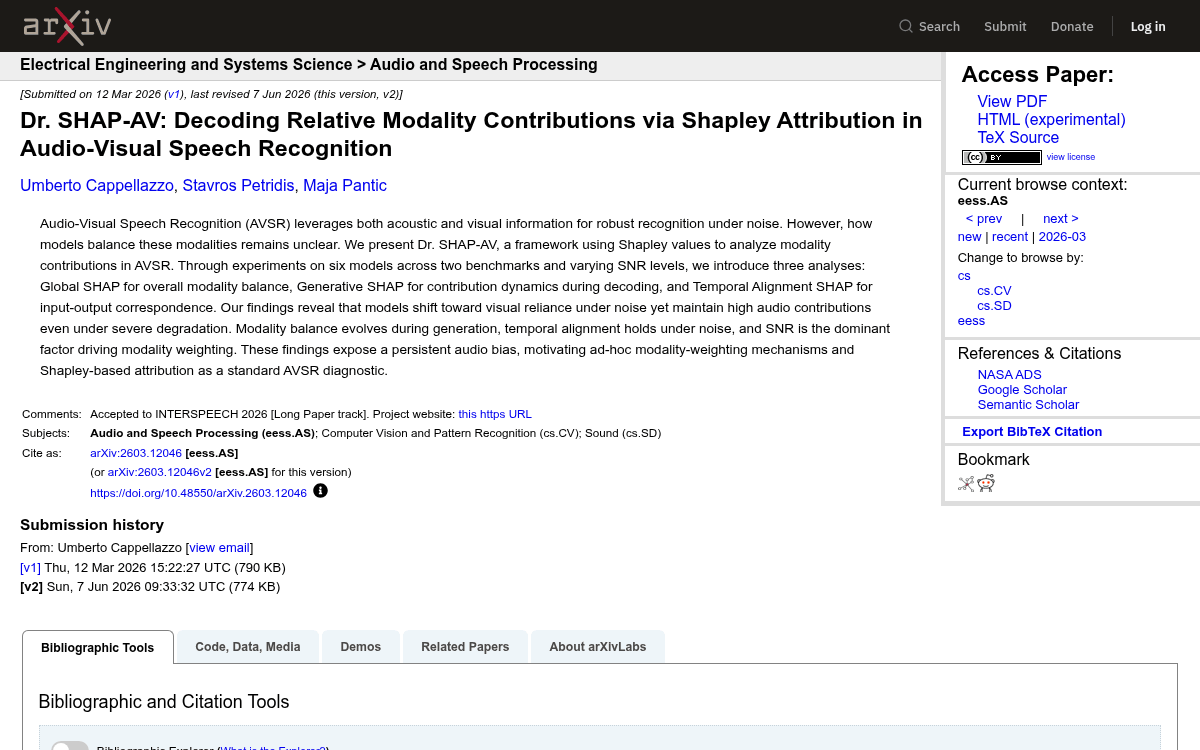
Audio-Visual Speech Recognition (AVSR) systems are supposed to be the best of both worlds: when the microphone signal turns to mush, the model should lean on the lips. In practice, nobody really knew how much these models actually watch versus listen. A new framework called Dr. SHAP-AV from Imperial College London and NatWest AI Research puts a number on it, and the number is uncomfortable.
The team applies Shapley values, the cooperative game theory tool for fairly splitting credit among players, to quantify exactly how much audio tokens versus video tokens contribute to each generated character. Shapley values are performance-agnostic: they quantify how models utilize inputs based solely on prediction behavior, not on whether the output is correct. That matters, because you can now diagnose modality reliance even when the transcription is wrong.
The bias hiding under state-of-the-art WER
The motivating experiment is brutally simple: take six leading AVSR models, zero out either the audio or the video tokens at inference, and see what breaks. Removing video tokens while retaining audio results in WER values that remain close to the full AVSR system, confirming that audio alone largely drives recognition in clean conditions. Kill the audio instead and most models collapse, with word error rate jumping one to two orders of magnitude.
That gap exists because audio directly encodes the full speech signal at high temporal resolution, whereas visual lip movements are captured at lower frame rates and carry intrinsically more ambiguous information, as many phonemes share near-identical visual appearance. During joint training the model latches onto the easier signal and the visual encoder gets weak gradients. Standard WER benchmarks hide this because clean-condition AVSR barely beats audio-only ASR anyway.
Three lenses on the Shapley matrix
Dr. SHAP-AV computes a Shapley matrix Φ where each entry is the contribution of one input feature to one generated token, then slices it three ways.

- Global SHAP sums absolute contributions across all tokens to give one audio/video split per utterance.
- Generative SHAP bins tokens into windows across the output sequence to see if reliance drifts as decoding progresses.
- Temporal Alignment SHAP checks whether early input frames actually drive early output tokens, producing diagonal heatmaps when alignment holds.
Exact Shapley computation is exponential, so they use Permutation SHAP with M=2000 sampled coalitions, cross-checked against Sampling SHAP. Masked features are set to zero, and for Whisper-Flamingo they use grouped audio masking so that each SHAP mask element covers the same 0.04s of signal on both streams, preventing bias toward the 50 Hz audio encoder.
What the numbers say
The headline finding is that models do adapt, but not nearly as much as you would expect. At low SNR (−10 dB), where audio is severely corrupted by noise, models shift toward greater visual reliance, with audio contributions dropping to 39-46% for most models. As SNR increases and audio quality improves, models progressively increase their audio dependence, reaching 63-73% in clean conditions. Even at −10 dB, roughly 40% of the credit still goes to a signal that is basically garbage.
Architecture matters a lot. Auto-AVSR exhibits almost no adaptation, maintaining nearly constant audio contribution (around 57%) across all SNR levels, which the authors attribute to its MLP fusion learning fixed weights. Attention-based fusers like AV-HuBERT and Whisper-Flamingo swing by 30 points or more. During decoding, Omni-AVSR and Whisper-Flamingo show a U-shaped pattern under noise: they lean on lips at the start of an utterance, then let accumulated linguistic context pull them back toward audio.
The temporal alignment analysis is the reassuring bit. Both modalities independently maintain temporal correspondence between input features and output tokens, even under severe acoustic noise. Neither stream collapses into a bag-of-features shortcut.
Why this is useful
Concretely, this gives model builders a diagnostic that does not require ablating modalities and retraining. Point Dr. SHAP-AV at your checkpoint and you find out whether your fancy fusion module is actually fusing or just running an audio branch with visual decoration. It also suggests a clear engineering direction: task-specific adaptation strategies may be needed to encourage more appropriate modality weighting under adverse acoustic conditions, for example gating that scales cross-attention on audio by an estimated SNR.
The limitations are worth naming. Shapley approximation at M=2000 permutations is expensive per utterance, so this is a diagnostic tool rather than a training-loop signal. Zero-masking is an approximation of true feature removal, and the six models are all English-only on LRS2 and LRS3. Code is available on the GitHub repo, and the paper has been accepted to Interspeech 2026.