
Imperial College's ArgEval Fixes AI Medical Reasoning 8.7x Cheaper With One Edit
Imperial College researchers propose ArgEval, a framework letting users fix an LLM's decision logic once so it never repeats the same mistake again.
 Pro
Takeaways
- ArgEval builds editable argument graphs for every decision option, enabling global contestability of LLM decisions.
- Two-stage pipeline: build decision-space ontology and general QBAFs once, then instantiate per case.
- Best variant on glioblastoma treatment: 0.8818 LMR, 0.9771 NDCG, beating base LLM and ArgLLMs-O baselines.
- Uses 2.4x to 8.7x fewer completion tokens than baselines because reasoning is amortized across cases.
- Contesting the model on a single patient improved overall label match rate from moderate to state-of-the-art.
- Code available at github.com/adamdejl/argeval, tested with gpt-oss-20b and Qwen3-30B via vLLM.
Most attempts to make large language models trustworthy in high-stakes settings involve bolting an explanation onto the output after the fact. If the model gets something wrong, a user can push back on that specific case, but the underlying reasoning stays intact and the model happily makes the same mistake on the next patient. A team from Imperial College London has released ArgEval, a framework that flips this around by building a structured, editable argument graph for every decision option in a domain, so that correcting the model once fixes it everywhere.
The paper introduces ArgEval, a framework that shifts from instance-specific reasoning to structured evaluation of general decision options. Rather than mining fresh arguments for each case, it maps out the entire decision space up front, then instantiates that shared structure for each incoming case. The authors test it on treatment recommendation for glioblastoma, an aggressive brain tumor, and show that contesting the model on a single patient can measurably improve its predictions on the other 359.
The problem with fixing an LLM one case at a time
Chain-of-thought and verbalized explanations look plausible but often misrepresent what the model actually did internally. Recent work by Chen et al. found that these rationalizations are unfaithful, meaning they inaccurately describe the true internal reasoning of models. Recent argumentation-based approaches like ArgLLMs and ArgRAG partially address this by having the LLM mine arguments for and against a claim, assembling them into a formal graph that can be evaluated deterministically. The graph itself becomes the explanation, so it is faithful by construction.
The catch: those systems only handle binary claims (true/false) and only support what the authors call local contestability. You can correct the argument graph for one case, but the fix does not propagate. ArgEval targets open-ended decisions with many options and makes contestations stick globally.
How the pipeline is put together

ArgEval splits its work into two phases. The heavy lifting happens once, ahead of time:
- Decision-space ontology construction. An LLM ingests policy documents (in the medical test, four clinical guidelines on glioblastoma) and extracts a hierarchical ontology of decision options. In the glioblastoma experiment, gpt-oss-20b identified 179 treatment entities, later filtered down to 9 atomic options mentioned in at least three of the four guidelines.
- General QBAF construction. For each option, the LLM builds a quantitative bipolar argumentation framework (QBAF), which is a tree of arguments attacking or supporting that option. Every argument gets a base score between 0 and 1 (its intrinsic strength) plus a natural-language condition describing when it applies. Conditions are then formalized as JSON schemas, and a global parameter schema tracks every variable referenced.
- Case-specific inference. When a new case arrives, the LLM only has to extract structured parameters from the description. The engine then prunes any argument whose condition is not satisfied, runs a deterministic gradual semantics (DF-QuAD) over what remains, and reads the root argument's final strength as the recommendation score.
Because inference is just parameter extraction plus a graph evaluation, most of the reasoning work is amortized across every future case. That is where the token savings come from, and it is also what makes contestation global: edits to the shared QBAFs, ontology, or parameter schema affect every case going forward.
What the numbers show

The team evaluated ArgEval against a base LLM and ArgLLMs-O (an adapted version of ArgLLMs that uses the same option ontology) on 360 synthetic patient vignettes generated from combinations of age, MGMT methylation status, Karnofsky Performance Status, tumor location, and a spurious sex parameter, producing 3,240 treatment-label pairs. Ground-truth labels came from an algorithm reviewed by a clinical oncologist.
Two metrics matter: label match rate (LMR) for absolute recommendation quality and NDCG for how well the treatment ranking matches ground truth. The best-performing ArgEval variant used Qwen3-30B with depth 2, no root estimation and argument scheme inclusion, achieving the top overall LMR of 0.8818 with a comparatively high NDCG of 0.9771. The base LLM hit 0.8775 LMR / 0.9578 NDCG; ArgLLMs-O landed in a similar range.
The efficiency gap is where things get interesting. Thanks to its global reasoning, even the most expensive depth-2 ArgEval variant required roughly 2.4x and 8.7x fewer completion tokens compared to the cheapest base LLM version and the cheapest ArgLLMs-O version, respectively. The cheapest ArgEval configurations use under a million input tokens versus ~80M for ArgLLMs-O.
Fixing one case, improving many
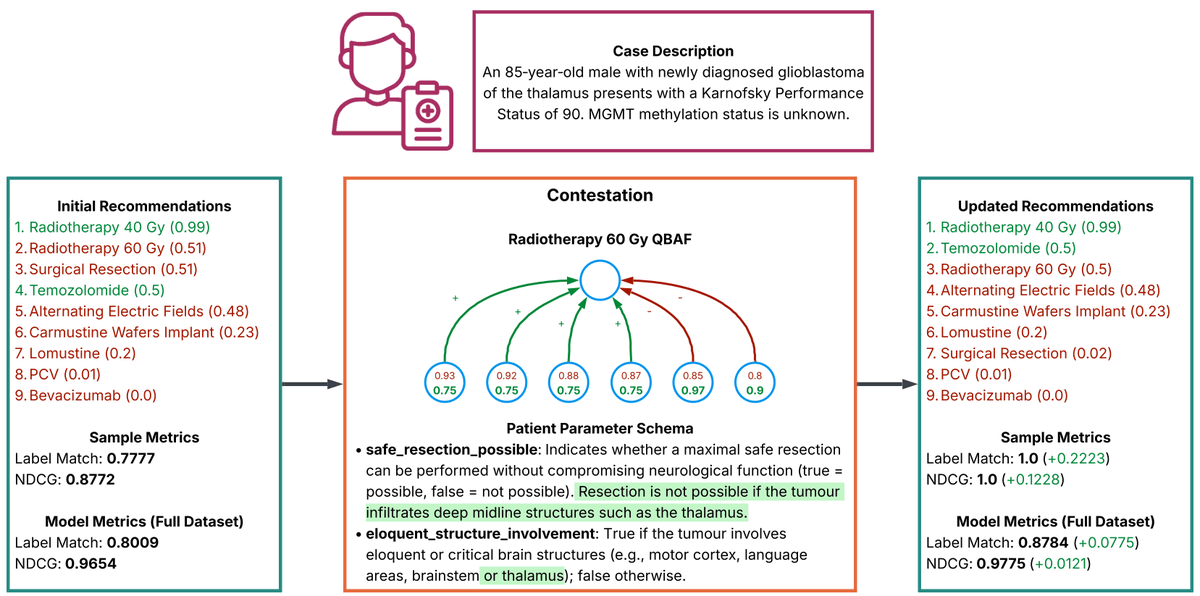
The contestability case study is the most striking result. Starting from a moderate-performing variant that mis-ranked several treatments for a specific elderly patient, the authors made two edits: they nudged a few base scores in the Radiotherapy 60 Gy QBAF and clarified two parameter descriptions related to surgical resection contraindications for thalamic tumors. Performing the two contestations based on a single sample resulted in a substantial performance improvement on the full dataset, reaching an LMR of 0.8784 and NDCG of 0.9775, which surpasses the performance of all other methods using gpt-oss-20b.
Where it helps and where it does not
ArgEval is a good fit when you have written policy or guideline documents defining the decision space, when explanations need to be auditable, and when you expect experts to correct the system over time. It is a poor fit for tasks without stable underlying rules, or where the decision space cannot be enumerated from source documents.
The downsides are real. ArgEval seems more sensitive to hyperparameters than the baselines, with substantial variations between versions, likely because any deficiencies during general QBAF construction affect all subsequent inferences. Variants that let the LLM score the root argument itself perform notably worse, since a treatment with a high intrinsic score may still be wrong for a specific patient. And global contestability cuts both ways: a bad edit propagates just as easily as a good one, so it needs domain experts in the loop.
The code is available at github.com/adamdejl/argeval, with experiments run on open-weight models (gpt-oss-20b and Qwen3-30B-A3B-FP8) via vLLM, so the whole stack is reproducible on modest hardware.