
IIT's Open-Source IterIEKF Cuts Robot Walking Error by 63%
A new open source filter for legged robot state estimation cuts velocity error up to 63% and converges 2.5x faster than the standard invariant EKF.
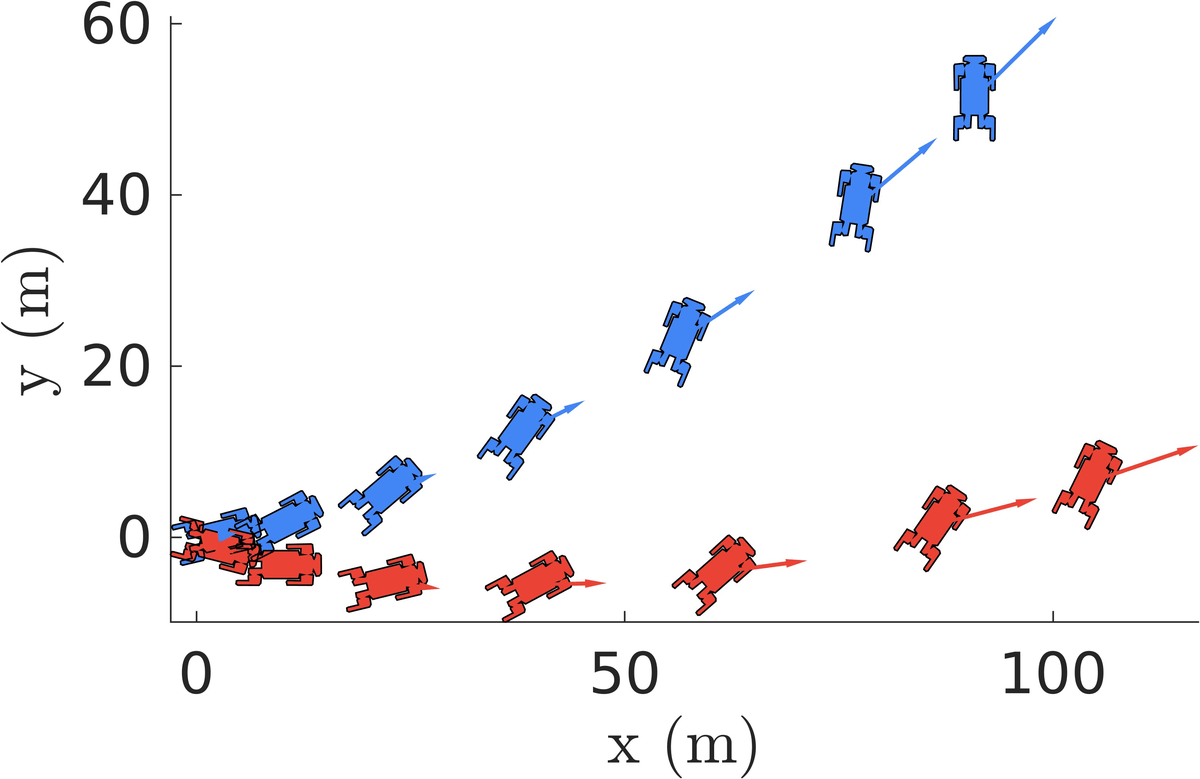
Takeaways
- New Iterated Invariant EKF for quadruped odometry uses only proprioceptive measurements, no cameras or LiDAR.
- Cuts velocity MAE by 63% and gravity direction error by 60% vs standard IEKF on bumpy-terrain simulation.
- Converges 2.5x faster than IEKF under large initial pose errors in MuJoCo experiments.
- Validated on real ANYmal D data from GrandTour Pilatus-Hike2 trail, 12% pitch angle improvement.
- Open-source implementation and simulation tools available at project page.
- Requires well-characterized, small measurement covariance; degrades if noise is large or non-Gaussian.
State estimation on a quadruped is one of those unglamorous problems that quietly decides whether the robot walks or falls. A team from the Dynamic Legged Systems Lab at IIT, together with collaborators at PUC-Rio, Liège and Mines Paris PSL, has released an open-source filter that tightens the math behind this loop and cuts velocity error by more than half in some scenarios compared to the current invariant EKF baseline.
The filter is called the Iterated Invariant Extended Kalman Filter (IterIEKF), and the paper is the first time it has been formulated for legged robots. Code, simulation tools and documentation are available at the project page.
Why classical Kalman filtering keeps breaking on legs
A Kalman filter is optimal when two things are true: the dynamics are linear with Gaussian noise, and the measurement model is linear with Gaussian noise. Neither holds on a quadruped. The robot's orientation lives on the rotation group SO(3), foot contacts switch on and off, and both global position and yaw are structurally unobservable from proprioception alone.
The community's answer over the last decade has been the Invariant EKF (IEKF). Instead of treating rotation, velocity and position as independent variables, it embeds them into a single matrix Lie group (SE_2(3)) so the error dynamics become independent of the current state. When the dynamics and observations satisfy appropriate invariance properties, the error dynamics become autonomous, which improves consistency and reduces sensitivity to linearization. That fixed one half of the problem, prediction. The measurement update was still linearized once, around the prior mean, and the result taken as the posterior, even when that mean sat far from the true mode of the distribution.